
The Reason for This Page
On many journal sites a heading such as "Indexed In" sits above a crowd of logos. Yet a logo is only an image: it evidences nothing, anyone can copy it, and the collection often blends real indexing services with platforms that simply store files. Always follow a claimed listing to the service's own record instead of trusting the picture.
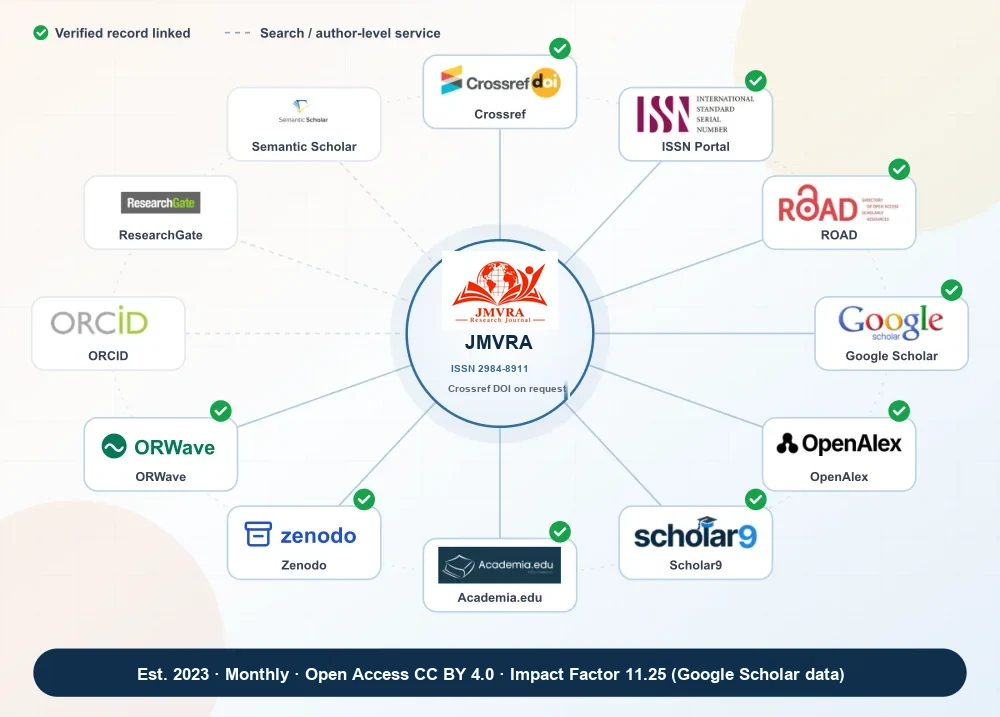
In place of that wall of logos, this page offers a table that states each coverage status in plain language and explains how you can check every line yourself. Where the answer is "not currently indexed", the page says exactly that. A researcher choosing where to publish gains more from this than from any badge, and the journal holds itself to this standard.
Verified at the source
Current Numbers You Can Check
All figures link back to the issuing service. They were read on 30 Sep 2026 and move whenever that service refreshes its data.
Coverage Status Table
| Service | Type | Status | How to verify | Last checked |
|---|---|---|---|---|
| Crossref | DOI registration | Verified DOIs | Crossref journal record, or look up any DOI through doi.org | 30 Sep 2026 |
| ISSN Portal / ROAD | Serial registration | Verified | ISSN Portal record | 30 Sep 2026 |
| Google Scholar | Scholarly discovery | Verified citation profile | Journal profile | 30 Sep 2026 |
| OpenAlex | Scholarly discovery | Verified discovery link (search results) | Source record | 30 Sep 2026 |
| Zenodo | Open repository | Verified repository search link | Zenodo search | 30 Sep 2026 |
| Scholar9 | Transparent review registry | Verified | Journal page | 30 Sep 2026 |
| ORWave | Discovery platform | Verified | Journal listing | 30 Sep 2026 |
| Semantic Scholar | Scholarly discovery | Search | Search the journal name | 30 Sep 2026 |
| BASE | Scholarly discovery | Not yet confirmed | Look up ISSN 2984-8911 on base-search.net | — |
| WorldCat | Library catalogue | Not yet confirmed | Look up ISSN 2984-8911 on worldcat.org | — |
| Scopus | Selective citation index | Not currently indexed | Consult the official Scopus source list | 30 Sep 2026 |
| Web of Science | Selective citation index | Not currently indexed | Consult the official Master Journal List | 30 Sep 2026 |
| DOAJ | Open access directory | Not currently indexed | Look up ISSN 2984-8911 on doaj.org | 30 Sep 2026 |
| PubMed / MEDLINE | Subject index (biomedical) | Not currently indexed | Look in the NLM catalogue | — |
One click each
Verify JMVRA Yourself
Verified links lead to the journal’s own record, or to a search result for it, on the service. Search links lead to a general search on a platform used for sharing.
Crossref Search Verified
All JMVRA articles deposited there, together with DOI and metadata.
Google Scholar Verified
Citation profile of the journal, showing citations, h-index and i10-index.



OpenAlex Verified
A free catalogue of scholarly outputs that contains this journal as a source along with the works attached to it.
Google Search Verified
Indexed pages from jmvra.org plus results for the full journal name.
ROAD / ISSN Verified
Entry for 2984-8911 in the directory kept by the ISSN International Centre.

ResearchGate Search
A research network on which authors post JMVRA papers; search for the journal name there.
Indexing & discovery
Indexing
Official lists and registers in which the journal or its articles appear.
Crossref Verified
The agency that registers DOIs; each DOI-registered paper has its metadata deposited here.
Crossref DOI on request Verified
A paper can be given a permanent Digital Object Identifier on request, which keeps it citable.
ISSN Portal Verified
The journal’s serial registration is ISSN 2984-8911, held by the ISSN International Centre.

ORCID Registry
Author-identifier registry that links each author’s profile to their published work.

Publons / ResearcherID Registry
Reviewer and researcher registry, today called Web of Science reviewer recognition, that logs peer-review activity.
Zenodo Verified
An open repository run by CERN for depositing archived research outputs.
Scholar9 Verified
Registry of transparent peer review in which the journal’s review certificate is recorded.
Discovery
Researchers can find, search, read, save or share published articles here.
Google Scholar Verified
A search and citation-tracking service whose citation data underlies the journal’s Impact Factor.
OpenAlex Verified
Open index of works, authors and citations that carries on Microsoft Academic’s data.
ORWave Verified
Open Research Wave: a platform for discovering open-access journals and research.
Academia.edu Verified
Academic sharing platform that gives readership analytics for each paper uploaded.

Semantic Scholar Search
AI-driven search that surfaces papers by meaning, citations and influence.
ResearchGate Search
Researchers’ network where authors upload papers and readers follow their output.
Mendeley Search
Reference manager in which readers save papers and cite them from the metadata.


SSRN Search
Elsevier’s preprint and working-paper network — a repository, not a journal index.
Microsoft closed Microsoft Academic at the end of 2021, though older pages still list it; OpenAlex, above, carries on its data.
Four Types of Listing, and JMVRA’s Position
The phrase “Indexed in” covers four quite different situations. Once you know which type a listing is, you know how much weight it carries.
Selective citation indexes
Run by an editorial board, so a journal has to apply and win acceptance.
Registration & identifiers
Shows that the journal and every article exist, in a lasting and verifiable way.
Discovery engines
Gather open metadata, making work easy to find and cite.
Sharing platforms
Sites where researchers post their own copies, which is not indexing in any sense.
Scholarly Discovery
Services of this type crawl or harvest article metadata, so published work can be found and cited. Most people have this category in mind when they say "indexing":
- Google Scholar — reads well-structured journal pages and assembles a citation graph. Inclusion happens automatically instead of being awarded, and it may change over time.
- Semantic Scholar — a corpus for academic search drawn mainly from publisher metadata and Crossref records.
- OpenAlex — an open collection of scholarly works, mostly sourced from Crossref and other open data.
- BASE — collects metadata from repositories and journals using open protocols.
- WorldCat — a catalogue of library holdings that helps confirm a title exists bibliographically.
Being present in them is not the same as passing a selective editorial assessment. It shows that the metadata is tidy, open and accessible, a real technical accomplishment but a separate claim from admission to a curated index.
Persistent Identifiers
- Crossref — assigns a DOI to an article when asked and shares its metadata throughout the scholarly world. CrossRef DOI explains what gets deposited and how to confirm that a DOI resolves.
- ORCID — gives authors one unambiguous identity throughout their careers. Authors are encouraged to provide an ORCID when submitting so that their record is linked to the correct person.
Of all the independently checkable proof that an article has been published, a DOI that resolves is the strongest. Anyone can confirm it within seconds, which is precisely why it counts for more than a badge. A reviewer of your CV can repeat the check just as easily.
Research-Sharing Platforms
ResearchGate, Academia.edu and Mendeley do not act as indexing services. Researchers use them to upload and circulate copies of their own work. Placing them below an "Indexed In" heading, as numerous journal sites do, misleads readers, and this site avoids it.
Even so, they help authors gain visibility, and you may share your published article there in keeping with the Copyright & Licence terms. Post the DOI link instead of a PDF so that views and citations are attached to the article record. Keep a note of where you shared it so you can update links later.
Not Currently Indexed
JMVRA is at present not indexed in Scopus, Web of Science or DOAJ. A page, email or advertisement that implies otherwise is incorrect and ought to be reported to the editorial office.
There is a practical consequence. Should your institution, funder or degree rules explicitly require publication in a journal indexed by Scopus or Web of Science, this journal does not meet that requirement, and you ought to pick a venue that does. Telling you so directly helps you more than hedging would.
Originality
Turnitin & iThenticate Plagiarism Detection
All submissions undergo a similarity screening ahead of peer review, and authors can ask for the similarity report. The acceptable similarity level is under 15%.
Turnitin
Comparison with published literature, web content and previously submitted work for similarity.

iThenticate
Turnitin’s solution for researchers and publishers, which can also flag AI-generated writing.
Licences & standards
Licensing, Access and Recognition



Registered ISSN • Open Access • Transparent Peer Review • Creative Commons CC BY 4.0 • Ethics policies based on COPE guidance
JMVRA is a Transparent, Peer-Reviewed, Open Access Journal (Refereed Journal). Following the discontinuation of the UGC and UGC-CARE journal listing, and in alignment with the latest UGC-CARE recommendations and guidelines, JMVRA is aligned with UGC’s Suggested Parameters for Choosing Peer-Reviewed Journals. UGC public notice (PDF)
Impact Factor and Citation Metrics
Verify JMVRA’s impact metrics yourself: each figure links to the service that reports it.
Source: JMVRA Google Scholar profile
Until then, you can check JMVRA’s citations yourself on Google Scholar, OpenAlex (search results) or Crossref Search.
Important note: The Impact Factor (11.25) is a calculated metric based on citations from Google Scholar and Semantic Scholar. It is not an official Clarivate Journal Impact Factor (JCR). All other statistics are taken from their respective platforms and may vary over time; please verify each metric at the original source using the links above.
JMVRA at a Glance
Journal statistics and publication information
Digital preservation
How JMVRA Keeps Each Published Paper Preserved
At present JMVRA safeguards its archive through its own preservation network. The journal has begun applying to join a LOCKSS-based preservation network, which will mean libraries independently hold copies as well.
- Now
Own preservation network
- Each article sits at a permanent URL that is never reorganised or reassigned
- Crossref DOIs that resolve independently of the website
- Zenodo (CERN) holds archived copies, while OpenAlex and Google Scholar hold records
- Papers that are withdrawn or retracted remain online with a marking and are never removed
- A documented succession plan covering any end of publication
- In progress
Our Application to Join LOCKSS
JMVRA has begun applying to a LOCKSS-based network where each participating library stores a copy and compares it with those of the others. The application is in progress, and this page will be revised once participation is confirmed.
About LOCKSS ↗ - Options
Further services
Below, CLOCKSS, Portico and the PKP Preservation Network are evaluated too, along with the requirements of each.
Compare the services ↓
CLOCKSS vs Portico vs LOCKSS vs PKP PN
Each takes a distinct approach to preserving digital scholarly content.
| Feature | CLOCKSS | Portico | LOCKSS | PKP PN |
|---|---|---|---|---|
| Primary purpose | Long-term preservation | Long-term preservation | Distributed preservation | Preservation of journals published on OJS |
| Technology | LOCKSS-based | Independent preservation infrastructure | Open-source LOCKSS software | LOCKSS-based network run by PKP |
| Dark archive | Yes | Yes, for its preservation service | Depends on network configuration | Yes |
| Public access after trigger | Yes, under its policies | Yes, under defined conditions | Access varies with the network and preservation terms | Yes, when the journal ceases publishing or content becomes unavailable |
| Publisher participation | Paid service | Paid service | Some participation options are free | Free for eligible journals |
| Community model | Publishers and libraries | Preservation service supported by libraries and publishers | Library-centered preservation networks | PKP with participating libraries |
| Main requirement | Participation agreement and fee | Participation agreement and fee | Joining or forming a network | Requires the journal to run on Open Journal Systems (OJS) with the PN plugin enabled |
| Fit for JMVRA | Possible later (paid) | Possible later (paid) | Application process started | Applies only should the journal switch to OJS, as JMVRA uses its own platform |
Today’s standard
JMVRA and Current Peer-Review Standards
Judgement of peer review rests on process and proof. Below are the practices that institutions and indexing services expect, each linked to its policy page.
Double-blind review Verified
Each paper is assessed by subject experts who do not see who the authors are.
Transparent review records Verified
Scholar9 holds the reviewer reports and certificates.
Similarity screening Verified
Turnitin / iThenticate screens each submission prior to review, and the author can request the report.
AI-use disclosure Verified
AI tools have to be disclosed by authors, and AI-writing detection is on hand.
Conflict-of-interest policy Verified
Applies to editors, reviewers and authors alike.
Ethics following COPE guidance Verified
Policies on authorship, misconduct, corrections and retractions.
UGC & UGC-CARE
JMVRA in Light of UGC’s New Recommendations
JMVRA is a Transparent, Peer-Reviewed, Open Access Journal (Refereed Journal). Following the discontinuation of the UGC and UGC-CARE journal listing, and in alignment with the latest UGC-CARE recommendations and guidelines, JMVRA is aligned with UGC’s Suggested Parameters for Choosing Peer-Reviewed Journals.
35 suggested parameters arranged in 8 groups
Basis: Annexure-I of UGC’s notice. In JMVRA’s assessment, 28 parameters count as met and 2 as partly met, while 3 are not published and 2 do not apply; every result is explained.
Circulars and notices from UGC
- Public Notice — CARE Journals (discontinuation) (PDF) ↗
- Final list of UGC-CARE journals (1,474, archived) (PDF) ↗
- Public Notice — CARE (PDF) ↗
- Public Notice — CARE, 14 January 2019 (PDF) ↗
Evidence for each parameter
About the journal
Journal of Modern and Versatile Research Approach (JMVRA): Quick Overview
- Journal
- Journal of Modern and Versatile Research Approach About
- ISSN (online)
- 2984-8911 Verify
- Established
- 2023
- Frequency
- Monthly Current issue
- Publisher
- JMVRA Publication
- Impact Factor
- 11.25 (Google Scholar data) Details
- DOI
- Crossref DOI
- Review
- Double-blind, transparent records Policy
- Access & licence
- Open access, CC BY 4.0 Policy
- Subjects
- Multidisciplinary Research areas
- Editorial board
- Named editors View board
- Reviewers
- 3,000+ Reviewer list Join
- [email protected] Contact
- Phone / WhatsApp
- +91 91063 65667 Support
| Charge | Indian authors | Foreign authors |
|---|---|---|
| Publication fee (after acceptance) Details | ₹971 INR | $41 USD |
| Crossref DOI (optional, on request) Add | Optional | $20 |
| Hard copy of certificate (optional) | ₹500 | $100 |
| Bundle: journal hard copy + certificate + DOI | ₹1100 | $170 |
| Transparent peer-review report (on request) | ₹700 | $20 |
Payments: publication charges · pay fees online · payment options · payment terms
Checking Any Entry Yourself
- Go directVisit the service’s own site by entering its address yourself, never through a logo on a journal page.
- Search the ISSNLook up ISSN 2984-8911 in addition to the title. Titles get copied, whereas the ISSN is the dependable identifier.
- Look for articlesMake sure real article records show up, rather than a bare title entry with nothing underneath.
- Match the publisherVerify that the publisher name and website in the record agree with the site you are visiting.
- Keep proofWrite down when you checked, and save a screenshot if the result matters for an institutional submission.
Use these steps on every journal you consider, including this one. If a journal resists being checked, that reaction tells you plenty.
Language We Avoid
| Phrase | Why it is avoided |
|---|---|
| "international publishing practice" | Hints at Scopus coverage while stopping short of claiming it. A journal is either indexed or it is not. |
| "Under evaluation by Scopus" | Only mentioned when an application is truly open, and then with a date. |
| "Indexed in ResearchGate" | ResearchGate serves for sharing; it is not an index. |
| "Approved by UGC" | See UGC Status & Parameters for the accurate position and how to check it. |
| "World's leading journal" | Marketing that cannot be verified, swapped for facts readers can check. |
Report an Inaccuracy
Whenever a statement here exaggerates coverage, recognition or metrics, email [email protected] giving the page address and the point you think is mistaken. The page is then corrected and its "last checked" date refreshed.
Being accurate is no favour to readers; it is how a journal earns the right to be taken seriously.
A Method for Checking Any Journal's Listing Claims
Statements about databases and directories are easy to make and sometimes hard to trust. A repeatable method lets you test any journal's claims without relying on its own wording.
- Go to the database's own site. Search the official service directly instead of clicking only from the journal's page. If a title is truly included, the independent search should return a matching record.
- Match the identifier, not just the name. Many journals have similar titles. Compare the serial number, publisher and website shown in the record with those on the journal page to avoid mixing up lookalikes.
- Distinguish listing from search results. Some tools simply display matches for a query, which is not the same as formal coverage. Read what each service says it actually includes before treating a hit as proof.
- Record the date and take a screenshot. Coverage can change. Saving the page with the date of your check gives you evidence if a dispute or committee question arises later.
- Ask your librarian when unsure. University librarians know the recognised selection lists and can interpret unclear records. A short conversation often settles doubts faster than extended online searching.
Verify through the official service, match the identifiers carefully, and keep dated evidence of what you found.
Indexing & Discovery FAQs
Does JMVRA have UGC CARE approval?
Yes. UGC discontinued CARE listing, so journals are now judged against UGC’s Suggested Parameters for Choosing Peer-Reviewed Journals; JMVRA, a Transparent, Peer-Reviewed, Open Access Journal (Refereed Journal), is aligned with them, with its status published parameter by parameter.
Does Scopus, Web of Science or DOAJ index JMVRA?
No, and the journal is upfront about it. Its records can be found at Academia.edu, ORWave, Zenodo, Scholar9, OpenAlex, Google Scholar, the ISSN Portal/ROAD and Crossref, with a link to each further up this page.
Which DOI prefix does JMVRA use?
DOIs are registered through Crossref. A DOI is registered for an article on request, at publication.
What is the basis for the 11.25 Impact Factor?
11.25 is a calculated metric based on citations from Google Scholar and Semantic Scholar. It is not an official Clarivate Journal Impact Factor (JCR); the method is explained on Impact Factor Details.
How do I confirm these listings for myself?
Click any “Verified” link here; it takes you directly to the record or search result on the service itself instead of to a badge.
What is meant by the “Search” tag?
It marks a service that is a general search or sharing platform, so the link opens a search for the journal and not a journal record.
Ready to publish?
Publish With a Journal You Can Verify
Every paper gets a similarity check and transparent, double-blind peer review before being published open access under CC BY 4.0, and a Crossref DOI is added if you ask for one. The journal is aligned with UGC’s Suggested Parameters; its fee of ₹971 INR (Indian authors) or $41 USD (foreign authors) is collected only after acceptance.