
Defining the Impact Factor
Based on citations, an impact factor is an average estimating how frequently a typical article in a journal is cited during a set window. It characterises the journal rather than any single paper, and carries meaning only if the citation data source and the years counted are stated with it. Always read the figure together with its stated method.
Librarians originally created the measure to choose which journals to subscribe to, not to assess individual researchers. Over time it has been drafted into hiring, promotion and funding decisions, so knowing how it is built is important: a number quoted without its source and window cannot be verified, and an unverifiable number should carry no weight in a career decision.
What it tells you
- The citation frequency of a typical article in the journal
- If the journal's work is being read and put to use
- The way that use shifts across the years
- A figure you can work out again from the named source
What it leaves unsaid
- The quality, or citation count, of any one paper
- If a journal is indexed or on a UGC CARE list
- Nothing whatsoever when its source and window are absent
- Comparisons between journals in different fields
JMVRA Impact Factor
| Journal | Journal of Modern and Versatile Research Approach (JMVRA) |
|---|---|
| ISSN | 2984-8911 |
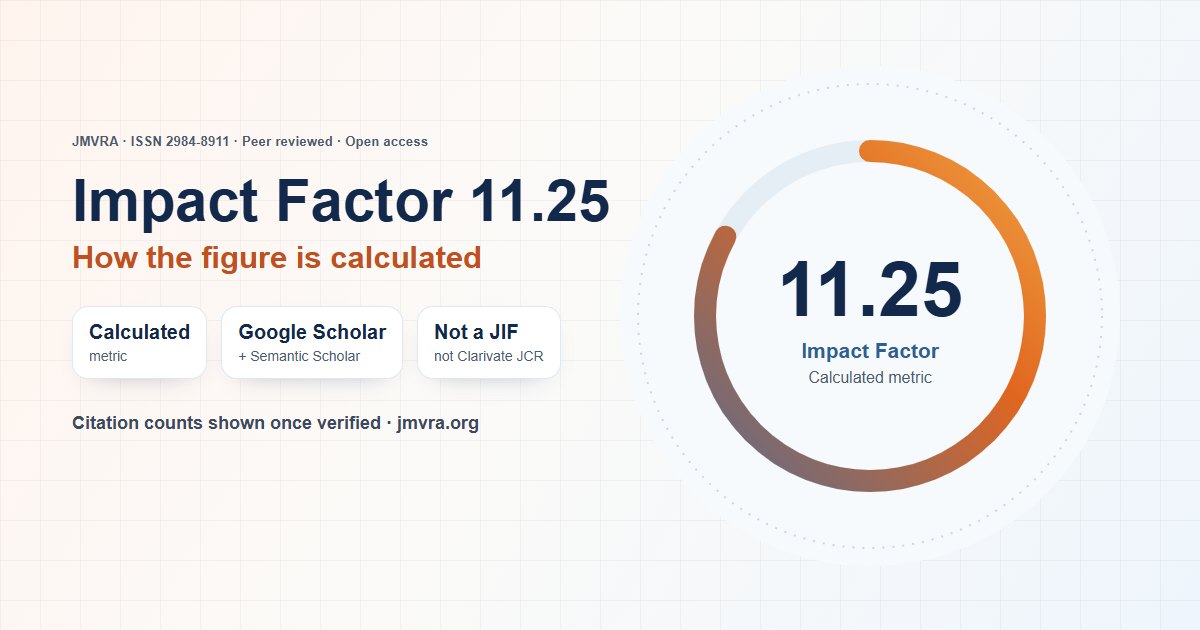
| Impact factor | 11.25 |
| Citation data source | The journal’s Google Scholar profile, supported by Semantic Scholar |
| Method | A calculated metric based on citations recorded by Google Scholar and Semantic Scholar; see the definitions on the Impact Factor methodology page |
| Supporting figures | Citations, h-index and i10-index: pending verification · check them on the Google Scholar profile |
| What it is not | Neither a Clarivate Journal Impact Factor nor a Scopus CiteScore, since JMVRA is outside Web of Science and Scopus |
| Last reviewed | 30 Sep 2026 |
Where the 11.25 comes from
Three open steps produce the figure: citations to JMVRA articles recorded by Google Scholar and Semantic Scholar, a published method, and a single calculated result that anyone can compare with those sources. It is not an official Clarivate Journal Impact Factor (JCR), and no link in the chain relies on a database the reader is unable to open.

Citation growth
Citation history will appear here once verified data is available. Yearly totals for JMVRA articles, counted from 2023 onwards, are added only after they have been checked against the journal’s Google Scholar profile:
Citations
Google Scholar Metrics and the Impact Factor
The Impact Factor of 11.25 is a calculated metric based on citations recorded by Google Scholar and Semantic Scholar. This figure should not be mistaken for an official Clarivate Journal Impact Factor (JCR).
Source: JMVRA Google Scholar profile
Until then, you can check JMVRA’s citations yourself on Google Scholar, OpenAlex (search results) or Crossref Search.
Important note: The Impact Factor (11.25) is a calculated metric based on citations from Google Scholar and Semantic Scholar. It is not an official Clarivate Journal Impact Factor (JCR). All other statistics are taken from their respective platforms and may vary over time; please verify each metric at the original source using the links above.
The Calculation Method
The usual two-year calculation works like this:
Both terms rely on the chosen window and on the database supplying the citations, so two correctly computed figures for one journal may differ. For this reason the number should always come with its source and window. JMVRA’s 11.25 is calculated in this spirit from citations recorded by Google Scholar and Semantic Scholar; it is not an official Clarivate Journal Impact Factor (JCR).
A worked example
Imagine a journal that put out 200 citable articles over the two years preceding the calculation year, and those articles drew 460 citations in the calculation year. The impact factor then equals 460 ÷ 200 = 2.30. A three-year window, or citations taken from another database, would give a different yet equally "correct" number for the same journal.
Which items count as citable articles
The denominator normally includes research papers, review articles and short communications. Editorials, notices and correspondence generally stay out of it, even though some databases may still count citations to them in the numerator. Such lopsidedness helps explain why figures differ between sources, and it is one more reason to give the method along with the result. Always check which item types a source includes.
Citation Data Sources
Services tally citations in their own ways, so one journal can show a different value in each:
Checking It for Yourself
- Open the sourceEnter the journal name or ISSN 2984-8911 into Google Scholar or Semantic Scholar
- Count articlesThose the journal issued in the two years preceding the calculation year
- Count citationsGained by those articles within the calculation year
- Divide & compareDivide citations by articles and set the result beside the published figure
Should you be unable to reproduce a published figure from the stated source, email [email protected] and request the underlying counts.
More Metrics Worth Knowing
Quoting the Figure Correctly
In a CV, funding application or institutional report, state the journal's impact factor with its year and source, for instance: "Impact factor [value] ([year]), calculated from [source] citation data." A journal-level metric must never be offered as a gauge of one article's quality.
Published in Journal of Modern and Versatile Research Approach (ISSN 2984-8911); journal impact factor 11.25, calculated from Google Scholar and Semantic Scholar citations (reviewed 30 Sep 2026).
Do
- State the value, source and date as one
- Add a link to the Google Scholar profile for readers to verify
- Place your own article’s citations next to it
Avoid
- Labelling it a “Thomson Reuters”, Clarivate or Web of Science impact factor
- Giving the number without a source or year
- Treating it as a rating for your own paper
Limits and Honest Use
An impact factor averages a skewed distribution, so a handful of heavily cited papers can raise a journal's figure far above what a typical article gets. Figures also differ systematically between disciplines because citation habits vary by field, and they reveal nothing about how rigorous a given paper is. Keep these limits in mind whenever you compare journals.
Interpreting Journal Metrics Without Overreading Single Numbers
Metrics can be useful, but each one answers a narrow question. Researchers who understand their limits can use them sensibly in decisions about reading, publishing and reporting.
- Ask who produced the number. Different providers use different data and methods, so figures are rarely comparable. Always note the source and method before placing any value beside another journal's.
- Prefer article-level evidence. A journal-wide figure says little about one paper. Look at how your own article is read, cited and discussed, and report those details alongside any journal measure.
- Compare within one discipline. Citation habits differ greatly between fields, so a number that seems modest in one subject may be strong in another. Compare only similar journals.
- Describe metrics precisely in documents. In applications and profiles, name the metric, the provider and the period it covers. Precise wording avoids accusations of exaggeration and helps committees interpret your claim.
- Balance numbers with quality signals. Consider peer review practice, transparency, editorial standards and fit of readership. These qualities influence the long-term value of publishing more than any single score.
Quote metrics with their source, compare only like with like, and never let one figure replace judgement about quality.
Questions Researchers Often Ask
Will my paper be cited more if the impact factor is higher?
No. The figure averages across a whole journal, while your article's citations depend on its topic, quality and visibility and on how your field tends to cite.
Why do websites give differing impact factors for one journal?
They draw on different citation databases and year windows. A figure can be interpreted only when its source and window are given.
Does an impact factor equal being indexed or UGC CARE listed?
No, they are distinct matters. Refer to Indexing & Abstracting and UGC Status & Parameters.
What impact factor does JMVRA have?
The value is 11.25, a calculated metric based on citations from Google Scholar and Semantic Scholar, most recently reviewed on 30 Sep 2026. It is not an official Clarivate Journal Impact Factor (JCR). Citation counts, h-index and i10-index appear on JMVRA's pages only once verified.
Does the 11.25 for JMVRA count as a Clarivate Journal Impact Factor?
No. Since JMVRA is not in Web of Science it has no Clarivate Journal Impact Factor, and since it is not in Scopus it has no CiteScore. The 11.25 is a calculated metric based on Google Scholar and Semantic Scholar citations, which the page states each time the number appears.
How do I check JMVRA’s citation figures?
Visit the journal’s Google Scholar profile, which displays citations, h-index and i10-index for JMVRA articles; on this site those figures are shown only once verified. The Impact Factor methodology page explains the method.
Identify which number is quoted
Each Metric and What It Measures
People use “Impact factor” loosely for a number of different figures. Which one is being quoted matters more than the value itself.
| Metric | What it measures | Published by | JMVRA |
|---|---|---|---|
| Impact Factor (this page) | A calculated journal metric based on Google Scholar and Semantic Scholar citations | JMVRA (calculated metric, not a Clarivate JIF) | 11.25 |
| h-index | The value h at which h papers each have at least h citations | Google Scholar profile | Pending verification |
| i10-index | Papers cited 10 or more times | Google Scholar profile | Pending verification |
| Journal Impact Factor (JIF) | Average citations over two years for Web of Science journals | Clarivate (Journal Citation Reports) | None absent from Web of Science |
| CiteScore | Average citations over four years | Scopus | None not covered by Scopus |
| SJR | Citations weighted according to the prestige of the citing journal | SCImago (Scopus data) | None not covered by Scopus |
| Citation count | The citation count of one particular paper, the only measure that describes your work | Google Scholar, Crossref, OpenAlex | Per article |
Verified at the source
Current Numbers You Can Check
Every figure is linked to the service that issues it. Citation counts are shown only once verified, and they shift whenever those services refresh their data.
Related Pages
More on jmvra.org
Policies, records and author services on the main JMVRA site.
Journal & indexing
UGC & recognition
Peer review & ethics
For authors
Ready to publish?
Publish With a Journal You Can Verify
Each paper receives transparent, double-blind peer review and a similarity check, then appears open access under CC BY 4.0, with a Crossref DOI if requested. The journal is aligned with UGC’s Suggested Parameters, and collects its fee, ₹971 INR (Indian authors) or $41 USD (foreign authors), solely after acceptance.