
A Plain Guide to Indexing and Abstracting
Readers locate published research through indexing and abstracting services, which are databases and search systems. An indexing service logs an article's metadata so that it can be searched and cited, while an abstracting service also keeps the summary. Neither one stores the article; both direct readers to it.
Coverage is important because it decides whether a paper can be found outside the journal's own website. It does not award quality, and it differs from UGC CARE listing or an impact factor, even though people often mix these up.
What indexing is
- A record of the article's metadata that can be searched
- A way for readers beyond the journal to reach the paper
- A pointer from that record to the article and its DOI
- Anything a person can verify directly at the service
What indexing does not mean
- An award for quality, or a ranking of the journal
- Equivalent to UGC CARE listing or an impact factor
- A logo displayed on a journal page, which is just an image and not a record
- Guaranteed for good: coverage may begin and end
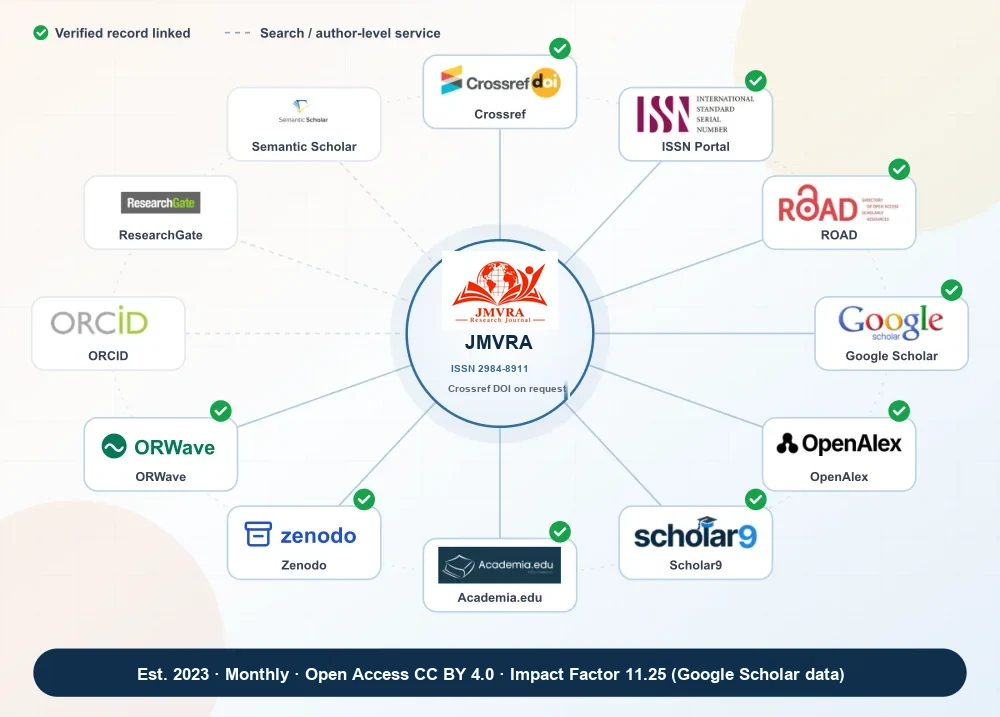
JMVRA Coverage
| Service | What it provides | Status / last verified |
|---|---|---|
| Crossref | DOI registration and linking of citations | Verified DOIs · 30 Sep 2026 |
| Google Scholar | Visibility in scholarly search, plus citation counts | Verified profile of the journal · 30 Sep 2026 |
| OpenAlex | Open index of scholarly works and their citations | Verified discovery link (search results) · 30 Sep 2026 |
| ISSN Portal / ROAD | Directory for serial registration and open access | Verified · 30 Sep 2026 |
| Zenodo | CERN's open repository for archived records | Verified repository search link · 30 Sep 2026 |
| Scholar9 | Registry of transparent peer review | Verified · 30 Sep 2026 |
| ORWave | Platform for discovering open-access work | Verified · 30 Sep 2026 |
| Scopus, Web of Science, DOAJ | Directory and selective indexes | Not currently indexed — openly disclosed |
Kinds of Services
“Indexed” actually spans five quite different kinds of service. Every kind works in its own way and is joined differently, and the line at the bottom of each card shows JMVRA's position.
How Content Gets to Them
An article never reaches a service on its own. Records travel along a chain that begins at peer review and finishes at a reader's search, and each stage can be verified at its own website.

- PublishedOnce accepted and copy edited, the paper joins an issue under a stable URL
- Metadata preparedTitle, authors, affiliations, abstract, keywords, ISSN, volume, issue, pages, date
- DOI depositedThe registration agency receives the record and mints the DOI
- Crawled & harvestedCrawlers visit the page, and harvesters gather records through standard protocols
- ListedEvery service adds the record according to its own timetable, frequently weeks afterwards
Peer Review Comes Before Indexing
Indexing services list what a journal has published; reviewing it is not their job, so review has to come first. Each JMVRA research article undergoes transparent, double-blind peer review ahead of publication, registration or harvesting.
Double-blind
Authors never learn who reviewed their paper, and reviewers never learn who wrote it.
- Checked for similarity beforehand (below 15%)
- Checked by domain experts
- Decision sent by email & WhatsApp
Transparent
The review leaves a trace, which allows anyone to check it was truly done.
- Review documented on Scholar9
- Public reviewer list
- On request, a formal report
The review record on Scholar9 is also among the services listed above, so proof that an indexed JMVRA article was reviewed is held in a public registry and not just on the journal's own website. The complete workflow is described on the JMVRA Peer Review: Transparent & Double-Blind page.
The Metadata Behind Discoverability
Whether an article can be found depends almost entirely on how accurate the deposited data are:
Mistakes in author names or affiliations are the leading reason an article is not linked to the correct researcher profile. Review them closely at the camera-ready stage.
How to Verify a Coverage Claim
Four short steps, each needing only minutes, are enough to settle a coverage claim about JMVRA or about any other journal:
- Start at the sourceOpen the service’s website itself and ignore any logo or badge shown on a journal page
- Query in two waysUse the ISSN 2984-8911 as well as the journal title
- Check for articlesReal article records, and not just an entry for the journal title
- Record the dateCoverage may begin and end, so write down when you looked
The dated results of these checks for JMVRA, service by service and including those where it is absent, appear on Indexing Verification.
Making Your Own Work Easier to Find
Indexing services can use only what you supply. Five habits matter most:
Making Your Published Paper Easier to Find Online
Appearing in a database is only the start; readers must also locate your work. These practices improve discoverability whichever journal publishes your paper.
- Choose title words readers search. Use the specific terms your audience would type, and avoid vague or decorative phrases. A precise title helps search systems match your paper with interested readers.
- Write keywords from real vocabulary. Select terms that appear in related literature rather than invented labels. Include both common and technical variants so different communities can reach the same article.
- Keep your author profile current. Maintain a researcher profile with a consistent name, affiliation and a persistent personal identifier. Linked records gather your outputs in one place and reduce confusion with namesakes.
- Share legitimately where permitted. Deposit the allowed version in your institutional repository and link it from your profile. Check the licence first so that sharing stays within agreed terms.
- Verify what a database actually holds. Search the database yourself for the journal and your title. Records can lag behind publication, and your own check shows whether something needs to be reported.
Discoverability comes from precise titles, careful keywords, consistent author records and your own habit of searching for your work.
Questions Researchers Often Ask
How long after publication until my article shows up in a database?
That depends on the service. DOI registration happens fast, whereas search engines and aggregators add records on their own crawl schedules, which may take several weeks.
Is a journal that is indexed also UGC CARE listed?
No. These are distinct assessments using distinct criteria. Refer to UGC Status & Parameters.
My article does not appear in search results. What can I do?
First check that the article page and DOI resolve properly, then email [email protected] quoting your paper ID, so the deposited metadata can be examined for errors.
In which databases is JMVRA indexed?
JMVRA (ISSN 2984-8911) has verified records at Crossref, Google Scholar, OpenAlex, the ISSN Portal / ROAD, Zenodo, Scholar9 and ORWave; the coverage table above links to each, and Indexing Verification gives the dates.
Does JMVRA appear in Scopus, Web of Science or DOAJ?
No, and the journal states this plainly. These selective services accept journals only through application and evaluation, and JMVRA makes no claim of coverage in them.
Is peer review done on JMVRA articles ahead of indexing?
Yes. All research articles pass through transparent, double-blind peer review before publication. Indexing services afterwards list the published article and do not review it. The review is logged on Scholar9, and the formal Transparent Peer Review Report can be obtained on request.
Verified at the source
Current Numbers You Can Check
Each figure links to the service that publishes it. These values were read on 30 Sep 2026 and will change when the services update their data.
One click each
Verify JMVRA Yourself
A Verified link takes you to the journal’s record, or to search results for it, on that service. A Search link instead runs a broad search on a platform used for sharing.
Crossref Search Verified
All deposited JMVRA articles, with DOI and metadata.
Google Scholar Verified
Citation profile of the journal: citations, h-index and i10-index.



OpenAlex Verified
An open catalogue of scholarly works that contains the journal’s source entry and the works under it.
Google Search Verified
Indexed pages of jmvra.org, together with hits for the full journal name.
ROAD / ISSN Verified
The ISSN record for 2984-8911 held in the directory of the ISSN International Centre.

ResearchGate Search
A research network on which authors share JMVRA papers; search it using the journal name.
Indexing & discovery
Indexing
The places in which the journal or its articles are officially listed or registered.
Crossref Verified
The DOI registration agency; metadata for each DOI-registered paper is lodged with it.
Crossref DOI on request Verified
On request, a paper receives a lasting Digital Object Identifier, keeping it citable.
ISSN Portal Verified
Serial registration of the journal: ISSN 2984-8911, recorded by the ISSN International Centre.

ORCID Registry
A registry of author identifiers that ties every author’s profile to the work they have published.

Publons / ResearcherID Registry
A registry for reviewers and researchers, now known as Web of Science reviewer recognition, which tracks peer-review activity.
Scholar9 Verified
A registry for transparent peer review, where the journal’s review certificate is logged.
Discovery
A place for researchers to find, search, read, save or share published articles.
Google Scholar Verified
Search and citation-tracking service supplying the citation data on which the journal’s Impact Factor rests.
OpenAlex Verified
An open index covering works, authors and citations, which continues Microsoft Academic’s data.
ORWave Verified
Open Research Wave is a platform for open-access journals and research discovery.
Academia.edu Verified
A platform for sharing academic work that offers readership analytics on every uploaded paper.

Semantic Scholar Search
Search driven by AI that brings up papers according to meaning, citations and influence.
ResearchGate Search
A network for researchers in which authors post papers and readers track their output.
Mendeley Search
A reference manager that lets readers store papers and cite them using the metadata.


SSRN Search
Elsevier’s network for preprints and working papers, which is a repository and not a journal index.
Older pages list Microsoft Academic, which Microsoft shut down at the end of 2021; OpenAlex, shown above, carries its data forward.
Related Pages
More on jmvra.org
Policies, records and author services on the main JMVRA site.
Journal & indexing
UGC & recognition
Peer review & ethics
For authors
Ready to publish?
A Journal You Can Verify for Your Publication
Charges of ₹971 INR (Indian authors) or $41 USD (foreign authors) come into play once a paper is accepted, never earlier. Expect transparent, double-blind peer review, similarity screening, optional Crossref DOIs, CC BY 4.0 open access, and alignment with UGC’s Suggested Parameters.