
Full Text · HTML
2,713 words · about 12 min read · open access under CC BY 4.0
Contents
Abstract
The rapid growth of cross-border e-commerce has created significant opportunities for Indian sellers to expand into global markets. However, logistics challenges such as high shipping costs, customs delays, infrastructure gaps, and delivery uncertainties affect their performance and competitiveness. This study analyses the logistics challenges faced by Indian sellers in cross-border e-commerce with special reference to Tiruppur and Coimbatore. Primary data were collected from 40 respondents using a structured questionnaire and analysed using percentage analysis, chi-square, ranking method, and ANOVA. The findings indicate that shipping cost and customs delays are the major logistics challenges affecting seller performance. The study suggests improving logistics infrastructure, adopting digital technologies, strengthening logistics partnerships, and providing government support to enhance efficiency and global competitiveness.
INTRODUCTION:
Cross-border e-commerce has emerged as a major component of global trade, enabling businesses to sell products internationally through digital platforms. Indian sellers are increasingly participating in global markets through platforms such as Amazon and eBayDespite these opportunities, logistics remains a major challenge in cross-border e-commerce due to high shipping costs, customs procedures, delivery delays, and infrastructure limitations.Another significant challenge lies in customs procedures and regulatory compliance. Cross-border shipments must adhere to export-import regulations, customs documentation, taxation rules, and country -specific compliance standards. In India, exporters must comply with requirements set by customs authorities, Directorate General of Foreign Trade (DGFT), and other regulatory bodies. In destination countries, sellers must meet import regulations, product standards, labelling requirements, and taxation policies. Delays or errors in documentation can result in shipment hold-ups, penalties, or returns, thereby incr`easing operational risks.
Infrastructure limitations also contribute to logistical inefficiencies. Although India has made substantial improvements in logistics performance, challenges such as port congestion, limited cold chain facilities, inadequate warehousing networks, and last -mile connectivity gaps still persist in certain regions. Sellers located in rural or semi-urban areas face additional difficulties in accessing reliable logistics partners capable of handling international shipments. Furthermore, delivery timelines and customer expectations create competitive pressure. International buyers expect fast, transparent, and affordable shipping options similar to domestic services. However, cross-border deliveries typically take longer due to customs clearance and international transit processes. Tracking and shipment visibility also remain areas of concern, especially when multiple logistics intermediaries are involved.
REVIEW OF LITERATURE:
Gunasekaran et al. (2017) examined supply chain performance in e -commerce and found that responsiveness and flexibility are critical for success. The study highlights that delays in logistics operations reduce customer satisfaction and competitiveness. It emphasizes the importance of real-time information sharing in supply chain management. The authors suggest adopting advanced information systems to improve coordination. The research concludes that agile logistics systems are essential for handling dynamic e-commerce demand.
Yafen Yuan (2023) examined cross-border e-commerce logistics and identified that the process is often hindered by multiple operational barriers such as complex customs procedures, long delivery timelines, and lack of efficient infrastructure. The study highlights that international logistics requires coordination among several stakeholders, making it more complicated than domestic logistics. It also points out that delays and high shipping costs reduce seller competitiveness. The author emphasizes the need for streamlined logistics systems and better policy support. Overall, the study concludes that improving infrastructure and simplifying customs processes can significantly enhance cross-border trade efficiency.
Parvin Banu Sirajudeen (2024) analyzed logistics service challenges in cross-border e-commerce and found that last-mile delivery issues and sustainability concerns are major obstacles. The study also discusses how inefficient transportation systems increase delivery time and cost. It emphasizes the growing importance of adopting technologies like artificial intelligence and blockchain to improve tracking and transparency. The author suggests that digital transformation can reduce inefficiencies and improve customer satisfaction. Additionally, the study highlights environmental concerns related to logistics activities. The findings stress the need for innovation and sustainable logistics practices.
Sirajudeen, R. (2024) Provides operational-level understanding of delivery and service challenges faced by Indian exporters. Sirajudeen (2024) focused specifically on logistics service providers in cross-border trade. The study analysed delivery speed, freight cost fluctuations, and tracking inefficiencies. It identified customs documentation complexity as a critical bottleneck. The research showed that sellers often struggle with unpredictable delivery timelines. It also highlighted reverse logistics as a costly and complex process. The author emphasized that technology adoption such as AI-based tracking systems improves transparency. The study recommended partnerships between logistics firms and e-commerce platforms. It concluded that efficient logistics coordination improves customer trust and seller performance.
Qian Liu (2024) focused on improving cross-border e-commerce logistics using big data technology. The study found that traditional logistics models are inefficient in handling the increasing volume of international orders. It highlights that big data analytics can improve demand forecasting and route planning. The research also emphasizes that data-driven logistics systems can reduce delivery time and costs. Additionally, the study points out that better data integration leads to improved decision-making. The findings suggest that adopting big data solutions is essential for enhancing logistics performance in cross- border trade.
Growing Importance of Cross-Border E-Commerce
Cross-border e-commerce has gained significant importance as global consumers increasingly purchase products from international sellers due to wider product variety, competitive pricing, and unique regional offerings. Indian sellers are particularly competitive in sectors such as handicrafts, textile and apparel products and home décor and leather items. The rising global demand for culturally distinctive and cost-effective products creates strong opportunities for Indian exporters. However, to fully benefit from this demand, an efficient logistics ecosystem is necessary to ensure smooth operations, timely delivery, and long-term sustainable growth.
Structure of Cross-Border Logistics
Cross-border e-commerce logistics consists of multiple interconnected stages that ensure the smooth movement of goods from sellers to international customers. The process begins with order processing, followed by packaging and labeling, and domestic transportation to ports or airports. It then includes export customs clearance, international freight movement, and import customs clearance in the destination country. Finally, products are delivered through last-mile delivery, and returns or reverse logistics are handled if required. Each stage directly affects the overall cost, delivery time, and reliability of the process, and any inefficiency can disrupt the entire supply chain.
Key Logistics Challenges Faced by Indian Sellers
Indian sellers involved in cross-border e-commerce face several logistics challenges that impact their performance. High shipping costs are a major issue, especially for small sellers who cannot access bulk shipping discounts. Customs delays due to complex documentation and compliance requirements often lead to shipment hold-ups, affecting delivery timelines and customer satisfaction. Infrastructure gaps make it difficult for sellers in smaller towns to access reliable logistics services. Additionally, delivery time uncertainty arises from factors such as customs procedures, weather conditions, and international freight schedules.
Technological Dimension of Logistics
Digital technologies are transforming logistics by improving efficiency and transparency. Tools such as automated inventory systems, real-time tracking, electronic documentation, artificial intelligence, and blockchain have enhanced logistics performance globally. However, many small-scale Indian sellers are unable to adopt these technologies due to limited financial resources and lack of technical expertise.
Emerging Trends in Cross-Border Logistics
Emerging trends such as export-focused fulfillment centers, digital customs processing, regional trade agreements, and improved transport systems are shaping cross-border logistics. While these developments may reduce inefficiencies, challenges still remain. The success of Indian sellers in global markets depends largely on efficient and reliable logistics. This study focuses on analyzing these challenges to improve their global competitiveness.
Research Gap
Existing studies on e -commerce logistics mainly focus on general challenges like cost, infrastructure, and technology separately. However, there is limited region-specific research on key export hubs like Tiruppur and Coimbatore. This study addresses this gap by providing a combined and detailed analysis based on primary data from these regions, offering more practical and context-specific insights.
Scope of the Study
This study focuses on analyzing the logistics challenges faced by Indian sellers in cross-border e-commerce. It examines key issues such as shipping, transportation costs, customs clearance, delivery delays, and international regulations. The study also explores challenges in packaging, tracking, and returns, along with the role of logistics service providers and e-commerce platforms in supporting global trade. Additionally, it highlights the impact of these challenges on seller performance and customer satisfaction. It aims to identify areas for improvement in logistics operations. The study also provides insights to enhance efficiency and competitiveness in international markets.
OBJECTIVES
- To analyse the logistics challenges faced by Indian sellers in cross-border e-commerce.
- To identify key logistics issues in international shipping.
- To study the impact of logistics challenges on seller performance.
- To understand seller satisfaction with existing logistics support
- To suggest measures to improve cross-border logistics efficiency.
Limitations of the Study
- The study is based on a small sample size of 40 respondents, which may not represent all Indian sellers.
- It is limited to a specific geographical area, so findings may not apply to other regions.
- The study was conducted within a limited time period.
- Data is based on respondents’ opinions, which may include personal bias.
- The study focuses only on logistics challenges and excludes other factors like regulations and marketing.
ANALYSIS AND INTERPRETATION:
The tools used for analysis in this study are,
- Percentage Analysis
- Chi-square Analysis
- Ranking Method
- ANOVA
Percentage Analysis: A method of expressing data as percentages to easily compare proportions within a dataset. It simplifies interpretation by converting raw numbers into relative terms.
Chi-square Analysis: A statistical test used to examine the association between categorical variables. It helps determine whether observed differences are due to chance or actual relationships.
Ranking Method: A technique used to identify and prioritize factors based on their importance or severity as perceived by respondents. It helps in understanding which logistics challenges are considered most significant by the sellers.
ANOVA (Analysis of Variance): A statistical method used to compare means of three or more groups. It identifies whether at least one group differs significantly from others.
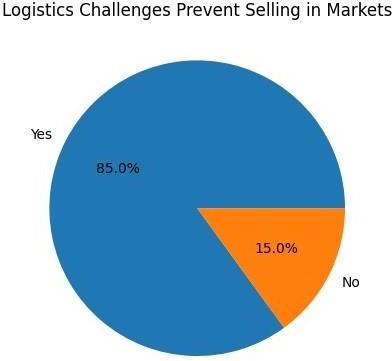
PERCENTAGE ANALYSIS:
Response Number Percentage
Yes 34 85%
Total 40 100
Source: Primary Data
Interpretation
The table shows that 85% say logistics challenges prevent selling in some markets while 15% say no.
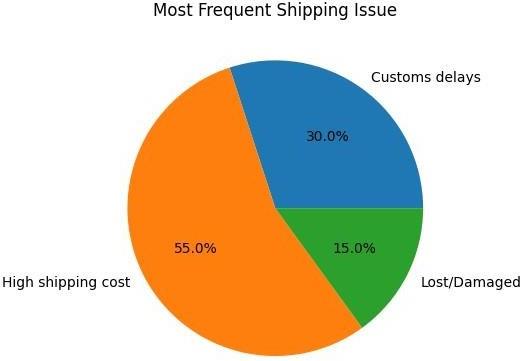
| Issue | Number | Percentage |
|---|---|---|
| Customs delays | 12 | 30% |
| High shipping cost | 22 | 55% |
| Lost / damaged products | 6 | 15% |
| Total | 40 | 100 |
Source: Primary Data
Interpretation
The table shows that 55% face high shipping costs most frequently, 30% customs delays and 15% damaged goods.
CHI SQUARE ANALYSIS
Null Hypothesis: There is no significant association between age group of sellers and the type of logistics challenges faced.
Alternative Hypothesis: There is a significant association between age group of sellers and the type of logistics challenges faced.
| Case Processing Summary | |||||
|---|---|---|---|---|---|
| N | Valid Percent | N | Cases Missing Percent | N | Total Percent |
| Age Group * Which stage of 40 cross-border logistics is most | 100.0% | 0 | 0.0% | 40 | 100.0% |
challenging?
Age Group * Which stage of cross-border logistics is most challenging?
Crosstabulation
Count
Which stage of cross-border logistics is most challenging?
| Age Below 25 years Group 25–35 years | Customs Clearance Transportatio 1 3 | International n 0 2 | Last-Mile Delivery 0 1 | Returns / Reverse Logistics 0 0 | Total 1 6 |
|---|---|---|---|---|---|
| 36–45 years | 4 | 7 | 6 | 1 | 18 |
| Above 45 years | 3 | 5 | 3 | 4 | 15 |
| Total | 11 | 14 | 10 | 5 | 40 |
Chi-Square Tests
Asymptotic Value df Significance (2-sided)
| Pearson Chi-Square | 8.994a | 9 | .438 |
| Likelihood Ratio | 9.088 | 9 | .429 |
| Linear-by-Linear | 4.574 | 1 | .032 |
Association
N of Valid Cases 40
- 14 cells (87.5%) have expected count less than 5. The minimum expected count is.13.
Interpretation
The Chi-square test result shows that the p-value (0.438) is greater than the standard significance level of 0.05. Therefore, the null hypothesis is accepted and the alternative hypothesis is rejected. This indicates that there is no significant association between the age group of sellers and the type of logistics challenges faced. This means that sellers across different age groups tend to face similar types of logistics challenges in cross- border e-commerce, and age does not play a major role in influencing the nature of these challenges.
RANKING ANALYSIS
| Strategies | 5 | 4 | 3 | 2 | 1 | Total | Weighted Average | Rank |
| Poor logistics support services | 3 | 21 | 10 | 6 | 0 | 141/40 | 3.525 | I |
| 15 | 84 | 30 | 12 | 0 | ||||
| Complex documentation | 7 | 6 | 23 | 3 | 1 | 135/40 | 3.375 | II |
| 35 | 24 | 69 | 6 | 1 | ||||
| Long delivery time | 5 | 13 | 8 | 13 | 1 | 128/40 | 3.2 | III |
| 25 | 52 | 24 | 26 | 1 | ||||
| Customs clearance delays | 5 | 10 | 9 | 3 | 13 | 111/40 | 2.775 | V |
| 25 | 40 | 27 | 6 | 13 | ||||
| High shipping | 6 | 3 | 22 | 8 | 1 | 125/40 | 3.125 | IV |
costs
Interpretation
The ranking analysis shows that poor logistics support services is the most frequently faced challenge among sellers, securing the first rank with the highest weighted average of 3.525. This indicates that sellers largely struggle with inadequate logistics support in cross-border operations. Complex documentation is ranked second (3.375), highlighting the difficulty sellers face in handling international paperwork and compliance requirements. Long delivery time takes the third position (3.2), reflecting delays in shipping and delivery processes.
High shipping costs are ranked fourth (3.125), suggesting that although costs are a concern, they are slightly less critical compared to service and documentation issues. Lastly, customs clearance delays rank fifth (2.775), indicating it is relatively less frequent compared to other challenges. Overall, service-related and procedural issues are more prominent than cost-related challenges in cross- border e-commerce logistics.
ANOVA
Null Hypothesis: There is no significant difference in satisfaction with logistics support among sellers with different years of experience.
Alternative Hypothesis: There is a significant difference in satisfaction with logistics support among sellers with different years of experience.
Descriptives
How satisfied are you with the overall logistics support provided for cross-border e-commerce?
95% Confidence Interval for Mean Minimu Maximu Std. m m N Mean Deviation Std. Error
Lower Bound Upper Bound
ANOVA
How satisfied are you with the overall logistics support provided for crossborder e-commerce?
Interpretation
The ANOVA result shows a significance value of 0.984, which is greater than 0.05. Therefore, the null hypothesis is accepted and the alternative hypothesis is rejected.
This indicates that there is no significant difference in satisfaction with logistics support among sellers with different years of experience. Sellers, regardless of their experience level, have similar levels of satisfaction with logistics support in cross-border e-commerce.
FINDINGS PERCENTAGE ANALYSIS:
- 85% of the respondents agree that logistics challenges restrict entry into certain markets.
- 55% of the respondents identify high shipping cost as the most frequent shipping issue.
CHI-SQUARE ANALYSIS:
The Chi-square test was used to examine the relationship between the age group of sellers and the type of logistics challenges faced. The result shows a significance value greater than 0.05. Therefore, the null hypothesis is accepted, indicating that there is no significant association between age group and logistics challenges.
RANKING ANALYSIS:
The ranking analysis shows that poor logistics support services are ranked as the most critical challenge faced by sellers. Complex documentation is ranked as the second major challenge, followed by long delivery time as the third.
ANOVA:
The ANOVA test was conducted to determine whether there is a significant difference in satisfaction levels among sellers with different years of experience. The results show a significance value greater than 0.05. Therefore, the null hypothesis is accepted.
SUGGESTIONS:
- Reduce high shipping costs through subsidized rates, bulk shipping options, and cost-sharing for small sellers.
| • Simplify customs clearance procedures to avoid delays and ensure faster delivery. • Improve coordination between sellers, e-commerce platforms, and logistics providers. • Encourage the use of technology such as AI-based tracking and digital documentation.: • Strengthen international transportation and last-mile delivery systems. • Promote proper packaging standards to reduce product damage. • Provide affordable logistics solutions for small and individual sellers. | |
|---|---|
| • Enhance competitiveness. | overall logistics infrastructure to improve efficiency and global |
| CONCLUSION: The study concludes that cross | -border e-commerce sellers in India face significant logistics -related |
challenges that adversely affect their performance and growth. Key issues include high shipping costs, delays in international transportation, inefficient logistics support, and complex documentation procedures. Although most sellers rely on platform-based logistics services for shipment management, satisfaction levels remain moderate due to limitations in efficiency, transparency, and cost-effectiveness. These challenges are consistent across different age groups and experience levels, indicating their systemic nature. Overall, such constraints restrict sellers’ ability to scale and expand effectively in international markets. However, the study highlights that technology-based solutions such as automation, AI tracking, and digital documentation can significantly improve logistics efficiency. Therefore, improving logistics infrastructure, enhancing service quality, and adopting advanced technologies are essential for strengthening cross-border e-commerce and supporting Indian sellers in the global market.
REFERENCE:
- • Gunasekaran, A., Subramanian, N., & Papadopoulos, T. (2017). Information technology in logistics and supply chain management. Transportation Research Part E, 99, 14–33.
- • Yuan, Y. (2023). Cross-border e-commerce logistics challenges and solutions. Journal of International Logistics Studies.
- • Sirajudeen, P. B. (2024). Logistics service challenges in cross -border e-commerce. Journal of Supply Chain and Logistics Management.
- • Sirajudeen, R. (2024). Operational challenges in cross -border logistics services. International Journal of Logistics Systems.
- • Liu, Q. (2024). Big data applications in cross-border e-commerce logistics. International Journal of Data-Driven Supply Chains.
- • https://drpress.org/ojs/index.php/fbem/article/view/6225
- • https://www.mdpi.com/2071-1050/15/4/3685
© 2026 The Author(s). Open access under the Creative Commons Attribution 4.0 International License (CC BY 4.0). This HTML text was made from the published PDF so it can be read on any device; the PDF is the version of record. A figure or table that could not be reproduced exactly here links to its page in the PDF.