Full Text · HTML
4,310 words · about 20 min read · open access under CC BY 4.0
Contents
Abstract
Determining post-divorce child maintenance becomes difficult when a father's financial capacity falls below the child's assessed needs. Indonesian scholarship has examined how needs and capacity are measured, but not how an award below need is justified or what status the remaining shortfall holds. This doctrinal study combines statutory, conceptual, and comparative analysis of four classical juristic texts from the Hanafi, Maliki, Shafi'i, and Hanbali traditions, read alongside the Marriage Law, the Compilation of Islamic Law, and a 2018 Supreme Court circular. Three findings emerge. First, adequacy of provision and capacity to bear the obligation must be connected without being collapsed into one measure. Second, the four texts differ on whether a poor father must seek earnings, so potential income cannot be presented as a criterion agreed across the schools. Third, Indonesian provisions already embed the father's capacity but do not explain how an award is justified when capacity falls below need. The article proposes a five-stage framework of needs, resources, expenditure, adjustment, and shortfall, and tests it on three hypothetical cases. An award justified by the father's capacity does not necessarily meet the child's needs; the shortfall must remain visible without automatically becoming paternal debt.
I. INTRODUCTION
Divorce ends a marriage, but a child's need for food, shelter, health care, and education continues. Article 41(b) of Law No. 1 of 1974 on Marriage places the costs of a child's care and education on the father, while Article 45 preserves that duty after the marriage is dissolved (Republik Indonesia, 1974, 2019). At the international level, Article 27 of the Convention on the Rights of the Child, ratified by Indonesia, recognises every child's right to an adequate standard of living and assigns primary responsibility to parents within their abilities and financial capacities (Republik Indonesia, 1990; United Nations, 1989). Both layers of norms refer to need and to capacity, yet neither explains what a court should do when the two do not meet.
Within Islamic normative sources, Qur'an al-Ṭalāq [65]: 7 grounds the consideration of capacity in maintenance, while al-Baqarah [2]: 233 links provision in the context of nursing to what is reasonable, to capacity, and to the prohibition of causing harm on account of a child (The Qur'an, n.d.). The hadith of Hind bint ʿUtbah affirms sufficiency and reasonableness as the measure of maintenance, but the issue there was inadequate provision caused by miserliness, not genuine economic incapacity (al-Bukhārī, n.d.). Without attention to context, the demand to meet needs and the limitation based on capacity appear to conflict, although they in fact address elements that must be related to each other.
Indonesian law already provides a basis for that relationship. Article 156(d) of the Compilation of Islamic Law (Kompilasi Hukum Islam) ties the maintenance burden to the father's capacity, and Article 156(f) allows the court to set the costs of a child's care and education with regard to the father's capacity (Republik Indonesia, 1991). Supreme Court Circular No. 3 of 2018 directs judges to consider justice and reasonableness by examining the economic capacity of the obligor and the basic needs of the wife and/or child (Mahkamah Agung Republik Indonesia, 2018; Pengadilan Agama Buntok, 2026). The Compilation was itself introduced to give judges a codified reference alongside the fiqh texts, so the relationship between its articles and juristic reasoning remains relevant in practice (Nurlaelawati, 2010). The problem is therefore not an absence of norms, but how those norms justify an award when the father's defensible capacity falls below the child's needs.
Previous research has touched on the relationship between need and capacity from several angles. Asnawi (2016) developed a jurimetric approach that takes into account the child's actual needs, the father's financial capacity, and minimum living standards, while Nafhani et al. (2025) set out evidentiary instruments through historical audits for past maintenance and inflation-adjusted projections for future maintenance. Maharani et al. (2026) compared three Religious Court decisions and concluded that child maintenance awards still depend mainly on the father's financial capacity rather than on objectively measured child needs. Nasution et al. (2024) found inconsistency in awards of past child maintenance (nafkah madiyah), shaped by the legal basis chosen by judges and by their assessment of the father's capacity.
Other studies have turned to the enforcement of decisions. Luthfi (2023) shows that the protection of post-divorce financial rights has moved toward enforcement; Fahmi et al. (2025) document salary deductions and digital monitoring in several Religious Courts; and Oktavia et al. (2026) find recurring non-compliance even where children's rights are recognised in the decision. Van Huis's (2010) field study showed early on that the implementation of child support decisions cannot be separated from the social and economic conditions of the parties. Devy and Muliadi (2019) examined a reduction of a maintenance claim in a single decision, Andini (2019) focused on sanctions, and the theses of Khoirunnisa (2018) and Putra (2025) addressed juristic views on child maintenance and the father who lacks means.
This mapping shows that measurement, decision patterns, and enforcement have been studied, but the normative justification for setting an amount below reasonable need, and the status of the resulting shortfall, have not yet been treated as a subject in their own right. This study therefore asks: to what extent do Indonesian maintenance guidelines provide an adequate basis for judicial reasoning when a father's partial capacity cannot meet the child's reasonable needs? The question is divided into three: (1) how do four selected juristic texts relate the adequacy of provision to the capacity of the provider, particularly regarding the duty to earn; (2) how do the legal maxims al-masyaqqah tajlib al-taysīr (hardship begets facility) and al-ḍarar yuzāl (harm must be removed) limit the adjustment of the amount; and (3) what justificatory framework can be formulated for Indonesia, and what is the status of the remaining shortfall?
The article does not claim to be the first to address need or capacity. Its contribution is to distinguish an award that is justified by the provider's capacity from the fulfilment of the recipient's needs, and to organise the relationship between the two in a traceable evaluative framework. The framework complement s the jurimetric literature (Asnawi, 2016; Nafhani et al., 2025) on the side of normative justification rather than measurement tools. The analysis is limited to school-age children who have not reached puberty (bāligh), have no income of their own, and require adequate basic education.
II. RESEARCH METHODOLOGY
2.1 Research Design
This is a normative (doctrinal) legal study, that is, research that examines legal materials in order to explain, systematise, and assess the coherence of norms within a legal system (Hutchinson & Duncan, 2012; Marzuki, 2017). Three approaches are used. The statutory approach reads the relationship between norms on parental responsibility, the consideration of capacity, and the setting of child costs. The conceptual approach separates reasonable need, actual capacity, earning capacity, partial incapacity, and neglect. The comparative juristic approach focuses on how rules are justified within each text, not merely on a list of similarities and differences in legal outcomes.
2.2 Subjects/Population and Sample
The objects of study are legal materials, not respondents. The primary juristic corpus was selected purposively on the basis that each text discusses child or kinship maintenance and explains its conditions and rationale: Badā'iʿ al-Ṣanā'iʿ by al-Kāsānī (1986) for the Hanafi tradition, Ḥāsyiyat al-Dasūqī ʿalā al-Syarḥ al-Kabīr (al-Dasūqī, n.d.) for the Maliki tradition, Mughnī al-Muḥtāj by al-Syirbīnī (2000) for the Shafi'i tradition, and Al-Mughnī by Ibn Qudāmah (1968) for the Hanbali tradition. The four texts are treated as reference points within their traditions, not as complete representations of every opinion in each school. Ibn Nujaym's Al-Asybāh wa al-Naẓā'ir (n.d.) serves as a companion source on the limits of the legal maxims, supported by Kamali's (2008) secondary account of the maxims.
The Indonesian legal materials comprise Law No. 1 of 1974 as amended by Law No. 16 of 2019, the Compilation of Islamic Law disseminated through Presidential Instruction No. 1 of 1991, Law No. 23 of 2002 as amended by Law No. 35 of 2014 on Child Protection, and Supreme Court Circular No. 3 of 2018 (Mahkamah Agung Republik Indonesia, 2018; Republik Indonesia, 1974, 1991, 2002, 2014, 2019).
Secondary materials, namely journal articles, theses, policy briefs, and news reports, are used to position the problem and to limit the contribution claimed. The study does not examine judicial practice empirically; empirical findings by others (Maharani et al., 2026; Nasution et al., 2024) serve as points of comparison.
2.3 Data Collection Procedure
Materials were collected through library research. The edition details of the four texts were checked against scans of the printed editions, while the chapters on maintenance were read through the digital transcriptions listed in the references, accessed on 24 October 2026. The juristic texts are cited by chapter heading and identifying phrase; printed page numbers are not given because the correspondence between the transcriptions and the printed editions could not be confirmed. Passages were selected when they explained the amount of maintenance, the provider's capacity, the recipient's needs, or the priority of expenditures. Opinions on maintenance owed to parents were not applied directly to maintenance owed to children, rules on spousal maintenance were separated from those on kinship maintenance, and the layers of base text (matn), commentary (syarḥ), and gloss (ḥāsyiyah) were distinguished to avoid misattribution. Secondary works available only as abstracts were used in a limited way.
2.4 Data Analysis
The analysis proceeded in five steps: (1) identifying the elements of need and capacity; (2) reconstructing the reasoning of each text; (3) comparing the texts under equivalent conditions; (4) evaluating them through the maxims al-masyaqqah tajlib al-taysīr and al-ḍarar yuzāl; and (5) reading the Indonesian norms systematically. The results were then tested on three hypothetical cases in which the child's needs are held constant while the father's circumstances vary. These cases are a tool for testing the consistency of the argument, not field data. Argumentative validity was maintained by presenting opinions that limit the thesis, separating the description of sources from the researcher's proposals, and avoiding the inference that differences in wording necessarily amount to legal conflict (Hutchinson & Duncan, 2012).
III. RESULTS AND DISCUSSION
3.1 RESULTS
Adequacy of Provision and Capacity to Bear the Obligation
The first finding is the need to distinguish the measure of the child's needs from the amount that can be imposed on the father. The measure of need asks what the child requires to live and attend basic education adequately; capacity to bear asks what resources can reasonably be required of the father. Treating the two as one makes the child's needs appear to shrink simply because the father's income has fallen. Reasonable need is not every claim made by the caregiver or the pre -divorce consumption pattern; it is the result of an assessment based on age, health, living environment, and access to education. Nor is the father's capacity identical to the income he declares; usable assets, recurring income, the costs of keeping his job, and dependants with a legal basis must be distinguished.
Partial incapacity means that the father has a defensible capacity to cover part, but not all, of the child's needs. This differs from refusing to pay a portion he is in fact able to meet. Economic capacity and payment behaviour are therefore examined as two dimensions. The difference between assessed need and the amount imposed is treated as evaluative information: it shows the part of the child's needs that the father's burden does not reach, without establishing a debt, the extinction of a right, or an obligation on other relatives.
The Four Texts on Need and Capacity
In Badā'iʿ al-Ṣanā'iʿ, al-Kāsānī (1986) links kinship maintenance to sufficiency because the obligation is tied to need. The text distinguishes the parent-child relationship from other kinship ties: between father and child, the ability to earn is given weight even when the father is not wealthy. The phrase bal qudratuhu ʿalā al-kasb kāfiyah (rather, his ability to earn suffices) makes earning capacity a relevant element. Poverty therefore does not automatically remove the maintenance claim, but the text cannot be stretched into an assumption that every healthy father has a job.
In Ḥāsyiyat al-Dasūqī, the discussion of child maintenance places the provider's capacity alongside the priority of needs. Al-Dasūqī (n.d.) explains that a poor father is not obliged to earn through a skill in order to maintain his poor child, even if he possesses that skill; the phrase lā yajibu ʿalā al-ab al-muʿsir an yatakassaba (it is not obligatory for an insolvent father to seek earnings) makes this limitation explicit. The explanation appears in the gloss layer and must be read together with the commentary. This finding limits any claim that potential capacity is agreed upon by the four schools, without implying that neglecting a child is justified.
Mughnī al-Muḥtāj shows a more detailed relationship among sufficiency, surplus resources, and the effort to earn. Al-Syirbīnī (2000) defines sufficiency as the measure of kinship maintenance and mentions an obligation on a person able to work, according to the preferred opinion, if he finds lawful work suited to him, through the condition idhā wajada mubāḥan yalīqu bihi (if he finds permissible work befitting him). This condition matters methodologically: earning capacity is not an abstract attribute proven by age or health alone, but requires work that is actually available.
In Al-Mughnī, Ibn Qudāmah (1968) treats sufficiency as the measure of kinship maintenance, based on need and custom, with the expression qadr al-kifāyah (the measure of sufficiency) as an identifying phrase. In discussing the conditions, he examines the recipient's need and the existence of resources exceeding the provider's own maintenance; both property and earnings are named as relevant sources. This reasoning shows that the amount and the existence of capacity must be read together, without turning a lack of resources into a conclusion that the recipient's need has disappeared. Table 1 summarises the four lines of reasoning.
| Source Point of reasoning examined | Limit of the conclusion |
|---|---|
| Al-Kāsānī (Hanafi) | Sufficiency of need and the ability to Actual poverty does not end the inquiry into earn in the father-child relationship. capacity; earning opportunities may not be assumed. |
| Al-Dasūqī (Maliki) on requiring a poor father to work. | The provider's capacity and the limit Potential capacity cannot be claimed as a measure agreed by the four schools. |
| Al-Syirbīnī (Shafi'i) | Sufficiency, surplus resources, and Using earning capacity requires attention to its suitable lawful work that is available. conditions and to the opinion adopted. |
| Ibn Qudāmah (Hanbali) condition of surplus property or earnings. | Amount based on need and custom; The measure of need is distinct from the conditions of capacity; work details are not equated across schools. |
Source: Author's analysis of the selected corpus.
The comparison yields two findings. First, need and the provider's capacity are related but not identical in all the texts examined. Second, the scope of capacity is not uniform, especially regarding the duty to earn. The defensible comparative conclusion is therefore not that all schools require maximum imposition based on the father's potential, but that every claimed adjustment must state which doctrine of capacity it relies on.
Basic Education within the Measure of Sufficiency
Lists of needs in classical texts should not be read directly as itemised modern school costs, but the absence of an item does not show that it is rejected. In the Indonesian context, education has a direct normative basis in Article 41(b) of the Marriage Law and Article 156(f) of the Compilation of Islamic Law, so its recognition does not depend on finding a term for school fees in classical texts. The measure used is the cost required for basic education to be followed adequately, including supplies, necessary transport, and access to learning.
The Two Maxims and the Limits of Adjustment
The maxim al-masyaqqah tajlib al-taysīr directs attention to hardship that is relevant to the performance of a legal duty, but Ibn Nujaym (n.d.) distinguishes degrees of hardship and stresses the limits of its consideration. The maxim is not a general licence to extinguish obligations. The maxim al-ḍarar yuzāl, which Kamali (2008) classifies among the normative maxims accepted across the schools, comes with the restriction that harm must not be removed by an equivalent harm. The two maxims are formulated here as a reciprocal test: the consideration of hardship prevents imposition without a basis in capacity, while the consideration of harm prevents a low award from being accepted as a complete solution without regard to the child's needs.
Adequacy of the Indonesian Normative Basis
Article 41(b) of the Marriage Law connects the father's responsibility, the costs the child requires, and the possible involvement of the mother through a court determination. Article 156(d) of the Compilation makes the father's capacity the measure of the burden, and Article 156(f) provides the basis for setting costs with regard to that capacity (Republik Indonesia, 1974, 1991). Circular No. 3 of 2018 adds an evaluative direction by linking economic capacity, basic needs, justice, and reasonableness. Adjustment of the amount therefore already has a normative basis; what is missing are indicators of reasoning that connect need, capacity, priority of expenditures, and the amount finally imposed. This study found no sufficient ground to assert a total legal vacuum.
A Framework for Justifying Adjustment
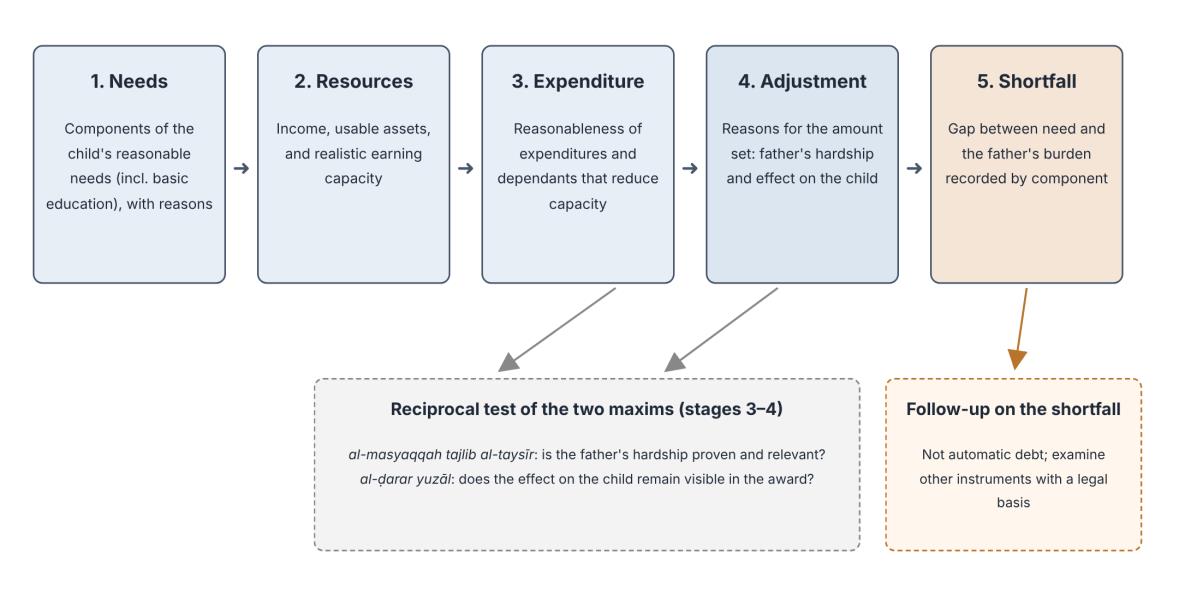
Building on these findings, a five-stage interpretive framework is proposed. It is neither an official court formula nor a rule attributed wholesale to one school; its purpose is to make the reasons for adjustment traceable. The flow of the framework is shown in Figure 1 and its guiding questions in Table 2.
Source: Author's formulation.
| What does the child require to live and attend Accepted components of need, with reasons. basic education adequately? | ||
|---|---|---|
| Stage 1. Needs | Guiding question | Output to be explained |
| 2. | What resources are available, and what | Capacity with a factual basis, not merely a |
| Resources | earning capacity is realistic? | declaration. |
| 3. | Which expenditures and dependants may | Basis of priorities and expenditures that can |
| Expenditure reasonably reduce capacity? | still be adjusted. | |
| 4. | Why can a particular amount be imposed | Relationship between capacity, hardship, |
| Adjustment | when need is greater? | and effect on the child. |
| 5. Shortfall | Which needs remain beyond the father's burden? | The shortfall and its effects, without automatic debt. |
Source: Author's analysis of the selected corpus.
The first stage assesses the child's reasonable needs separately from the father's declared capacity. The second examines defensible capacity; earning capacity is considered only when its doctrinal basis and realistic conditions are explained. The third assesses the reasonableness of expenditures: basic living costs, medical treatment, and the costs of keeping a job are distinguished from expenditures that can be adjusted. The fourth requires reasons for the amount set, weighing the father's hardship against the risk to the child through the two maxims. The fifth records unmet needs by component, without turning the record into an order of debt.
Testing through Hypothetical Cases
The test uses illustrative figures not drawn from real families. In all cases, the child's assessed reasonable needs for basic living and basic education are set at IDR 2,000,000 per month. In the first case, after reasonable living costs and the costs of keeping his job are taken into account, the father's capacity is IDR 1,200,000, with no other resources or realistic additional opportunities; imposing that amount is justified, while IDR 800,000 is recorded as unmet need. In the second case, the declared capacity of IDR 1,200,000 turns out to include discretionary spending of IDR 800,000 that can be stopped without affecting basic needs or employment, so capacity is reassessed at IDR 2,000,000 and a downward adjustment is not justified. In the third case, actual capacity equals that in the first case, but suitable lawful work is genuinely available, adding an illustrative IDR 500,000, so capacity becomes IDR 1,700,000 and the shortfall IDR 300,000. The results are shown in Table 3.
| Case | Distinguishing circumstance Recognised capacity | shortfall |
|---|---|---|
| First or realistic opportunities found. | Capacity of IDR 1,200,000; no additional resources IDR 1,200,000 | IDR 800,000 |
| Second Declared capacity of IDR 1,200,000 includes adjustable discretionary spending of IDR 800,000. | IDR 2,000,000 after reassessment | IDR 0 |
| Third Actual capacity of IDR 1,200,000; suitable work available (illustrative addition of IDR 500,000). | IDR 1,700,000, with basis and limits | IDR 300,000 |
explained Source: Author's analysis; illustrative figures, not field data or a maintenance standard.
The test shows the internal consistency of the framework: the same declaration does not always yield the same justification, and identical needs do not force identical burdens when capacity differs. It also shows that recording the shortfall is not, by itself, a solution to unmet need.
3.2 DISCUSSION
Interpretation of Findings
The main finding is that justifying the father's burden and fulfilling the child's needs are two different assessments. The award of IDR 1,200,000 in the first case can be justified from the father's side, but it cannot be described as sufficient from the child's side. The distinction matters because, without it, the figure for need tends to be quietly adjusted to the father's income, and the child's shortfall disappears from the court's reasoning. The doctrinal disagreement over the duty to earn also means that a judge who relies on potential income should state the basis of that choice rather than attribute it to a consensus of the schools.
Relationship to Literature
This finding is consistent with Maharani et al. (2026), who found that awards still rest on the father's capacity rather than on measured child needs. That pattern illustrates the risk discussed here: the child's needs appear to shrink with the father's income. Their recommendation for measurable guidelines can be read as complementing the first and second stages of this framework, while the third to fifth stages supply the justificatory reasoning they did not elaborate. Asnawi (2016) and Nafhani et al. (2025) provided calculation and evidentiary tools; this article's contribution lies in the normative reasoning that connects the results of that assessment to an award below need.
The inconsistency in past-maintenance decisions reported by Nasution et al. (2024) shows that the legal status of unpaid maintenance is genuinely contested: some judges reject such claims because child maintenance is understood as provided for use (li al-intifāʿ) rather than for ownership (li al-tamlīk), while others grant them by stressing the father's duty. This divergence supports the article's position that the status of the shortfall cannot be inferred automatically from texts on capacity. Wirastri and van Huis (2024) also note that much of the reform of Muslim family law in Indonesia has occurred through judicial interpretation outside statutory amendment, which makes an interpretive proposal such as this framework more realistic than waiting for legislative revision.
Sources from outside Indonesia offer a limited comparison. According to The Express Tribune's (2025) report on a decision of the Supreme Court of Pakistan, the amount of child maintenance was linked to the child's reasonable needs and the father's means, the Hanafi school was described as requiring maintenance as long as the father is able to work, and the burden may shift to the mother or grandfather when the father is genuinely unable. Because this is a press report, it is used only to illustrate a pattern, not as legal authority. From child support policy in the United States, Turetsky (n.d.) concludes that orders set above low-income parents' ability to pay generate uncollectible debt and reduce payment regularity. Bartfeld and Meyer (1994) showed earlier that ability to pay is closely related to compliance. These findings come from a different legal system, but they align with this framework's caution against fictitious capacity and against converting the shortfall automatically into debt.
Studies of enforcement (Fahmi et al., 2025; Luthfi, 2023; Oktavia et al., 2026; van Huis, 2010) show that a sound decision on paper does not guarantee payment. The five-stage framework does not replace enforcement mechanisms, but it makes the award more likely to match the father's real capacity while making the child's shortfall visible, so that it can be followed up through competent instruments, including the mother's involvement through a court determination under Article 41(b) of the Marriage Law. Article 27 of the Convention on the Rights of the Child, which requires states to take measures to secure the recovery of maintenance for the child, provides an additional basis for such follow-up (United Nations, 1989).
Limitations of the Study
The study is limited by the selection of one principal text per tradition, the use of digital transcriptions of the maintenance chapters without printed pagination, and the absence of primary court decisions analysed by the author. The findings do not cover all internal differences within the schools or every interpretation of the national guidelines. The literature mapping is targeted rather than systematic, and several theses were accessible only as abstracts. The hypothetical cases do not prove the framework's effectiveness in court; their value is limited to testing the link between reasons and conclusions.
Implications
For judicial practice, a judgment that sets maintenance below reasonable need should state four things: the accepted components of need, the basis for assessing the father's capacity, includin g the reasons for accepting or rejecting potential income, the assessment of the reasonableness of deducted expenditures, and an explicit statement of the remaining shortfall. This proposal does not require regulatory change, because Article 156(d) and (f) of the Compilation and Circular No. 3 of 2018 already contain the elements of capacity and need. Further research should analyse the content of court decisions to see how the shortfall is recorded or ignored, validate figures for child needs, and evaluate compliance and the effectiveness of enforcement.
IV. CONCLUSION
Adjusting child maintenance under a father's partial incapacity requires distinguishing the adequacy of the child's provision from the capacity to impose the burden on the father. A reading of the four selected texts shows that the provider's capacity is not formulated uniformly, especially regarding the duty to earn, so potential capacity requires an explicit doctrinal basis and realistic opportunities. The maxims al-masyaqqah tajlib al-taysīr and al-ḍarar yuzāl function as a reciprocal test of the father's hardship and the effects of adjustment on the child, without automatically extinguishing the obligation or imposing a burden beyond capacity.
The Indonesian provisions examined already provide a basis for considering the father's capacity and the child's needs. The proposed strengthening is a five-stage framework: identifying needs, examining resources, assessing the reasonableness of expenditure, justifying the amount, and recording unmet needs. The shortfall remains a reason to deepen the evaluation and to examine lawful instruments of provision, without automatically being treated as the father's debt. Empirical research on Religious Court decisions is recommended to test the application of this framework
REFERENCES
- Al-Bukhārī, M. ibn I. (n.d.). Ṣaḥīḥ al-Bukhārī, Kitāb al-Nafaqāt, hadith no. 5364 [Digital text]. Sunnah.com. https://sunnah.com/bukhari:5364
- Al-Dasūqī, M. ibn A. ʿA. (n.d.). Ḥāsyiyat al-Dasūqī ʿalā al-Syarḥ al-Kabīr. Dār Iḥyā' al-Kutub al-ʿArabiyyah, ʿĪsā al-Bābī al-Ḥalabī. Maintenance chapter read via digital transcription: https://www.islamweb.net/ar/library/content/13/3370/
- Al-Kāsānī, ʿA. al-D. A. B. ibn M. (1986). Badā'iʿ al-ṣanā'iʿ fī tartīb al-syarā'iʿ (2nd ed.). Dār al-Kutub al-ʿIlmiyyah. Maintenance chapter read via digital transcription: https://www.islamicbook.ws/asol/hanafi/bdaea-alsnaea-026.html
- Al-Syirbīnī, M. ibn A. al-Khaṭīb. (2000). Mughnī al-muḥtāj ilā maʿrifat maʿānī alfāẓ al-minhāj (ʿA. M. Muʿawwaḍ & ʿĀ. A. ʿAbd al-Mawjūd, Eds.). Dār al-Kutub al-ʿIlmiyyah. Kinship maintenance chapter read via digital transcription: https://www.islamicbook.ws/asol/shafi/mgni-almhtaj-037.html
- Andini, N. (2019). Sanksi hukum bagi ayah yang tidak melaksanakan kewajiban nafkah terhadap anak pasca perceraian: Studi komparatif perspektif hukum Islam dan hukum positif di Indonesia [Legal sanctions for fathers who fail to pay child maintenance after divorce]. Qiyas: Jurnal Hukum Islam dan Peradilan, 4(1). https://ejournal.uinfasbengkulu.ac.id/index.php/QIYAS/article/view/2003
- Asnawi, M. N. (2016). Implementasi jurimetri dalam penentuan jumlah nafkah anak [Implementing jurimetrics in determining the amount of child maintenance]. Jurnal Hukum dan Peradilan, 5(3), 331–
- https://doi.org/10.25216/jhp.5.3.2016.331-350
- Bartfeld, J., & Meyer, D. R. (1994). Are there really deadbeat dads? The relationship between ability to pay, enforcement, and compliance in nonmarital child support cases. Social Service Review, 68(2), 222–
- https://doi.org/10.1086/604048
- Devy, S., & Muliadi, D. (2019). Pertimbangan hakim dalam menetapkan nafkah anak pasca perceraian: Studi putusan hakim nomor 0233/Pdt.G/2017/MS-MBO [Judicial considerations in setting post-divorce child maintenance]. El-Usrah: Jurnal Hukum Kel uarga, 2 (1), 123 –138. https://doi.org/10.22373/ujhk.v2i1.7646
- Fahmi, A., Scott, A. B., Ezzerouali, S. A., & Alejandro, S. F. (2025). The broken bridge: Are religious courts upholding the promise of post-divorce support for women and children in Indonesia? Journal of Private and Commercial Law, 9(2), 249–268. https://journal.unnes.ac.id/journals/jpcl/article/view/34530
- Hutchinson, T., & Duncan, N. (2012). Defining and describing what we do: Doctrinal legal research. Deakin Law Review, 17(1), 83–119. https://doi.org/10.21153/dlr2012vol17no1art70
- Ibn Nujaym, Z. al-D. (n.d.). Al-asybāh wa al-naẓā'ir [Digital transcription, sections on hardship and the removal of harm]. Al-Maktabah al-Islāmiyyah. https://www.islamicbook.ws/asol/alashbah-walndhaer-labn-njim-001.html
- Ibn Qudāmah, ʿA. ibn A. (1968). Al-Mughnī (Ṭ. M. al-Zaynī, Ed.). Maktabat al-Qāhirah. Kitāb al-Nafaqāt read via digital transcription: https://www.islamweb.net/ar/library/content/15/5635/
- Kamali, M. H. (2008). Shari'ah law: An introduction. Oneworld.
- Khoirunnisa. (2018). Nafkah anak pasca perceraian dalam perspektif mazhab empat dan hukum positif di Indonesia: Studi kasus di Kota Administrasi Jakarta Pusat [Post-divorce child maintenance in the four schools and Indonesian positive law] [Master's thesis, Institut Ilmu Al -Qur'an Jakarta]. https://repository.iiq.ac.id/handle/123456789/312
- Luthfi, A. H. (2023). Protective judicial lawmaking: Post-divorce financial rights and enforcement in Indonesia's religious courts. IN RIGHT: Jurnal Agama dan Hak Azazi M anusia, 12(2), 323–355. https://doi.org/10.14421/inright.v12i2.5142
- Maharani, N. A., Kurniati, & Mustafa, Z. (2026). Analisis maqāṣid syarī'ah terhadap pertimbangan hakim dalam putusan nafkah anak pasca perceraian di Pengadilan Agama [A maqāṣid al-sharīʿah analysis of judicial reasoning in post-divorce child maintenance decisions]. Qisthosia: Jurnal Syariah dan Hukum, 7(1), 13–27. https://doi.org/10.46870/jhki.v7i1.2284
- Mahkamah Agung Republik Indonesia. (2018). Surat Edaran Mahkamah Agung Nomor 3 Tahun 2018 tentang Pemberlakuan Rumusan Hasil Rapat Pleno Kamar Mahkamah Agung Tahun 2018 sebagai Pedoman Pelaksanaan Tugas bagi Pengadilan [Supreme Court Circular No. 3 of 2018]. https://jdih.mahkamahagung.go.id/legal-product/sema-nomor-3-tahun-2018/detail
- Marzuki, P. M. (2017). Penelitian hukum [Legal research] (Rev. ed.). Kencana.
- Nafhani, A., Suriyani, I., Luthfan, G. F. F., & Nasikhah, A. D. (2025). Ensuring justice in child support after divorce: A jurimetric review of at Religious Court of Demak decision. Jurnal Hukum dan Peradilan, 14(3), 531–548. https://doi.org/10.25216/jhp.14.3.2025.531-548
- Nasution, H., Triana, W., & Muchtar, A. R. (2024). Ensuring children's rights after divorce in Indonesia: Religious court decisions on nafkah madiyah. Al-Ahwal: Jurnal Hukum Keluarga Islam, 17(1), 41–57. https://doi.org/10.14421/ahwal.2024.17103
- Nurlaelawati, E. (2010). Modernization, tradition and identity: The Kompilasi Hukum Islam and legal practice in the Indonesian religious courts. Amsterdam University Press.
- Oktavia, D., Rosidi, I., & Hardani, S. (2026). When judgments are not enough: Enforcement, legal culture, and substantive justice in Islamic family law. Fikri: Jurnal Kajian Agama, Sosial dan Budaya, 11(1), 140–153. https://doi.org/10.25217/jf.v11i1.7477
- Pengadilan Agama Buntok. (2026, April 28). Kewajiban nafkah pasca perceraian: Antara kemampuan dan kebutuhan I [Post-divorce maintenance obligations: Between capacity and need I]. https://pa-buntok.go.id/kewajiban-nafkah-pasca-perceraian-antara-kemampuan-dan-kebutuhan-i-28-04-2026/
- Putra, I. A. P. (2025). Nafkah anak pasca perceraian bagi ayah yang tidak mampu: Studi pemikiran Imam Syafi'i dalam kitab Al-Umm perspektif maslahah [Post-divorce child maintenance for fathers without means: Al -Shāfiʿī's thought in Al-Umm] [Master's thesis, UIN Sultan Syarif Kasim Riau]. https://repository.uin-suska.ac.id/86370/
- Republik Indonesia. (1974). Undang-Undang Nomor 1 Tahun 1974 tentang Perkawinan [Law No. 1 of 1974 on Marriage].
- Republik Indonesia. (1990). Keputusan Presiden Nomor 36 Tahun 1990 tentang Pengesahan Convention on the Rights of the Child [Presidential Decree No. 36 of 1990 on the Ratification of the Convention on the Rights of the Child].
- Republik Indonesia. (1991). Instruksi Presiden Nomor 1 Tahun 1991 tentang Penyebarluasan Kompilasi Hukum Islam [Presidential Instruction No. 1 of 1991 on the Dissemination of the Compilation of Islamic Law]. https://jdih.usu.ac.id/id/regulasi/kompilasi-hukum-islam-khi
- Republik Indonesia. (2002). Undang-Undang Nomor 23 Tahun 2002 tentang Perlindungan Anak [Law No. 23 of 2002 on Child Protection].
- Republik Indonesia. (2014). Undang-Undang Nomor 35 Tahun 2014 tentang Perubahan atas Undang- Undang Nomor 23 Tahun 2002 tentang Perlindungan Anak [Law No. 35 of 2014 amending Law No. 23 of 2002 on Child Protection].
- Republik Indonesia. (2019). Undang-Undang Nomor 16 Tahun 2019 tentang Perubahan atas Undang- Undang Nomor 1 Tahun 1974 tentang Perkawinan [Law No. 16 of 2019 amending Law No. 1 of 1974 on Marriage].
- The Express Tribune. (2025, July 26). SC sets guidelines for child maintenance . https://tribune.com.pk/story/2557921/sc-sets-guidelines-for-child-maintenance
- The Qur'an. (n.d.). Al-Baqarah [2]: 233 and al-Ṭalāq [65]: 7.
- Turetsky, V. (n.d.). Setting realistic and accurate child support orders: Child support policy fact sheet. Ascend at the Aspen Institute. https://ascend.aspeninstitute.org/wp - content/uploads/2023/11/3_ChildSupport_Right_Sizing_Orders.pdf
- United Nations. (1989). Convention on the Rights of the Child. United Nations Treaty Series, Vol. 1577, p. 3. https://www.ohchr.org/en/instruments-mechanisms/instruments/convention-rights-child
- van Huis, S. C. (2010). Rethinking the implementation of child support decisions: Post-divorce rights and access to the Islamic court in Cianjur, Indonesia. Law, Social Justice & Global Development Journal, 2010(1). https://warwick.ac.uk/fac/soc/law/elj/lgd/2010_1/vanhuis
- Wirastri, T. D., & van Huis, S. C. (2024). The state of Indonesia's marriage law: 50 years of statutory and judicial reforms. AHKAM: Jurnal Ilmu Syariah, 24 (2), 215 –232. https://doi.org/10.15408/ajis.v24i2.38424
© 2026 The Author(s). Open access under the Creative Commons Attribution 4.0 International License (CC BY 4.0). This HTML text was made from the published PDF so it can be read on any device; the PDF is the version of record. A figure or table that could not be reproduced exactly here links to its page in the PDF.