
Scope of the Journal
IJCRT is multidisciplinary. It accepts original research, review articles, short communications and case studies from every field listed on this page, and from areas that sit between them.
The list below is indicative rather than exhaustive. A manuscript is assessed on the quality of its question, method and evidence, not on whether its exact topic appears as a bullet point here. If your subject is not named but the work is scholarly, evidenced and of interest beyond your own institution, it is in scope.
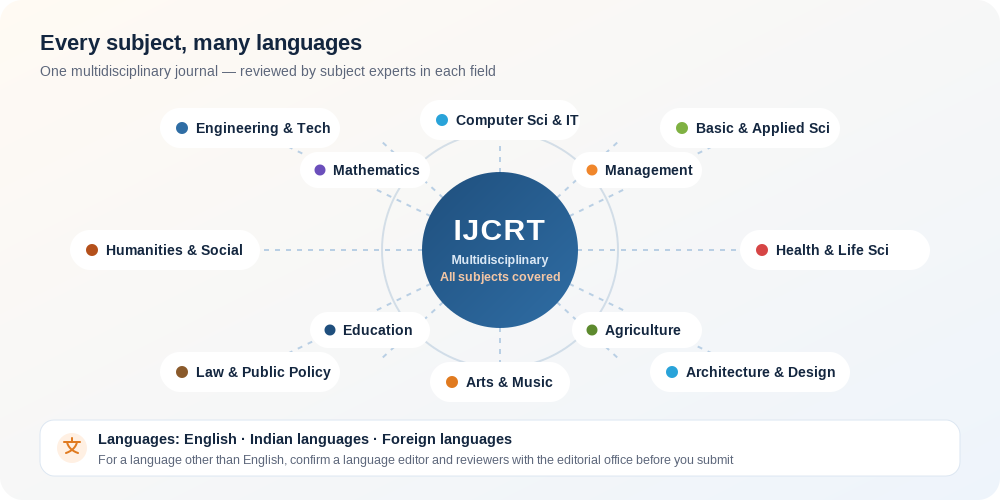
| Coverage | Multidisciplinary — all subjects covered, across every major academic and professional discipline |
|---|---|
| Accepted work | Original research, reviews, short communications, case studies, technical notes |
| Review model | Transparent, double-blind peer review by subject experts — see how every paper is reviewed |
| Language | Multilingual — English, all Indian (local) languages and foreign languages. For a language other than English, confirm with the editorial office before submission that a language editor and reviewers are available, and send the font details and font file — see Publishing in Your Language |
| Frequency | Monthly, with rolling submission |
Engineering and Technology
Civil, structural and geotechnical engineering; mechanical, thermal and production engineering; electrical and electronics engineering; power systems and renewable energy; electronics and communication; instrumentation and control; automobile and aerospace engineering; chemical and petrochemical engineering; materials science; industrial engineering; robotics, mechatronics and automation; manufacturing processes and quality engineering.
Engineering submissions should state the design problem, the constraints, the method of analysis or testing, and how results were validated. Simulation work should name the tool and its version, state the assumptions and boundary conditions, and explain why the model is adequate for the claim being made.
Computer Science and Information Technology
Algorithms and data structures; software engineering and architecture; artificial intelligence and machine learning; data science and analytics; computer networks and distributed systems; cloud and edge computing; cybersecurity and cryptography; databases and information retrieval; computer vision and image processing; natural language processing; human–computer interaction; Internet of Things and embedded systems; blockchain and distributed ledgers.
Computing submissions should describe the dataset or benchmark used, the baselines compared against, the evaluation metrics and the hardware or environment. Claims of improvement should be supported by results that another researcher could reproduce from the description given.
Basic and Applied Sciences
Physics, including condensed matter, optics, nuclear and applied physics; chemistry, including organic, inorganic, physical, analytical and green chemistry; biology, botany, zoology, microbiology, biochemistry and biotechnology; earth sciences, geology and geophysics; nanoscience and nanotechnology; astronomy and space science.
Experimental work should report materials, instruments, procedures, controls and the treatment of uncertainty in enough detail for the experiment to be repeated.
Mathematics and Statistics
Pure and applied mathematics; algebra, analysis, topology and geometry; differential equations and numerical methods; operations research and optimisation; graph theory and combinatorics; probability, statistical inference and stochastic processes; applied statistics and biostatistics; mathematical modelling of physical, biological and economic systems.
Theoretical contributions should state assumptions and give complete proofs. Applied statistical work should identify the population, sampling method, sample size and the tests used, and should distinguish statistical significance from practical importance.
Management and Commerce
General and strategic management; finance, banking and insurance; accounting and auditing; marketing and consumer behaviour; human resource management and organisational behaviour; operations and supply chain management; entrepreneurship and small business; international business and trade; tourism and hospitality management; business analytics; corporate governance and sustainability reporting.
Empirical management research should describe the sampling frame, the instrument, response rates and how reliability and validity were assessed. Case studies should explain what makes the case instructive to readers working elsewhere.
Education
Curriculum design and development; pedagogy and instructional methods; educational technology and e-learning; assessment and evaluation; teacher education and professional development; higher education policy and administration; inclusive and special education; early childhood education; vocational and technical education; educational psychology; distance and open learning.
Classroom interventions should describe the participants, the duration, the comparison condition where one exists, and the measures used, so that a reader can judge whether the finding would transfer to their own setting.
Health and Life Sciences
Public health and epidemiology; nursing and allied health; pharmacy and pharmaceutical sciences; physiotherapy and rehabilitation; nutrition and dietetics; health systems, policy and management; medical education; health informatics; traditional and complementary medicine.
Agriculture and Environment
Agronomy, horticulture and crop science; soil science and plant nutrition; plant pathology and entomology; animal husbandry, veterinary and dairy science; food science and post-harvest technology; agricultural engineering and precision farming; agricultural economics and extension; forestry; environmental science and pollution control; water resources; climate change, sustainability and renewable energy; disaster management.
Field trials should report location, season, design, replication and the statistical analysis applied, since agronomic results depend heavily on the conditions under which they were obtained.
Law and Public Policy
Constitutional and administrative law; criminal law and criminology; corporate and commercial law; intellectual property; international and human rights law; environmental law; labour law; cyber law and data protection; public administration, governance and policy analysis.
Doctrinal work should cite primary sources precisely and identify the jurisdiction and the date to which the analysis is current, since statute and case law change.
Architecture, Planning and Design
Architecture and urban design; town and regional planning; landscape architecture; interior design; product and industrial design; construction management; sustainable and green building; heritage conservation and restoration.
Design submissions should state the brief, the site or user context, the design method and how the outcome was evaluated — through post-occupancy study, simulation, user testing or expert review.
Arts, Music and Performing Arts
Fine and visual arts; music and musicology; dance, theatre and film studies; art history and criticism; photography, animation and digital media arts; folk and craft traditions.
Practice-based research should explain the question the work investigates, the method of making or performing, and how the outcome contributes knowledge beyond the work itself.
Physical Education, Sports and Yoga
Physical education and pedagogy; sports science and coaching; exercise physiology and biomechanics; sports psychology and sports management; yoga, wellness and health promotion.
Intervention studies should report participants, training protocols, duration, measurement instruments and any ethics approval, so that results can be compared across settings.
Home Science, Fashion and Textiles
Home science and family resource management; food science and nutrition; human development and family studies; fashion design and technology; textile science, apparel and merchandising.
Applied studies should describe samples, materials and test standards precisely, and explain how findings carry over to households, industry or policy.
Interdisciplinary Work
Work that crosses the boundaries above is explicitly welcome — computational social science, engineering education, health economics, environmental policy, digital humanities, bioinformatics, and similar combinations.
Interdisciplinary manuscripts carry an extra burden: they must be readable by reviewers from each contributing field. State the research question in terms both audiences recognise, define discipline-specific terminology on first use, and make clear what the contribution is to each field rather than assuming the reader shares your framing.
More Subjects Covered
IJCRT is multidisciplinary — all subjects are covered. Beyond the areas above, manuscripts in these fields are equally welcome:
- Pharmacy and pharmaceutical technology
- Dentistry and oral health
- Ayurveda, Homeopathy, Unani and Siddha
- Paramedical and medical laboratory technology
- Forensic science
- Biomedical engineering
- Textile engineering
- Mining and metallurgy
- Marine and ocean engineering
- Petroleum and energy engineering
- Environmental engineering
- Geoinformatics, remote sensing and GIS
- Quantum computing
- Generative AI and large language models
- AR, VR and immersive media
- Fintech and digital banking
- Digital marketing and e-commerce
- Logistics and aviation management
- Hotel, hospitality and event management
- Journalism and mass communication
- Library and information science
- Defence and strategic studies
- Social work and community development
- Rural development and cooperatives
- Women’s and gender studies
- Tribal and indigenous studies
- Religious and philosophical studies
- Sanskrit, Hindi and regional languages
- Indian knowledge systems
- Food and dairy technology
- Fisheries and aquaculture
- Sericulture and apiculture
- Veterinary and animal sciences
- Disaster and risk management
- Public administration and e-governance
- Psychology and counselling
- Commerce and taxation
- Insurance and actuarial studies
- Data journalism and digital humanities
- Sustainability and ESG reporting
The list keeps growing with the work authors send in. What matters is the quality of the question, method and evidence — not whether the exact topic appears here.
Publishing in Your Language
IJCRT is multilingual. Alongside English, it accepts papers in all Indian (local) languages and in foreign languages, so research can be published in the language in which it was done and in which its readers work.
A paper in a language other than English needs an editor who can handle that language and reviewers who can assess it. That is why one short step comes before submission: confirm with the editorial office that a language editor and reviewers are available for your language, and send the font you used so the paper can be typeset and displayed correctly.
Indian languages, for example
- Hindi
- Gujarati
- Marathi
- Bengali
- Tamil
- Telugu
- Kannada
- Malayalam
- Punjabi
- Odia
- Urdu
- Assamese
- Sanskrit
- Konkani
- Maithili
- Nepali
- Sindhi
- Kashmiri
- Dogri
- Manipuri
- Bodo
- Santali
- and other local languages
Foreign languages, for example
- French
- Spanish
- German
- Arabic
- Portuguese
- Russian
- Chinese
- Japanese
- and others
Before you submit in a language other than English
- Contact the editorial officeEmail [email protected] or WhatsApp with your title, subject and language
- Wait for confirmationThe office confirms that a language editor and reviewers are available for your language
- Send font details & fileThe font name and version, whether it is Unicode, and the font file (.ttf or .otf)
- Submit your paperQuote the confirmation when you submit, so the paper goes to the right editor
Confirm your language first
Tell the editorial office the language of your paper, its subject and title. Attach the font file and its details (font name, version, Unicode or legacy encoding). Submit once the office has confirmed that a language editor and reviewers are available.
How Every Paper Is Reviewed
Whatever the subject and whatever the language, every research paper goes through transparent, double-blind peer review by experts in that field.
Double-blind
Reviewers do not see who wrote the paper, and authors do not see who reviewed it.
- Similarity checked first (below 15%)
- Reviewed by subject experts
- Decision sent by email & SMS
Transparent
The review is recorded, so anyone can check that it really took place.
- Review record on Scholar9
- Public reviewer list
- Formal report on request
Reviewers are chosen for the method a paper uses as well as its topic, which is why choosing the right subject area (below) matters. The full workflow is on the Peer Review Process page.
Article Types
Five kinds of paper are accepted in every subject. Each card shows what the paper reports and, underneath, what reviewers look for in it.
Out of Scope
The following are declined at editorial screening, before peer review:
Choosing Your Subject Area
- Match the methodPick the area whose reviewers are best placed to judge your method, not merely your topic
- Name primary & secondaryFor interdisciplinary work, give the main area and mention the other in your covering note
- Choose real keywordsTerms readers in that area actually search — they drive reviewer choice and discoverability
- Unsure? Ask firstEmail the title and abstract to [email protected] before submitting
Subject Not Listed? Contact the Editor
Send your paper to the editor directly
If your subject is not named on this page, it is still very likely in scope. Email the manuscript, or just its title and abstract, to [email protected] and the editorial office will confirm the fit and the right reviewers. You can also message on WhatsApp, or submit online as usual.
- Include the title, abstract, keywords and your subject area in the email
- Attach the manuscript in Word or PDF if you want it considered straight away
- Mention any interdisciplinary angle so the right reviewers can be found
Frequently Asked Questions
Which subjects does IJCRT publish?
All subjects. IJCRT is multidisciplinary: engineering, computing, sciences, mathematics, management, humanities and social sciences, education, health, agriculture, law, architecture, arts, sports, home science and interdisciplinary work, plus the further fields listed on this page.
Can I submit a paper in Hindi, Gujarati or another Indian language?
Yes. IJCRT accepts papers in all Indian (local) languages. Before submission, confirm with the editorial office that a language editor and reviewers are available for your language, and send the font details and font file.
Can I submit in a foreign language other than English?
Yes. Foreign-language papers are accepted on the same basis: confirm language editor and reviewer availability with the editorial office first, then submit.
What font details should I send for a non-English paper?
The font name and version, whether it is a Unicode font or a legacy (non-Unicode) font, and the font file itself (.ttf or .otf), sent to [email protected] with your paper title.
How are papers reviewed?
By transparent, double-blind peer review: identities are hidden in both directions while the paper is reviewed by subject experts, and after publication the review is recorded on Scholar9, with a formal Transparent Peer Review Report available on request.
My subject is not listed. Can I still submit?
Very likely, yes. Email the title and abstract to [email protected] and the editorial office will confirm the fit and the right reviewers.
Ready to publish?
Publish With a Journal You Can Verify
Transparent, double-blind peer review, similarity screening, Crossref DOIs on request under 10.56975, open access under CC BY 4.0 and alignment with UGC’s Suggested Parameters — with a fee of ₹1501 (Indian authors) or $59 (foreign authors), charged only after acceptance.
Humanities and Social Sciences
Economics and development studies; sociology and anthropology; political science and international relations; psychology and behavioural science; history and archaeology; philosophy and ethics; literature, languages and linguistics; media, communication and cultural studies; geography and urban studies; library and information science; gender studies; social work.
Qualitative research should explain how participants or texts were selected, how data were collected and analysed, and how the researcher's own position may have shaped interpretation. Research involving human participants must record consent and any ethical approval obtained.