
Before You Submit
A manuscript submitted to IJCRT must be original, unpublished, and not under consideration at any other journal. Submitting the same work to two journals simultaneously wastes reviewers' time and is treated as a breach of publication ethics.
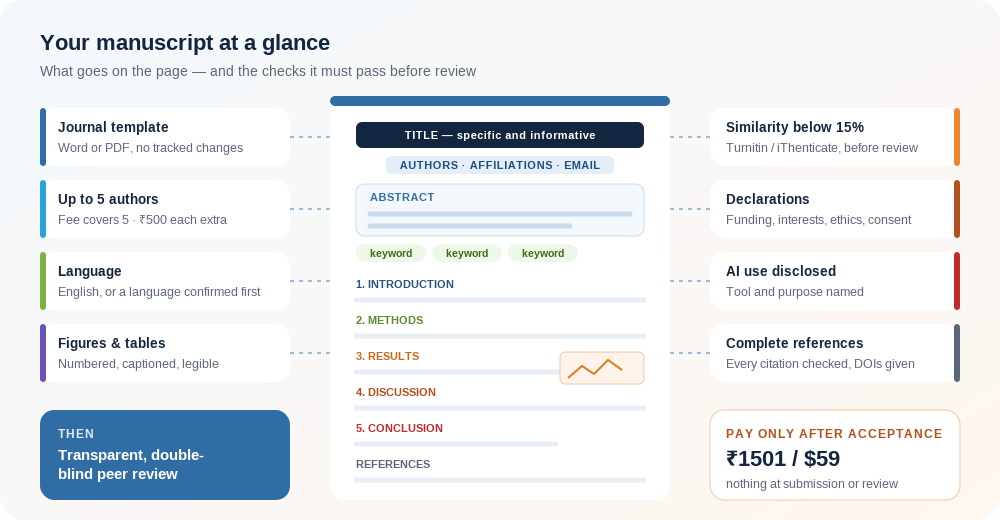
Six things to settle before you open the submission page:
The essentials at a glance
Manuscript Structure
- Title & abstract · ~6%
The paper in miniature - Introduction · ~10%
Problem, gap and aim - Literature · ~14%
What is known, fairly - Methods · ~20%
Enough to repeat it - Results · ~22%
Findings, presented once - Discussion · ~18%
Meaning and limits - Conclusion · ~5%
What was established - References · ~5%
Complete and checked
Typical proportions for an empirical paper — a guide, not a rule. Review articles and case studies are organised differently.
| Section | What it should contain |
|---|---|
| Title | Specific and informative; states the subject and, where possible, the finding. Avoid unexplained abbreviations. |
| Authors and affiliations | Full names, institutional affiliations, and the corresponding author's email. |
| Abstract | A self-contained summary of the question, approach, principal findings and implications. No citations or undefined abbreviations. |
| Keywords | Terms a reader would search for; they drive reviewer assignment and later discoverability. |
| Introduction | The problem, why it matters, what is already known, and the gap this work addresses. |
| Literature review | Engagement with existing work, including studies that disagree with your position. |
| Methodology | Enough detail for another researcher to repeat the work: design, materials, participants or data, procedure, analysis. |
| Results | The findings themselves, presented once — in text, a table or a figure, not all three. |
| Discussion | What the results mean, how they relate to prior work, and what limits their interpretation. |
| Conclusion | What was established, and what follows from it. No new results here. |
| References | Complete and consistent; every citation in the text appears here and vice versa. |
Review articles and case studies may depart from this structure where their material requires it, but must still make the method of selection and analysis explicit.
Formatting Requirements
Figures and Tables
Do
- Number figures and tables in the order they are first mentioned, and refer to each in the text
- Write captions that make sense without the surrounding text
- Label axes with quantities and units, readable at published size
- Credit the source of reproduced material and confirm permission
Avoid
- Low-resolution images — chart screenshots pasted from slides rarely stay legible
- Showing the same data in both a table and a figure
- Captions that only repeat the figure title
- Any undisclosed editing of what an image shows
References and Citations
Check every citation against the source it points to. Citing a paper from another paper's reference list, without reading it, is how errors propagate through a literature.
- Every in-text citation must appear in the reference list, and every reference must be cited in the text.
- Give complete details: authors, year, title, journal or publisher, volume, issue, pages, and the DOI where one exists.
- Prefer the published version of a work over a preprint where both exist.
- Cite the source of every idea, figure, dataset and quotation that is not your own.
- Do not pad the reference list with works you did not use, and do not add citations merely to inflate anyone's count.
Author, A. A., & Author, B. B. (Year). Title of the article. Journal Name, Volume(Issue), pages. https://doi.org/10.xxxxx/xxxxx
Authorship
Authorship belongs to those who made a substantial contribution to the work — its conception or design, the acquisition or analysis of data, or the drafting and revision of the manuscript — and who approve the version submitted and accept responsibility for it.
People who helped without meeting that bar — funding a project, providing materials, giving general supervision, proofreading — should be thanked in the acknowledgements rather than listed as authors. Adding an author who did not contribute (gift authorship), or omitting one who did (ghost authorship), are both misconduct.
The publication fee covers up to 5 authors per paper. Each additional author after the 5th is charged ₹500 — see Publication Charges.
Declarations
The manuscript must identify, where applicable:
Use of AI Tools
Disclose any use of generative AI tools in preparing the manuscript, stating which tool was used and for what — language editing, code generation, literature searching or otherwise.
AI tools cannot be listed as authors: they cannot take responsibility for the work or approve its submission. The authors remain fully accountable for everything in the manuscript, including the accuracy of any text, citation or analysis produced with such assistance. Fabricated references generated by a tool and left unchecked are the author's responsibility, not the tool's.
Similarity and Originality
Every manuscript is screened for similarity before it goes to review. Text reused from your own earlier publications counts too: self-plagiarism is still duplication of the published record.
Quote directly and cite the source where another author's exact words are needed. Paraphrase properly where they are not — changing a few words while keeping the sentence structure is not paraphrasing. The acceptable similarity threshold and the action taken when it is exceeded are set out in the Plagiarism Policy.
Originality
Plagiarism Detection: Turnitin & iThenticate
Every submission is screened for similarity before peer review, and the similarity report is available to the author on request. The accepted similarity threshold is below 15%.

Turnitin
Similarity check against published literature, web content and submitted work.

iThenticate
Turnitin’s service for publishers and researchers, with AI-writing detection available.
How to Submit
- PrepareUse the journal template and complete all declarations
- Check the fileIt opens correctly and has no tracked changes
- UploadThrough the submission portal at ijcrt.org
- Enter authors exactlyAs they should appear when published — this feeds the DOI metadata
- Keep the paper IDQuote it in every later message
Two Ways to Submit
Online portal or email — your choice
Upload through the online submission portal for an instant paper ID, or email the manuscript to [email protected] with the title, authors, affiliations and subject area. Download the journal template and forms first if you have not used them before.
Common Reasons a Paper Is Returned Before Review
Most returns happen at editorial screening and are avoidable. Check these six before you upload:
Out of scope
The topic falls outside the journal’s subject coverage, or no suitable reviewer exists. If unsure, ask the editor first.
Similarity above 15%
Reused text, including your own earlier work, that is not quoted and cited. Run a similarity check before submitting.
Missing declarations
Funding, competing interests, ethics approval, consent or data availability not stated.
Incomplete manuscript
No abstract or keywords, missing references, unreadable figures, or a file that does not open.
Published or under review elsewhere
Simultaneous submission or previously published work is declined at once.
No ethical approval
Research on human participants, patient data or animals without the committee and consent statements.
What Happens Next
- SubmitPaper ID issued
- ScreenScope & similarity
- ReviewDouble-blind
- DecideEmail & SMS
- RevisePoint by point
- AcceptCopyright & fee
- ProduceProofs; DOI on request
- PublishCurrent issue
| Stage | What happens |
|---|---|
| 1. Submission | Manuscript received, paper ID issued |
| 2. Screening | Scope, completeness, declarations and similarity checked |
| 3. Peer review | Transparent, double-blind review by subject experts |
| 4. Decision | Accept, revise or reject — notified by email and SMS |
| 5. Revision | Authors respond point by point and resubmit |
| 6. Acceptance | Undertaking signed online, copyright form, camera-ready copy and payment |
| 7. Production | Copy editing, proofing, DOI registration (on request) |
| 8. Publication | Article appears in the current issue |
How the review itself works
Double-blind
Reviewers do not see who wrote the paper, and authors do not see who reviewed it.
- Similarity checked first (below 15%)
- Reviewed by subject experts
- Decision sent by email & SMS
Transparent
The review is recorded, so anyone can check that it really took place.
- Review record on Scholar9
- Public reviewer list
- Formal report on request
The full process, stage by stage, is on the Peer Review Process page.
Responding to Reviewers
- Answer each commentIndividually, in a separate letter, in the reviewer’s order
- Say what & whereWhat you changed, with section and page numbers
- Disagree with evidenceReasoned disagreement is fine; ignoring a comment is not
- Highlight changesSo they can be found quickly in the revision
- Return on timeOr ask for an extension before the deadline
Reviewers volunteer their time. A courteous, substantive response letter gets a manuscript through a second round far faster than a defensive one.
Camera-Ready Copy and Proofs
After acceptance you will supply the camera-ready file, the signed copyright form and the publication charge. Check the proof carefully:
- Author names, order & affiliations
- Title & abstract
- Equations, symbols & special characters
- Figure & table numbers and captions
- Reference list
Author names and affiliations go into the permanent DOI metadata, and equations and special characters are the commonest casualties of file conversion — check those first.
Proof corrections are for errors, not for rewriting. Substantive changes to content at this stage may require the manuscript to return to review.
After Publication
Errors discovered after publication are handled through a correction, an expression of concern or a retraction as appropriate. The original record is annotated rather than deleted, so the scholarly record stays intact.
Final Checklist
- Original, unpublished, not under review elsewhere
- Prepared in the journal template, with abstract and keywords
- Author list, order and affiliations agreed by all contributors
- Every citation checked against its source; reference list complete
- Figures and tables numbered, captioned and legible
- Funding, competing interests, ethical approval, consent and data availability declared
- Any use of AI tools disclosed
- Similarity within the policy limit
- Tracked changes removed and the final file checked to open correctly
- All authors have approved the submitted version
- No more than 5 authors, or the extra-author charge understood
- English, or another language already confirmed with the editorial office
Author Questions
Which file format should I submit?
Word or PDF, prepared in the journal template, as the submission portal specifies. Remove tracked changes and comments before uploading.
How long should the abstract be, and how many keywords?
Most journals ask for 150–300 words and four to eight keywords. The submission portal states the current requirement, which takes precedence.
Which citation style should I use?
Any recognised style, applied consistently from the first citation to the last reference. Mixing styles is one of the commonest reasons for a return before review.
Is anything payable at submission?
No. The charge of ₹1501 (Indian authors) or $59 (foreign authors) is payable only after acceptance. Nothing is due at submission or during review.
What similarity percentage is accepted?
Below 15%. Every manuscript is screened with Turnitin / iThenticate before review; the similarity report is available to the author on request.
Can I send my paper to the editor by email?
Yes. Email the manuscript to [email protected] with the title, authors, affiliations and subject area. The online portal is quickest, because it issues the paper ID immediately.
Can I use AI tools to prepare my manuscript?
Only with disclosure — name the tool and what it was used for. AI tools cannot be authors, and you remain responsible for every sentence and citation.
When will I hear back after submitting?
Your paper is evaluated by expert reviewers, and acceptance or rejection notifications are sent via email and SMS. No fixed turnaround is promised, because review time depends on the reviewers and the revision needed.
How is my paper reviewed?
By transparent, double-blind peer review: identities are hidden in both directions while subject experts review the paper, and after publication the review is recorded on Scholar9, with a formal Transparent Peer Review Report available on request.
Can I write my paper in a language other than English?
Yes. IJCRT accepts papers in all Indian (local) languages and in foreign languages. Before submission, confirm with the editorial office that a language editor and reviewers are available, and send the font details and font file.
How many authors can a paper have?
The publication fee covers up to 5 authors. Each additional author after the 5th is charged ₹500.
Ready to publish?
Publish With a Journal You Can Verify
Transparent, double-blind peer review, similarity screening, Crossref DOIs on request under 10.56975, open access under CC BY 4.0 and alignment with UGC’s Suggested Parameters — with a fee of ₹1501 (Indian authors) or $59 (foreign authors), charged only after acceptance.