Design and Development of a Wheeled Automated Soil Testing Robot Using a Solar Panel and Soil Sensors
1. Introduction
Soil is an important natural resource that supports plant growth and agricultural production. Soil moisture and nutrient availability influence crop development and irrigation and fertilizer management. Soil testing helps farmers understand soil conditions and make informed decisions about agricultural practices.
Traditional soil testing commonly involves collecting soil samples and analyzing them using suitable laboratory procedures. Sensor-based measurement systems offer opportunities for obtaining soil-related information more conveniently [1, 2]. Recent research has investigated soil sensors, agricultural monitoring technologies, and robotic systems for soil sampling and analysis [2–5]. Sensor readings depend on sensor technology, calibration, soil conditions, and testing procedures [1, 3].
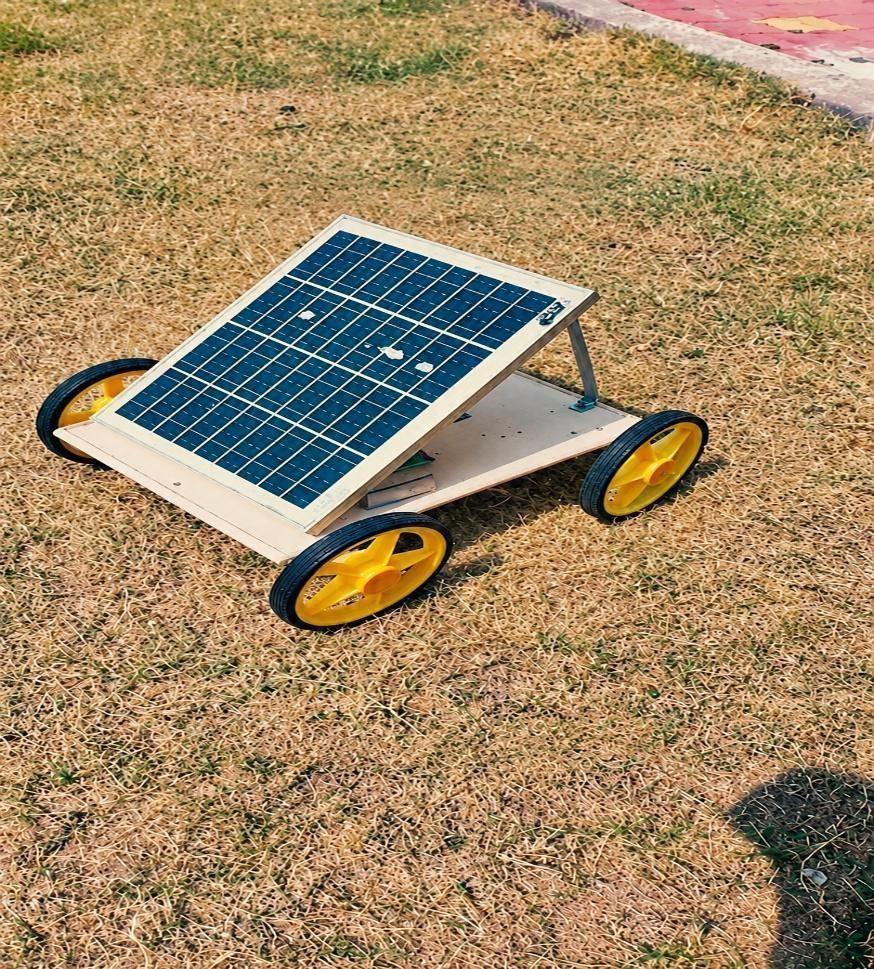
The present project focuses on a wheeled Automated Soil Testing Robot. The prototype has a four-wheel chassis and an inclined solar panel mounted above the platform. Soil moisture and NPK sensors are used for soil-related measurements. The project combines a mobile mechanical structure with sensor-based testing and provides a basis for further development and experimental evaluation.
1.1 Aim and Objectives
Aim: To develop and evaluate a wheeled Automated Soil Testing Robot capable of moving across the ground and obtaining soil moisture and NPK sensor readings.
- To develop a mechanical chassis suitable for a mobile soil-testing platform.
- To provide a four-wheel arrangement for robot movement.
- To mount a solar panel above the chassis using an inclined support structure.
- To integrate soil moisture and NPK sensing components.
- To obtain and record readings from the installed sensors.
- To evaluate the consistency of sensor readings through repeated measurements.
- To identify prototype limitations and areas for future improvement.
2. Literature Review
2.1 Soil Testing Sensors
Mudigiri and Mamatha [1] reviewed the application of soil-testing sensors in agriculture, providing background on sensor-based approaches for monitoring soil properties. Faqir et al. [2] reviewed advanced soil and plant sensors used in agriculture and discussed their role in monitoring agricultural and environmental parameters.
2.2 Soil Moisture and Nutrient Measurement
Stroobosscher et al. [3] investigated whether capacitance-based soil moisture probes could respond to nitrogen, phosphorus, and potassium applications through changes in volumetric ion content. Their work highlights the importance of distingui shing moisture measurements from validated nutrient measurements. In this project, the soil moisture sensor and NPK sensor are treated as separate components, and their readings require evaluation according to sensor specifications and reference measurements.
2.3 Mobile Soil-Testing Robots
Vasquez Chavez et al. [4] presented the Soil Sampling and Analysis Robot (S.S.A.R.), providing a relevant example of a mobile robotic approach to soil sampling and analysis. Xu et al. [5] surveyed wireless soil-sensing technologies and provide further background for soil monitoring systems.
2.4 Research Gap and Project Motivation
The reviewed studies demonstrate the importance of soil sensing and the potential application of mobile robots in agricultural monitoring [1–5]. These sources alone do not establish that the present prototype is unique or more effective than existing systems. This project focuses on developing and documenting a wheeled prototype that combines soil moisture and NPK sensing with an inclined solar panel mounting arrangement.
Comparative testing is needed to determine practical advantages and limitations.
3. System Design, Prototype Development and Working Methodology
3.1 System Description
The proposed system is a wheeled mobile platform intended for soil monitoring. Its main components are the mechanical chassis, four-wheel mobility system, solar panel, soil moisture sensor, NPK sensor, and electronic control/data collection system. The chassis supports the components; the wheels provide mobility; the solar panel is a potential energy source depending on the implemented electrical connections. The soil moisture sensor provides moisture-related readings, while the NPK sensor is intended to provide readings associated with nitrogen, phosphorus, and potassium. The controller, wiring, display, communication method, and software should be documented according to the actual hardware used.
3.2 Mechanical Design and Prototype Development
The developed prototype consists of a flat platform-type chassis supported by four wheels. An inclined support frame holds the solar panel above the chassis. This arrangement provides space beneath the panel for mounting electronic and sensing components. Actual dimensions, materials, total mass, wheel diameter, panel rating, and chassis load capacity should be added from project measurements.
3.3 Working Principle
- Move the robot to the selected testing location.
- Check the mechanical structure and sensor connections.
- Position or insert the sensors according to their operating instructions.
- Obtain soil moisture and NPK readings.
- Record the readings with sample identification and test conditions.
- Repeat measurements to assess consistency.
- Compare readings with suitable reference measurements, where available.
3.4 Experimental Methodology
The project team reports that the robot moves and soil readings have been tested. Numerical readings, the number of trials, and reference laboratory results have not been supplied for this paper. Therefore, the methodology below describes how the experimental work should be documented and evaluated.
3.4.1 Preliminary Inspection
Inspect the chassis, wheels, panel mounting, sensor installation, and electrical connections. Confirm safe movement under the intended testing conditions.
3.4.2 Soil Sample Selection
Select the soil sample or testing location and assign it a unique identification number. Record relevant conditions, including sample location, soil condition, and testing date.
3.4.3 Sensor Measurements
Use the soil moisture and NPK sensors according to their operating instructions. Record readings exactly as displayed or transmitted. Do not assign units or convert values unless supported by sensor documentation.
3.4.4 Repeatability Testing
Take repeated readings from the same sample under similar conditions and compare them to identify variation.
3.4.5 Reference Comparison
Where possible, compare sensor readings with an appropriate reference method. Use a suitable calibrated method for moisture and an appropriate laboratory method or validated instrument for NPK.
3.4.6 Performance Assessment
Evaluate mobility, successful sensor operation, consistency of repeated readings, agreement with reference measurements, and power-system performance.
4. Results and Discussion
4.1 Prototype Development
The prototype has a four-wheel mechanical platform and an inclined solar panel mounting structure, as shown in Figure 1. The project team reports that the robot moves and soil readings have been tested. These observations document progress in prototype development and initial operation.
4.2 Soil Sensor Readings
The numerical values, units, sample characteristics, number of measurements, and reference results have not been supplied. Consequently, the magnitude and reliability of the measurements cannot yet be assessed quantitatively.
Table 1. Experimental soil sensor readings.
4.3 Discussion
The prototype combines mobility with soil sensing in one platform. The four-wheel structure provides a means of moving the system between testing locations, while the sensors are intended to obtain soil - related measurements. Practical value depends on measurement consistency, sensor suitability, and the reliability of mechanical and electrical components. Reference measurements are necessary to establish whether readings are reliable for agricultural decision-making. No numerical improvement, accuracy, or reduction in testing time is claimed without supporting data.
5. Conclusion, Limitations and Future Scope
5.1 Conclusion
This paper presents the design and development of a wheeled Automated Soil Testing Robot incorporating a four-wheel mechanical platform, an inclined solar panel mounting arrangement, a soil moisture sensor, and an NPK sensor. The project team reports that the prototype can move and that soil readings have been tested.
The mechanical structure provides a foundation for combining mobility and soil sensing in an agricultural application. Quantitative conclusions about sensor accur acy, repeatability, solar-power performance, and suitability for agricultural recommendations require documented experimental results and reference comparisons.
5.2 Limitations
- The soil moisture and NPK sensors require calibration using suitable procedures.
- Sensor readings need comparison with suitable reference methods.
- Multiple trials are required to evaluate measurement consistency.
- Sample IDs, readings, units, and testing conditions should be recorded systematically.
- Prototype dimensions, mass, mobility, and stability need to be measured.
- The solar panel's actual electrical contribution needs to be verified.
- The controller, software, wiring, and data-display method should be documented according to the hardware actually used.
5.3 Future Scope
- Evaluate the robot under different soil and ground conditions.
- Compare the prototype with existing approaches before making claims about cost, speed, or performance.
- Conduct calibration, repeated measurements, systematic data recording, and validation under different soil conditions.
References
- C. Mudigiri and B. Mamatha, “Application of Soil Testing Sensors in Agriculture: A Review,” Journal of Experimental Agriculture International, vol. 46, no. 7, pp. 667–678, 2024. DOI: https://doi.org/10.9734/jeai/2024/v46i72620
- Y. Faqir, A. Qayoom, E. Erasmus, M. Schutte-Smith, and H. G. Visser, “A Review on the Application of Advanced Soil and Plant Sensors in the Agriculture Sector,” Computers and Electronics in Agriculture, vol. 226, article 109385, 2024. DOI: https://doi.org/10.1016/j.compag.2024.109385
- Z. J. Stroobosscher, A. Athelly, and S. M. Guzmán, “Assessing Capacitance Soil Moisture Sensor Probes’ Ability to Sense Nitrogen, Phosphorus, and Potassium Using Volumetric Ion Content,” Frontiers in Agronomy, vol. 6, article 1346946, 2024. DOI: https://doi.org/10.3389/fagro.2024.1346946
- C. M. Vasquez Chavez, D. A. Garcia, and C. E. Ovalle, “Soil Sampling and Analysis Robot S.S.A.R.,” Proceedings of the LACCEI International Multi -Conference for Engineering, Education, and Technology, 2024. DOI: https://doi.org/10.18687/LACCEI2024.1.1.1984
- Y. Xu et al., “A Survey of Wireless Soil Sensing Technologies,” IEEE Access, vol. 12, pp. 12010–12038, 2024. DOI: https://doi.org/10.1109/ACCESS.2024.3352006