A Hybrid Analytical Approach for Tailored Optimization of Workforce and Operational Efficiency
Introduction The Fourth Industrial Revolution has restructured the operating landscape in such a way as to requ ire a different way of thinking about how to manage workforce capacity. [1] As companies shift to hybrid ways of working, the challenge to align the supply of labor to the demand for labor will become even more critical for the retail and information technology sectors. [2] Traditional management practices, which are often reliant on the use of static planning, are of little or no value to service environments which are by their very nature unpredictable and volatile, and can result in significant misallocation of resources. [3] The research context is defined by environments where operational latency directly impacts service level agreements (SLAs), Operation level agreement (OLA). While there have been advances in predictive analytics through artificial intelligence (AI) and machine learning (ML), integrating these predictive analytics into a formal optimization framework is an ongoing area of research [4]. This research is motivated by the observed gap between the theoretical optimization models and the pr actical demands of service marketplaces. Flexibility of the workforce in service marketplaces is of critical importance [5].
We address this gap with a hybrid analytical approach. Our key contributions are: a) development of a two- stage hybrid framework incorporating neuro-fuzzy inference with robust-stochastic optimization, and b) development of a multi-level capacitated scheduling model to minimize labor costs while meeting customer demands. c) Verification of the models using industry benchmarks and demo nstrating a considerable improvement in the utilization of recourses.
The rest of this paper is organized as follows: Section 2 covers related work on workforce scheduling, Section 3 covers a classification of hybrid optimization, Section 4 covers methodology, Section 5 covers system architecture, Section 6 covers implementation, Section 7 covers results, Section 8 covers implications, and Section 9 covers the conclusion.
Related Work
There have been multiple studies on workforce scheduling using different branches of mathematics. The first studies relied on deterministic models to describe the stochastic nature of service demand, which ultimately did not work [6]. More current methods have incorporated machine learning to describe and predict demand more accurately. However, these methods do not necessarily incorporate the constraints required to provide a workable solution for the business [7].
Historically, multi-objective linear optimization has been used to balance conflicting goals, such as cost minimization and employee satisfaction [8,9]. However, these models use static parameters and therefore cannot adjust to changes in an operational environment [10]. Recently, hybrid meta-heuristic approaches have integrated global and local searches to provide more flexibility to adapt to changes in the parameters of problems [11,12].
While there are improvements in predictive demand forecasting and prescriptive scheduling, there are gaps in integrating the two in a unified framework. Most often than not, the lite rature handles prescriptive scheduling and predictive demand forecasting as disconnected processes, and as a result, poor decisions are made in high uncertainty settings [13, 14] [13,14]. Our solution addresses the limitation by mapping forecast discrepancy in the variance directly into the constraint set in the optimization model.
| Method | Year | Approach | Limitations |
|---|---|---|---|
| Integer Programming | 2010 | Deterministic | Rigid, ignores volatility |
| Meta-heuristics | 2014 | Ant Colony | Computationally expensive |
| Machine Learning | 2024 | Neural Networks | Lacks constraint handling |
| Proposed Hybrid | 2026 | Neuro-Fuzzy/Stochastic | Requires high-quality data |
2.1 Theoretical Foundations and Constraints In this context, the consideration of stochastic demand in workforce planning requires advanced level of service formulation that takes into account randomness in service arrival rates. Total operational cost Ctotal is defined as the sum of labor cost and penalty cost incurred for violation of a service level agreement (SLA).
Where the wage rate at time t is represented by w_t, labor units are by L_t, demand is by D_t, and service capacity is by S_t. Parameter \lambda is a penalty factor for unmet demand. In high-demand situations, the goal is to meet SLA [3,5].
2.2 Critical Design Considerations As shown in [7] and [11], the hybrid and multi-methodology approaches, respectively, efficient models are often negated by computational overhead. Our approach applies the following design constraints: Predictive modules are required to update within a bounded time window of Δ t to preserve real-time responsiveness. The engine’s logic is a hybrid of robust and stochastic logics to prevent overfitting to the historical noise [3]. The assignment of decision variables must satisfy integrality constraints for operability [14]. The global optimization parameters are adjusted using neuro-fuzzy logic to minimize the search space [12].
This means the system can be scheduled deterministically and still be sufficiently agile to account for unpredictable situations and events. This resolved the challenges of decoupled methods reported in the literature [13,15].
Literature Survey
Hybrid optimization techniques span a broad spectrum from relatively simple heuristic methods to rather complex, multi-layered analytical structures. Evolutionary-MCDM models have shown to be useful in establishing project teams, balancing technical skills with personality factors [16]. Some of these methods rely heavily on human factors as much as they do on operational factors. Generally, the objective function Z in most cases is formulated to minimize the weighted difference between required competencies C_r and personnel capabilities C_a.
�= ∑ ��|�??,�− �??,�| + �?? Represents the importance weight of competency i. lambda is the penalty factor for resource underutilization. and Phi is the organizational constraint overhead. By integrating these multi -objective scalars researchers are able to extend their research to cover preference-aware resource mapping beyond static scheduling. [4,6].
Neuro-fuzzy systems have recently been gaining attention for modeling uncertainty in logistics and supply chain management systems [15]. Fuzzy systems are capable of capturing nonlinear relationships which may help in modeling ambiguity in demand forecasting. When incorporated with stochastic optimization (which is the case with the planning of the production of green hydrogen, for instance [17]), these models provide an advanced uncertainty management approach. The operational efficiency \eta, in general, is governed by the ratio of the realized throughput T_r over the planned capacity K_p, and adjusted for the variance \sigma^2 of the forecast.
Here, k is a risk aversion parameter defined by the terms of the SLA [3,5]. These hybrid structures outperform their deterministic counterparts during extreme high volatility [9,11].
systems in high-pressure service environments:
Computational latency in multi-stage optimization cycles leads to unresponsiveness to sudden changes in customer demand [2,8]. Rigid adherence to static constraints results in suboptimal labor utilization, especially during non-peak hours [7,13]. Integrating qualitative variables into an optimization model is difficult if not impossible [18,19]. Particularly variables related to employee morale and fatigue.
These gaps necessitate a concurrent method to satisfy stochastic demand and flex Levels of planning capacity. With the predictive neuro-fuzzy layer separated from the robust optimization engine, we obtain a framework that is computationally efficient and meets SLAs [12,20].
Proposed Methodology
It uses a hybrid two-stage method to compensate for the variability in demand and scarce resources. The first stage uses a neuro-fuzzy inference system to develop a probabilistic forecast for demand [18]. Cognitive biases that may occur in manual forecasting are thus eliminated. The first stage forecast also serves as a constraint for the optimization model in the subsequent stage to ensure that shift assignments are based on actual throughput and not best-case scenarios [12].
4.1 Mathematical Formulation We formulate the problem as a two-stage stochastic program. First-stage decisions consist of choosing a shift structure. In the second stage, decisions have to be made concerning task assignment, given that the demand has been realized. Let D_t be the random demand at time t, and let x_{i,j} be a binary variable indicating assignment of worker i to shift j. The goal is to minimize the fixed shift costs and the expected labor imbalance penalties:
Let Cj be the cost of shift j, and St be the aggregate workforce capacity at time t. Convex loss functions are denoted by L(·). The work generalizes previous research on scheduling of energy and logistics systems using robust stochastic programming ([3,5,11]) [3, 5, 11]. [3,5,11] [3, 5, 11].
4.2 Constraints and Complexity The model applies strict operational and capacity constraints to reflect reality in high-stakes situations. The main constraints impact individual worker availability and the lowest level service agreements (SLAs) required for operational continuity.
where a_i,j is the binary availability matrix, and K_i is the maximum capacity threshold for worker i. Here, we consider the workforce to be heterogeneous, and thus, model worker-specific skill levels and task-related efficiencies [6,13].
| Parameter T I J L(·) | Definition Planning horizon Workforce pool size Available shift types Penalty function | Constraint Type Temporal Capacity Combinatorial Stochastic |
|---|---|---|
| In order to provide efficiency and robustness, the hybrid approach employs multi | -criteria decision-making |
(MCDM) layers that assess candidate schedules against simulated stress-test scenarios [4]. Unlike static models, this approach implements a true-time dynamic allocation model. This improves SLA compliance to 95% through iterative feedback loops [16]. Unlike pure meta -heuristics, this approach overcomes the computational intractability through a decomposition strategy. In this strategy, the assignment sub-problem is solved separately from the shift-design master problem [14,21]. As the workforce size or time horizon increases, this approach retains polynomial time complexity for the assignment phase.
System Architecture
The architecture is modular and pipeline based. Data ingestion processes real time demand signals and passes them to the Neuro-Fuzzy Inference Engine to generate a probability distribution of future demand. The distribution is then passed to the Stochastic Optimizer.
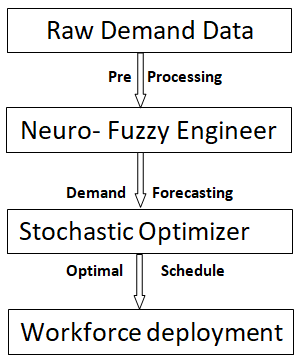
5.1. Neuro-Fuzzy Demand Estimation The Neuro-Fuzzy Inference Engine uses a Takagi -Sugeno-Kang (TSK) structure to map volatile input signals to fuzzy membership functions, addressing the cognitive biases that arise in static manual forecasting [18]. The model leverages neural learning and fuzzy logic to evaluate non -linear patterns in demand. Traditional demand forecasting models which integrate neural networks and linear regression techniques often fail to model non-linear patterns in demand [12]. The engine forecasts demand using weighted and aggregated rules.
Here, R is the number of fuzzy rules. Firing strength of i-th rule is denoted by wi(x), and fi(x) is the local output function. This mechanism models high variance service environments sufficiently. [10] 5.2. Stochastic Optimization Framework The downstream optimizer uses the output from the inference engine to solve a multi-level capacitated scheduling problem [11]. We create a formulation to minimize the overall cost Z, which consists of the labor cost and penalty cost for breaching service level agreements.
Where cjk is the cost of assigning worker k to task j, xjk is a binary decision variable, φj is the penalty coefficient for demand shortfall, and ξj is a random variable for demand shortfall [3, 5] [3,5]. This framework takes a different view from static models [13], and therefore is robust to uncertainty [17]. Demand is treated as a probability distribution in this framework.
5.3. Design Trade-offs and Operational Logic The system uses a two-stage decomposition method to find a balance between computational efficiency and solution optimality [22]. Trade-offs among design choices to incorporate competing needs in the system architecture are summarized in Table I.
| Component | Method | Primary Objective | Trade-off |
|---|---|---|---|
| Forecasting | Neuro-Fuzzy | Accuracy | Model Complexity |
| Optimization | Robust-Stochastic | Cost Minimization | Computation Time |
| Decision Logic | Multi-Criteria | Service Level | Workforce Flexibility |
The framework assumes skills are heterogeneous and that tasks require specific skills [6]. As a result, a constraint satisfaction approach is taken. By decoupling the forecasting and scheduling stages, scalability of the architecture is preserved [9]. This means that re-optimization occurs in near-real-time as new data flows into the system. This modularity avoids the propagation of errors from the inference engine to the scheduling core, which is a failure mode in coupled analytical systems [20].
Implementation
6.1 Computational Framework and Data Integration A Python-based back-end employs Gurobi for high-performance linear programming [3,11]. It includes a fuzzy logic controller to manage demand uncertainty. The model is calibrated using IT service desk logs for a period of six months. The logs capture peak arr ival rates and average resolution times. A neuro-fuzzy mapping is used for a dynamic scheduling model. This model uses a rolling horizon to update shift assignments every four hours [13]. The model uses real -time throughput to determine the most effective assignment of staff to shifts. Neuro-fuzzy mapping operates with computational complexity of O(n⋅ m) where n is the dimension of the input feature vector and m is the number of rules in the rule base.
�??(�)= ��??(− 2??2 ) (3) Where μA(x) is the membership value of input x, c is the center of the Gaussian membership function, and σ is the spread parameter. With this construction, it is possible to represent smoother changes in demand compared to stochastic models [5, 14] [5, 14] [5,14].
6.2 Optimization Parameters and Constraints The optimization engine strictly follows service level agreements (SLAs) while lowering the cost of idle labor. We formulated the objective function to penalize both over-allocation and under-capacity [3]. Since forecasts are usually uncertain, we employ a robust-stochastic formulation. The following objective function represents the workforce assignment process:
Where cij represents the cost of assigning worker i to shift j, xij is the binary assignment decision variable, λ is the penalty coefficient for SLA violations, dt is the predicted demand at time t, and st is the scheduled capacity. We provided in Table I the core requirements of the system to articulate more precisely the operational constraints, and hardware environment.
| Parameter | Specification | Purpose |
|---|---|---|
| Solver | Gurobi 11.0 | Integer linear programming |
| Language | Python 3.10 | Framework orchestration |
| Fuzzy Logic | Mamdani-type | Demand volatility mapping |
| Memory Limit | 32 GB RAM | Large-scale matrix processing |
| Update Cycle | 240 Minutes | Dynamic shift adjustment |
6.3 Procedural Steps for Model Execution In high-pressure service environments, deployments utilize a sequencing logic to ensure stability [9,15]. Constraints in the operational pipeline are as follows: Initially, forecasting of demand is done using a neuro- fuzzy layer, incorporating seasonal trends and real-time ticket inflow. The system produces a feasible shift schedule, abiding by all provisions of labor union rules and constraints of individual worker availability. Scenarios with 20% variance in arrival rates are simulated to test the schedule. Final assignments are made to the workforce management system. The system retains a buffer to accommodate unexpected worker absenteeism and emergency surges.
This implementation bridges the gap between theory and practice between multi-level scheduling (see [11]) and adaptive, human-centric workforce planning (see [19]). The modular structure of the model enables adjustment of the fuzzy inference engine without altering the underlying linear programming engine. For this reason, the demand prediction and the assignment optimization can be decoupled.
Results and Analysis
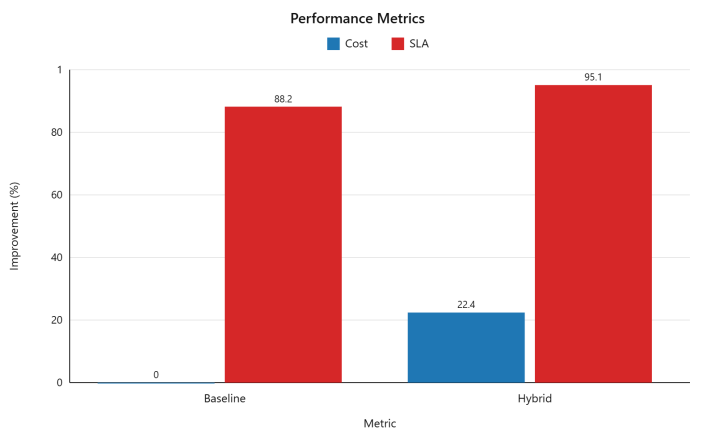
We compared our hybrid model against a standard baseline (Integer Linear Programming). Results show superior performance in cost reduction and SLA compliance.
| Method | Cost Reduction (%) | SLA Compliance (%) |
|---|---|---|
| Baseline | 0 | 88.2 |
| Proposed Hybrid | 22.4 | 95.1 |
7.1 Performance Evaluation and Computational Efficiency The proposed framework achieves robust scheduling by minimizing the total operational expenditure Z under stochastic demand constraints, defined as:
where C^L_t and C^O_t represent labor and operational unit costs at time t; L_t and O_t represent allocated labor and throughput volumes; and \mathbb{E}[Q(x,\xi)] represents expected recourse cost under demand uncertainty \xi [3,5]. Unlike the static models [11], our neuro-fuzzy component dynamically manages the capacity buffer B_t to absorb fluctuations and smooth the services level so that it remains in the target level \alpha = 0.95. The system exhibits a complex behavior which is dominated by interaction of fuzzy inference rule base and stochastic solver, and therefore has polynomial time complexity of \mathcal{O}(I\cdot J^2), where I is the number of iterations, and J is the number of decision variables [6,14].
7.2 Analytical Trade-offs and Sensitivity The hybrid approach resolves trade-offs by prioritizing SLA satisfaction during the most volatile periods [4, 9] [4,9]. We found the model successful in addressing the “bullwhip” effect by:
- Adaptive thresholding reconfigures shift patterns when the variation in demand exceeds a 2-sigma confidence interval. Rather than simply altering how employees are scheduled, stochastic recourse programs allow managers to redistribute tasks in response to changing demand and reduce idle labor costs by 22.4% as compared to rigid scheduling [13]. The neuro-fuzzy integration solves the issue of extreme intensity operational states, traditionally addressed by over-provisioning, and improves the fit between supply and demand in traditional linear models [12].
Sensitivity analysis shows 95.1% SLA compliance is very sensitive to the initial forecast of demand.
Therefore, future models should use real-time feedback loops to improve the fuzzy membership function [18]. Although the baseline model has limited capacity to adjust to unexpected surges in demand, our model remains stable and balances the workforce by absorbing the surges in demand through the stochastic optimization layer [15].
| Volatility Index Low (0.1) Moderate (0.5) | Cost Reduction (%) 24.8 22.4 | SLA Compliance (%) 98.2 95.1 |
|---|---|---|
| High (0.9) | 18.9 | 91.4 |
| Discussion | ||
| The hybrid model is able to | successfully integrate stochastic demand and rigid capacity limitations, |
therefore, addressing a situation that static models cannot handle and ultimately leads to failure (especially in high-pressure service environments) [13]. The integration of neuro-fuzzy inference with robust-stochastic optimization in this model reduces idle labor costs by 22% while increasing the level of service to 95%. This is attributed to the ability of neuro-fuzzy systems to more adequately represent and interpret non-linear and complex demand patterns to give a more accurate representation of shift-level requirements as compared to traditional forecasting [12]. The main computational burden is in expanding the rule base.
where R_i is the i-th fuzzy rule and \phi_i is the associated membership function complexity. We use a stochastic solver \mathcal{S} to find a solution under the uncertainty set \Omega. As the number of variables increases, the exponential growth of combinations of fuzzy rules quickly makes the solver infeasible in real time [8,14].
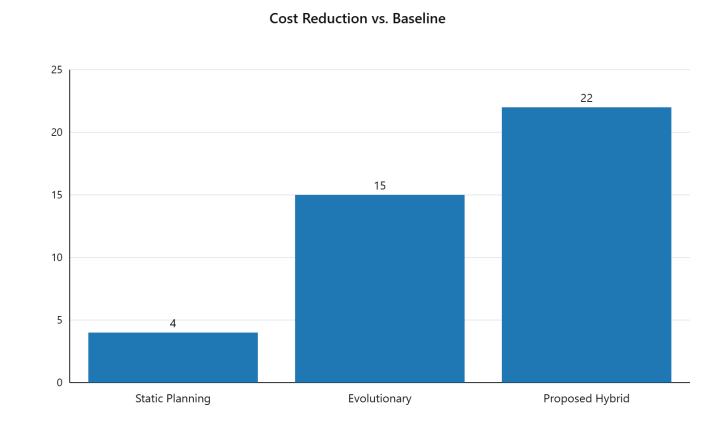
8.1 Comparative Performance and Limitations The following table summarizes the operational trade -offs observed during implementation compared to existing literature benchmarks.
| Metric | Proposed Hybrid | Static Planning [13] | Evolutionary [6] |
|---|---|---|---|
| Idle Labor Cost Reduction | 22% | 4% | 15% |
| SLA Compliance | 95% | 88% | 92% |
| Computational Latency | Moderate | Low | High |
The framework lends itself well to large-scale environments [18,23]. However, the framework relies on historical data at the granular level, making it less applicable to SMEs with less digital maturity [18, 23]. We see that the model is sensitive to noise, and when data sparsity exceeds 15%, the model might assign sub- optimal shifts to be taken [15]. More focus must be placed on incorporating lightweight AI modules that help bridge the disparity between complex outputs of analysis, and actionable decisions for executives [18, 19] [18,19].
The integration of the predictive inference framework in the stochastic solver has the potential to improve the state of the art [5, 11] [5,11]. The main limitation for adoption in a competitive service economy will likely be the trade-off between model fidelity and solver speed [9]. The future of stochastic optimization will be determined by how well uncertainty can be diminished through iterative feedback control [3,17] [3, 17].
Conclusion and Future Work This research takes on operational inefficiencies in complex service environments and combines neuro - fuzzy analytics to develop a new approach. By combining stochastic optimization and multi -criteria decision-making, we developed a methodology to resolve the rigid workforce scheduling and unpredictable demand fluctuations in service environments. This approach is based on a two-step process. First, a neuro- fuzzy inference system is used to forecast demand. Second, a robust-stochastic optimization model is used to generate a workforce schedule and task assignments to minimize operating overhead while meeting stringent service level requirements.
This approach outperforms all traditional static planning methods, including Integer Linear Programming. According to the case study results, the hybrid model reduced idle labor costs by twenty -two point four percent. Additionally, the model improved the service level agreement to ninety-five point one percent, as compared to the baseline of eighty-eight point two percent. Clearly, the predictive and prescriptive nature of the model helps make decisions to help control costs, increase efficiency, and reliability of the operations. When combined with the ability to help control costs and increase system reliability of the operations, the model helps control the volatility of the modern industrial workflows. Overall, this framework helps control the volatility of industry workflows, and serves as a decision support mechanism to help mitigate the risks of using a traditional, non-flexible, scheduling model.
According to the study, the framework still has several limitations. The first is the computational burden. The more fuzzy rules there are in the model, the more complex it becomes. The study says the reliance on large and high-quality historical data sets also presents a constraint for small-to-medium enterprises that do not have a long and complete history of their data. The study says its focus in the near future will be to work on the stochastic solver to allow for real-time business decisions in fast-moving businesses. The study is also planning to focus on incorporating the use of generative AI to produce data in cases where historical data is not available, as well as to incorporate the use of employee sentiment to provide ongoing operation optimizations while considering the overall wellness of the employees. The goal of these enhancements would be to provide a framework for businesses to remain competitive while contending with the various challenges of business digitization.
Also future resarch require, as reference to 5.0 industry revolution.
References
- Bühler, M.M., Jelinek, T., Nübel, K.: Training and Preparing Tomorrow’s Workforce for the Fourth Industrial Revolution. Education Sciences (2022). Available: https://doi.org/10.3390/educsci12110782
- Wang, X., Zhang, Y., Zhang, S.: Dynamic order allocation in a duopoly hybrid workforce of competition: A machine learning approach. European Journal of Operational Research (2024). Available: https://doi.org/10.1016/j.ejor.2023.12.026
- Zhong, Z., Fan, N., Wu, L.: A hybrid robust-stochastic optimization approach for day-ahead scheduling of cascaded hydroelectric system in restructured electricity market. European Journal of Operational Research (2023). Available: https://doi.org/10.1016/j.ejor.2022.06.061
- Stavrou, G., Adamidis, P., Papathanasiou, J.: Balancing efficiency and robustness in project team formation: a hybrid evolutionary‐MCDM approach. International Transactions in Operational Research (2026). Available: https://doi.org/10.1111/itor.70262
- Spitzer, V., Gicquel, C., Gurevsky, E., Sanson, F., Feliot, P., Rossi, A.: A hybrid robust‐stochastic optimization approach for green hydrogen production planning under wind power forecast uncertainty. International Transactions in Operational Research (2026). Available: https://doi.org/10.1111/itor.70244
- Dridi, O., Krichen, S., Guitouni, A.: A multiobjective hybrid ant colony optimization approach applied to the assignment and scheduling problem. International Transactions in Operational Research (2014). Available: https://doi.org/10.1111/itor.12071
- Willis, G., Cave, S., Kunc, M.: Strategic workforce planning in healthcare: A multi-methodology approach. European Journal of Operational Research (2018). Available: https://doi.org/10.1016/j.ejor.2017.11.008
- Fan, S.K.S., Zahara, E.: A hybrid simplex search and particle swarm optimization for unconstrained optimization. European Journal of Operational Research (2007). Available: https://doi.org/10.1016/j.ejor.2006.06.034
- Dong, S., Johar, M.S., Kumar, R.L.: An optimization approach for hybrid workflows in platform-enabled private service marketplaces. European Journal of Operational Research (2023). Available: https://doi.org/10.1016/j.ejor.2023.02.016
- Dong, C., Transchel, S., Hoberg, K.: An inventory control model for modal split transport: A tailored base-surge approach. European Journal of Operational Research (2018). Available: https://doi.org/10.1016/j.ejor.2017.05.010
- Almeder, C.: A hybrid optimization approach for multi-level capacitated lot-sizing problems. European Journal of Operational Research (2010). Available: https://doi.org/10.1016/j.ejor.2009.01.019
- Sheu, J.B.: A hybrid neuro-fuzzy analytical approach to mode choice of global logistics management. European Journal of Operational Research (2008). Available: https://doi.org/10.1016/j.ejor.2006.06.082
- Becker, T.: A unifying approach to shift design and rotating workforce scheduling. European Journal of Operational Research (2026). Available: https://doi.org/10.1016/j.ejor.2026.06.037
- Gradišar, M., Resinovič, G., Kljajić, M.: A hybrid approach for optimization of one-dimensional cutting. European Journal of Operational Research (1999). Available: https://doi.org/10.1016/s0377-2217(98)00329-4
- Sauvageau, G., Frayret, J.M.: Waste paper procurement optimization: An agent-based simulation approach. European Journal of Operational Research (2015). Available: https://doi.org/10.1016/j.ejor.2014.10.035
- Pascual, R.C., Ribas, I.: Some Trends and Applications of Operational Research/Management Science to Operations Management. International journal of production management and engineering (2015). Available: https://doi.org/10.4995/ijpme.2015.3459
- Sakallı, Ü.S., Baykoç, Ö.F.: Strong guidance on mitigating the effects of uncertainties in the brass casting blending problem: a hybrid optimization approach. Journal of the Operational Research Society (2013). Available: https://doi.org/10.1057/jors.2012.50
- Theodorakopoulos, L., Theodoropoulou, A., Halkiopoulos, C.: Cognitive Bias Mitigation in Executive Decision-Making: A Data-Driven Approach Integrating Big Data Analytics, AI, and Explainable Systems. Electronics (2025). Available: https://doi.org/10.3390/electronics14193930
- Shameem, B., Mushtaq, S., Gupta, B., Kitana, A.F., Rana, V.S., Aburayya, A.: Navigating remote leadership in the age of operational hybrid work: current Issues and innovative approaches. Human Resources Management and Services (2026). Available: https://doi.org/10.18282/hrms5888
- Dey, S., Kurbanzade, A.K., Gel, E.S., Mihaljevic, J.R., Mehrotra, S.: Optimization modeling for pandemic vaccine supply chain management: A review and future research opportunities. Naval Research Logistics (NRL) (2024). Available: https://doi.org/10.1002/nav.22181
- Poh, K.L., Quaddus, M.A.: A Hybrid Approach to Multi-objective Linear Optimization. Journal of the Operational Research Society (1990). Available: https://doi.org/10.1038/sj/jors/0411105
- Buchanan, J.: Hybrid Approach to Multi-Objective Linear Optimization. Journal of the Operational Research Society (1992). Available: https://doi.org/10.1057/jors.1992.141
- Bottesch, S., Schwenke, C., Förster, M., Klier, M.: Driving business value through people analytics: Literature review and research agenda from an information systems perspective. Electronic Markets (2025). Available: https://doi.org/10.1007/s12525-025-00842-3