CONVERSION AND DEVELOPMENT OF AN INTERNAL COMBUSTION ENGINE SCOOTER INTO A BATTERY ELECTRIC VEHICLE
I. INTRODUCTION
Electric vehicles are becoming an important alternative to conventional petrol and diesel vehicles because of increasing fuel costs, environmental pollution, and the need for energy-efficient transportation. An electric vehicle uses electrical energy stored in a battery to operate an electric motor, and the motor converts this electrical energy into mechanical energy that drives the wheels. The battery supplies electrical power to the motor through a motor controller or inverter, so the basic energy flow is Battery → Controller → Electric Motor → Transmission/Wheel → Vehicle Motion, as shown in Fig. 1. Electric vehicles offer high efficiency, low operating noise, reduced maintenance and reduced dependence on fossil fuels.
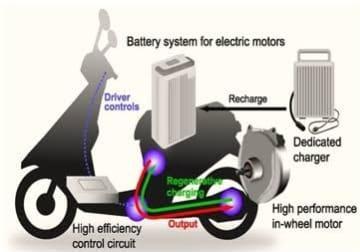
The conversion of an existing petrol-powered scooter into an electric vehicle is an effective approach because the existing chassis, wheels, suspension, steering system, braking system and other mechanical components can be reused. In this work a conventional Mahindra Flyte scooter is considered for conversion by replacing its internal combustion engine and associated fuel-system components with an electric motor, battery, motor controller and supporting electrical components. The selection of a suitable motor and controller is one of the most important aspects of such a conversion. The motor must have sufficient torque to start the vehicle, accelerate it, overcome road resistance and climb slopes, while the controller must supply the required voltage and current to the motor and provide smooth speed and torque control. A properly matched motor, controller and battery improves vehicle performance, efficiency, reliability and driving range.
1.1 Need for Converting a Petrol Scooter into an Electric Vehicle
Conventional petrol scooters use internal combustion engines that burn fuel to produce mechanical power. Although these vehicles are widely used, they produce exhaust emissions and require regular engine maintenance. Converting a petrol scooter into an electric vehicle reduces petrol consumption, local exhaust emissions, operating cost and noise, allows reuse of the existing vehicle chassis, improves energy efficiency, reduces engine maintenance and promotes electric mobility. It also provides a useful platform for EV research and education, and it can be applied to older vehicles whose mechanical structure is still in good condition.
1.2 Mahindra Flyte Scooter
The Mahindra Flyte is a scooter that was originally designed with an internal combustion engine. For an electric conversion, the existing chassis and mechanical structure can be utilized while the petrol engine, exhaust system, fuel tank and other components that are no longer required are removed or replaced according to the conversion design. The parts that can potentially be retained include the chassis or frame, wheels, tyres, suspension system, steering system, br aking system, body panels, seat and, where suitable, the instrumentation.
1.3 Aim and Objectives of the Study
The main aim of this study is to convert a conventional Mahindra Flyte petrol scooter into an efficient, reliable and environmentally friendly electric vehicle by selecting and integrating a suitable electric motor and motor controller. The study examines the power and performance requirements of the scooter and selects a motor on the basis of vehicle weight, required speed, acceleration, torque, load-carrying capacity, road resistance and operating conditions. A compatible controller is then selected to regulate the electrical power supplied from the battery to the motor, so that smooth acceleration, suitable speed, adequate starting and climbing torque, improved energy efficiency and reliable operation are achieved.
The objectives are to study the working principle of electric vehicles and the structure of the Mahindra Flyte scooter; to identify suitable electric motors and study different types of motor controllers; to select a suitable motor and a compatible controller according to vehicle requirements; to determine the required battery and electrical components and match the motor, controller and battery ratings; to develop a suitable conversion methodology and evaluate the expected performance of the converted vehicle; and to reduce fuel consumption and operating cost through an environmentally friendly transportation system.
1.4 Advantages, Limitations and Applications
The major advantages of electric conversion are reduced petrol consumption and operating cost, lower noise, reduced local emissions, high motor efficiency, low routine maintenance, instant torque, smooth acceleration, reuse of the existing scooter structure and reduced dependence on fossil fuels. Some limitations should also be considered. The initial conversion cost can be significant, battery weight increases vehicle mass, driving range depends on battery capacity, charging requires additional time, battery replacement can be expensive and additional electrical protection is required. The motor and controller must be correctly matched, mechanical and electrical integration can be challenging, improper installation can create safety risks, and vehicle performance depends on battery condition and load. The converted scooter can be used for daily commuting, college and campus transportation, short -distance travel, residential transportation, delivery services, industrial campus and factory transportation, tourist areas, and research and educational demonstrations.
II. LITERATURE REVIEW
N. Yadagiri et al. [1]
The authors studied the design and optimization of a front axle for an electric utility vehicle using CAD modelling and finite element analysis to find stress and deformation under diffe rent loads. Lightweight construction and material optimization reduced weight without significantly affecting strength. The study shows that CAD and finite element analysis are effective tools for developing efficient electric vehicle components, which is useful for checking the structural suitability of the Mahindra Flyte frame.
D. Vashist [2]
The author investigated a retrofit system for converting an internal-combustion two-wheeler into an electric vehicle, using rolling resistance, aerodynamic drag, vehicle mass and gradient resistance to find the required motor torque. Motor selection should consider the maximum torque for acceleration and hill climbing, not only rated power. This research gives a method for calculating the motor, controller and battery requirements of the Mahindra Flyte conversion.
M. Ramadhan et al. [3]
The authors converted a conventional motorcycle using a 3 kW BLDC hub motor, a 48 V, 15 Ah LiFePO4 battery and a BLDC controller. The vehicle achieved a range of about 30 km per charge and a maximum speed of about 56.7 km/h. The study shows that the motor, controller, battery and mechanical structure must be matched, and the same approach can be applied to the Mahindra Flyte.
S. Gamal et al. [4]
The authors developed an electric motorcycle conversion platform with a 3000 W BLDC motor, a 72 V, 40 Ah lithium-ion battery, a controller and a battery-management system, with overcurrent, overvoltage, short- circuit and thermal protection. The study shows that the battery, controller and motor must be treated as one integrated powertrain. This supports selecting a BLDC system with a suitably rated controller and battery for the Mahindra Flyte.
Vyshakh M. R. et al. [5]
The authors converted an internal-combustion motorcycle into a simple and cost-effective BLDC-powered electric motorcycle by replacing the engine and exhaust system with a motor, controller, battery pack and electrical components. The BLDC motor was chosen for its efficiency, and success depended on matching motor power, controller rating, battery capacity and transmission. The work follows the same basic concept as the Mahindra Flyte conversion.
E. Drummond et al. [6]
The authors developed an all-electric motorcycle covering the battery pack, battery-management system, controller and motor, and highlighted the difficulty of fitting an electric powertrain into a chassis designed for an engine. Battery packaging, accessibility, centre of gravity and frame space were considered. These findings are useful because the Mahindra Flyte frame must hold the motor, battery and controller without affecting balance and handling.
M. N. Yuniarto et al. [7]
The authors designed and tested a BLDC motor controller for an electric scooter using PID current control with six-step commutation on a dynamometer setup. The method reduced motor-current ripple and suited scooter applications. Controller selection should consider voltage rating, current capacity, commutation method and motor characteristics, which supports choosing a controller compatible with the BLDC motor of the Mahindra Flyte.
B. Pandey and D. Vashist [8]
The authors estimated the energy consumption of electric two-wheelers using a real-world driving cycle for Lucknow, India, and reported 14.89 Wh/km compared with 11.95 Wh/km for the WLTC. Standard cycles can therefore underestimate real consumption. This supports basing the motor and battery selection of the Mahindra Flyte on realistic operating conditions and estimating its range accordingly.
N. Kumaresan and A. Rammohan [9]
The authors built a MATLAB/Simulink model of an electric two-wheeler with the driving cycle, controller, motor, battery and vehicle, and validated it on a real -time target machine with less than 1% difference. Moderate mean speeds of about 18–35 km/h gave lower energy consumption and better range. The powertrain of the Mahindra Flyte should be designed for its expected speeds, with simulation before conversion.
A. Gurusamy and B. Ashok [10]
The authors developed an electric two-wheeler driving cycle for a Tier-2 Indian city, with a duration of 3271 s, a distance of 31.3 km, an average speed of 34.49 km/h and a maximum speed of 78 km/h. Standard cycles may not represent regional driving. An Indian urban cycle gives a more realistic basis for estimating the motor power and battery energy needed for the Mahindra Flyte.
B. S. Ammaiyappan [11]
The author developed a universal permanent-magnet motor controller for two- and three-wheelers, using a six- phase inverter with closed-loop speed and current control through PI and hysteresis controllers. Controller design strongly affects motor performance, and closed-loop control gives better regulation than open-loop control. The Mahindra Flyte controller must therefore handle the voltage, current and speed requirements of the selected motor.
M. Israr et al. [12]
The authors proposed an improved control framework for BLDC motors in battery-powered two- and three- wheelers, using modified field-oriented control with an optimized speed controller and a variable-frequency hysteresis current loop to reduce torque ripple. Controller performance directly affects acceleration smoothness, speed regulation and efficiency, which helps in choosing a controller for the Mahindra Flyte.
Huang [13]
The author designed a compact, lightweight and reliable permanent magnet synchronous motor controller for electric vehicles, covering component selection, protection circuits, board layout, control algorithms, structural strength and cooling, and tested a prototype. An EV controller must meet electrical, thermal and mechanical requirements, which guides the selection of a protected and suitably rated controller for the Mahindra Flyte.
S. S. Rauth and B. Samanta [14]
The authors compared induction, BLDC and permanent magnet synchronous motors for EV traction using field-oriented control with a neural-network controller in MATLAB/Simulink. BLDC motors suit applications needing compact size, good efficiency and suitable torque, while PMSM gives high power density and advanced control. The comparison helps decide between BLDC and PMSM for the Mahindra Flyte according to cost and control complexity.
S. Bharti et al. [15]
The authors studied a 1.2 kW six-phase permanent magnet synchronous motor in MATLAB/Simulink and compared a PI controller with a Takagi–Sugeno fuzzy controller. The fuzzy controller gave better overshoot, settling time and transient performance. The study shows that the control strategy matters as much as the motor, although a simpler controller may be preferred for a low-cost Mahindra Flyte conversion.
Z. Yang et al. [16]
The authors compared interior permanent magnet synchronous, induction and switched reluctance motors for EV and HEV use in terms of efficiency, torque–speed characteristics, control and noise and vibration. Each motor reaches its best efficiency in a different operating region, so a motor cannot be chosen on rated power alone. This supports comparing BLDC, PMSM and other options before selecting the Mahindra Flyte motor.
J. D. Widmer et al. [17]
The authors investigated EV traction motors that reduce or avoid rare-earth NdFeB magnets, considering ferrite, induction, wound-field synchronous and switched reluctance motors and comparing efficiency, torque density and cost. Motor selection depends on cost, material availability and sust ainability as well as performance. Although a small scooter may use a conventional BLDC or PMSM motor, this widens the factors considered in motor selection.
M. Kimiabeigi et al. [18]
The authors studied high-performance electric motors using ferrite magnets as a lower-cost alternative to rare- earth magnets, addressing their lower flux density and coercivity through motor design. Motor selection balances performance, cost, material availability and thermal behaviour, which matters in conversion projects with limited budget and space, even if the Mahindra Flyte uses a commercial BLDC motor.
S. Madichetty et al. [19]
The authors reviewed DC, induction, switched reluctance, brushless AC and brushless DC motors for EV propulsion and compared them on efficiency, weight, cost, reliability and power output. The review explains why BLDC and PMSM motors are common in electric two-wheelers and shows that no motor type suits every application, so the Mahindra Flyte motor must be chosen for its speed, torque, mass and space.
L. Kumar and S. Jain [20]
The authors reviewed electric propulsion systems and identified the energy-storage system, converter, motor, controller and power-flow control as components that must be integrated for good efficiency, range and cost. The battery voltage fixes the controller voltage rating and the motor current fixes its current capacity. This supports a system-level approach for the Mahindra Flyte, considering battery, motor, controller and transmission together.
III. ACKNOWLEDGMENT
The authors express their sincere gratitude to the Department of Mechanical Engineering for providing the facilities and support required to carry out this review work. We would like to thank our mentor, Mr. K. Dayakar for his continuous guidance, valuable feedback, and encouragement throughout the preparation of this manuscript. The authors also appreciate the contributions of faculty members and laboratory staff who assisted with resources and technical insights during the study.
REFERENCES
- Yadagiri, N. (2024). Design and Optimization of Front Axle in Electric Utility Vehicle. International Research Journal of Education and Technology.
- Vashist, D. (2019). Design Analysis of a Retrofit System for an Electric Two Wheeler. SAE Technical Paper 2019-28-2482. https://doi.org/10.4271/2019-28-2482
- Ramadhan, M., et al. (2024). Implementation of Conventional Motorcycle Conversion into Electric Motorcycle Using BLDC Motor and LiFePO4 Battery. MOTIVECTION: Journal of Mechanical, Electrical and Industrial Engineering, 6(3), 281–292. https://doi.org/10.46574/motivection.v6i3.339
- Gamal, S., et al. (2026). Design and Implementation of an IoT-Enabled Electric Motorcycle Conversion Platform with Integrated Rider Heart-Rate Monitoring and Safety Functions. Frontiers in Mechanical Engineering, 12, Article 1910304. https://doi.org/10.3389/fmech.2026.1910304
- V. M. R., et al. (2020). Conventional IC Engine to BLDC Powered Electric Motorcycle Conversion E Motorcycle. International Journal of Electrical Engineering and Technology, 11(2).
- Drummond, E., et al. (2019). Design and Construction of an Electric Motorcycle. In Proceedings of the 2019 Systems and Information Engineering Design Symposium (SIEDS). https://doi.org/10.1109/SIEDS.2019.8735634
- Yuniarto, M. N., et al. (2019). Design and Perform ance Analysis of Brushless Direct Current (BLDC) Motor Controller for Electric Scooter. IOP Conference Series: Materials Science and Engineering, 694(1), Article 012004. https://doi.org/10.1088/1757-899X/694/1/012004
- Pandey, B., & Vashist, D. (2024). Drive Cycle-Based Estimation of Energy Consumption for Electric Two-Wheeler. Energy Storage, 6, Article e70030. https://doi.org/10.1002/est2.70030
- Kumaresan, N., & Rammohan, A. (2024). Modeling and Performance Analysis of an Electric Two-Wheeler on Various Driving Cycles and Validation Using a Performance Real-Time Target Machine. Journal of Energy Storage, 101, Article 113935. https://doi.org/10.1016/j.est.2024.113935
- Gurusamy, A., & Ashok, B. (2024). Establishment of Electric Two-Wheeler Driving Cycle for Energy Economy and Life Cycle Assessment under Indian Tier-2 City Driving Environments. Sustainable Energy Technologies and Assessments, 66, Article 103826. https://doi.org/10.1016/j.seta.2024.103826
- Ammaiyappan, B. S. (2025). Design and Development of a Universal Permanent Magnet Motor Controller – Two Wheeler and Three Wheeler for Electric Vehicle Applications. Circuit World, 51(2), 58–75. https://doi.org/10.1108/CW-12-2023-0453
- Israr, M., et al. (2026). Improved Control Framework for BLDC Drives in Battery-Powered Electric Two and Three-Wheelers. AEU – International Journal of Electronics and Communications, 212, Article 156339. https://doi.org/10.1016/j.aeue.2026.156339
- Huang. (2023). Design and Research of Permanent Magnet Synchronous Motor Controller for Electric Vehicle. Energy Science & Engineering, 11(1), 112–126. https://doi.org/10.1002/ese3.1316
- Rauth, S. S., & Samanta, B. (2020). Comparative Analysis of IM/BLDC/PMSM Drives for Electric Vehicle Traction Applications Using ANN-Based FOC. In Proceedings of the 2020 IEEE 17th India Council International Conference (INDICON). https://doi.org/10.1109/INDICON49873.2020.9342237
- Bharti, S., Bhende, C. N., & Ray, O. (2022). Control of Six-Phase Permanent Magnet Synchronous Motor for Electric Vehicle Application. In Proceedings of the 2022 IEEE 2nd International Conference on Sustainable Energy and Future Electric Transportation (SeFeT). https://doi.org/10.1109/SeFeT55524.2022.9908704
- Yang, Z., et al. (2015). Comparative Study of Interior Permanent Magnet, Induction, and Switched Reluctance Motor Drives for EV and HEV Applications. IEEE Transactions on Transportation Electrification, 1(3), 245–254. https://doi.org/10.1109/TTE.2015.2470092
- Widmer, J. D., Martin, R., & Kimiabeigi, M. (2015). Electric Vehicle Traction Motors without Rare Earth Magnets. Sustainable Materials and Technologies, 3, 7–13. https://doi.org/10.1016/j.susmat.2015.02.001
- Kimiabeigi, M., et al. (2016). High-Performance Low-Cost Electric Motor for Electric Vehicles Using Ferrite Magnets. IEEE Transactions on Industrial Electronics, 63(1), 113 –122. https://doi.org/10.1109/TIE.2015.2472517
- Madichetty, S., Mishra, S., & Basu, M. (2021). New Trends in Electric Motors and Selection for Electric Vehicle Propulsion Systems. IET Electrical S ystems in Transportation, 11(3), 186 –199. https://doi.org/10.1049/els2.12018
- Kumar, L., & Jain, S. (2014). Electric Propulsion System for Electric Vehicular Technology: A Review. Renewable and Sustainable Energy Reviews, 29, 924–940. https://doi.org/10.1016/j.rser.2013.09.014