FORMULATION AND EVALUATION OF ALMOTRIPTAN ORAL FILM DELIVERY SYSTEM
1. Introduction
Conventional tablets and capsules may be difficult to administer to patients experiencing nausea, vomiting or swallowing difficulties during migraine attacks. Oral thin films are thin, flexible polymeric dosage forms that hydrate and disintegrate rapidly in the oral cavity and can be administered without water. They offer portability, ease of administration, accurate dosing and the possibility of improved patient compliance. Buccal delivery may also reduce exposure to gastrointestinal degradation and partially avoid hepatic first -pass metabolism. Almotriptan, a triptan used for acute migraine, was selected as a model drug for the development of a polymeric buccal film delivery system.
Migraine is a common and disabling neurological disorder characterized by recurrent attacks of moderate-to-severe headache, often accompanied by nausea, vomiting, and increased sensitivity to light and sound. The episodic nature of migraine and the rapid onset of symptoms necessitate drug- delivery systems that can provide prompt therapeutic action while improving patient convenience and compliance. Conventional oral dosage forms such as tablets and capsules ma y present limitations during acute migraine attacks because nausea and vomiting can interfere with swallowing and gastrointestinal drug absorption. Almotriptan is a selective serotonin 5-HT₁B/5- HT₁D receptor agonist belonging to the triptan class of antimigraine agents. It exerts its therapeutic effect primarily through constriction of dilated cranial blood vessels and inhibition of the release of vasoactive neuropeptides, thereby reducing migraine-associated pain and other symptoms.
Although conventional o ral almotriptan formulations are effective, the requirement for swallowing a solid dosage form may be inconvenient for patients experiencing nausea, vomiting, or difficulty swallowing during a migraine attack. Therefore, the development of an alternative o ral dosage form capable of rapid administration may provide potential advantages in terms of convenience and patient acceptability.
Oral films are thin, flexible polymeric dosage forms designed to rapidly disintegrate or dissolve when placed on the tongue or within the oral cavity. They offer several advantages over conventional solid dosage forms, including ease of administration without water, improved patient convenience, reduced risk of swallowing difficulties, and the potential for rapid drug release. Depending on the formulation and drug properties, oral films may facilitate drug dissolution in the oral cavity and can potentially provide a faster onset of action compared with conventional tablets. Their low dose requirement, large surface area, and abi lity to incorporate suitable film-forming polymers make them particularly attractive for drugs intended for acute therapy.
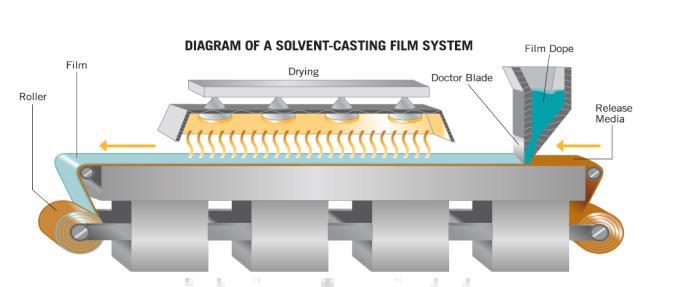
The solvent casting method involves dissolving water-soluble polymers in water while the drugand other excipients are dissolved in a compatible solvent. These two solutions are thencombined and stirred thoroughly to create a uniform mixture. The resulting homogeneoussolution is poured into a Petri dish and left to dry.
The formulation of an almotriptan oral film requires careful selection and optimization of film-forming polymers, plasticizers, superdisintegrants, sweeteners, and other excipients to achieve desirable mechanical strength, flexibility, uniformity, rapid di sintegration, and drug -release characteristics. Parameters such as film thickness, folding endurance, tensile strength, surface pH, drug content uniformity, disintegration time, dissolution profile, and stability are important considerations in the development and evaluation of the formulation.
In view of these considerations, the present study is aimed at the formulation and evaluation of an almotriptan oral film drug-delivery system to provide a convenient, rapidly disintegrating dosage form with satisfactory physicochemical and drug- release characteristics. The developed formulation may offer a patient -friendly alternative to conventional oral dosage forms for the management of acute migraine attacks.
- Materials and Methods preparation
2.1 Materials
| Ingredient F1 Almotriptan | F2 | F3 | F4 | F5 | F6 | F7 | F8 | F9 | F10 | F11 | F12 |
|---|---|---|---|---|---|---|---|---|---|---|---|
| 40 (mg) | 40 | 40 | 40 | 40 | 40 | 40 | 40 | 40 | 40 | 40 | 40 |
| Eudragit L100 | |||||||||||
| 200 (mg) | 250 | 300 | – | – | – | – | – | – | 150 | 150 | – |
HPMC K4M
- – – 200 250 300 – – – 150 – 150 (mg)
HPMC K15M
- – – – – – 200 250 300 – 150 150 (mg) Dichloromethane 8 8 8 8 8 8 8 8 8 8 8 8 (mL) Ethanol (mL) 8 8 8 8 8 8 8 8 8 8 8 8 Propylene glycol 0.3 0.3 0.3 0.3 0.3 0.3 0.3 0.3 0.3 0.3 0.3 0.3 (mL) Tween 80 (mL) 0.3 0.3 0.3 0.3 0.3 0.3 0.3 0.3 0.3 0.3 0.3 0.3
- Preparation of StandardCalibration Curve of working standard was taken in 10 ml standard ofAlmotriptan: volumetric flask and made up thevolume with 6.8 pH phosphate buffer to prepare 2μg, 4μg, 6μg, 8μg 100mg of Almotriptan was accurately weighed and and 10μg drug per mlsolution.Methanoland make dissolved in little amount of pH up the final volume up to 100ml with 6.8pH phosphatebuffer(pH1.2) in 100ml to get 100μg/ml phosphate buffer to prepare stocksolution. The 10ml (working standard). Then 0.2, 0.4, 0.6, 0.8 and 1ml of stock solution was further diluted with 6.8 pH.
3.1 Calibration curve
The calibration data for Almotriptan in pH 6.8 phosphate buffer showed a linear
Concentration (µg/mL)
Physical evaluation:
- Thickness:This thickness of the films was assessed at 3 different points using screw gauze.For each formulation, three randomly selected films were used.
- Folding endurance:The folding endurance was measured manually for the preparation film.A strip of the films (4x3 cm) was cut evenly and repeatedly folded at the same place till it isbroken.
- Moisture uptake:The films were placed in the desiccators containing 200 ml saturatedsolution of potassium chloride, to get the humidity inside the desiccators at 84%RH. After3days the films were taken and weighed the percentage moisture absorption of the film wasfound.
- Moisture content:The films were placed in the desiccators containing 200 ml saturatedsolution
Thickness Folding Formulation
| (mm) | endurance | |
|---|---|---|
| F1 | 0.3569 | 20 |
| F2 | 0.352 | 25 |
| F3 | 0.347 | 27 |
| F4 | 0.3496 | 24 |
| F5 | 0.346 | 30 |
relationship in the tested concentration range. The regression equation reported in the study was y = 0.0636x + 0.0751.
Absorbance at 258 nm
of potassium chloride, to get the humidity inside the desiccators at 84%RH. After3days the films were taken and weighed the percentage moisture absorption of the film wasfound.
- Drug content determination:The film of area 3.83cm 2 was cut and dissolved in PBS pH7.4. Then solvent ethanol and dichloromethane, to make polymer soluble, wer e added tothe mixture and the remaining volume was made up with PBS pH 7.4 to 100 ml in 100 mlvolumetric flask. Then 1 ml was withdrawn from the solution and diluted to 10 ml. Theabsorbance of the solution was taken at 258nm and concentration was calculate d. Bycorrecting dilution factor, the drug content was calculated.
All prepared films were reported to be flat, smooth and flexible. The results of thickness, folding endurance, drug content, moisture uptake and moisture content are presen ted below.
3.3 In-vitro permeation
formulations generally showed a better release Formulation F6 showed the highest cumulative profile than the HPMC K15M - containing release among the twelve formulations, reaching formulations under the reported test conditions. Time F1 F2 F3 F4 F5 F6 F7 F8 F9 F10 F11 F12 (h)
| 1 | 9.05 | 15.1 | 10.1 | 9.49 | 10.9 | 20.2 | 17.5 | 12.0 | 11.1 | 12.7 | 10.0 | 20.4 |
| 2 | 13.3 | 19.8 | 12.8 | 11.3 | 19.6 | 27.8 | 21.9 | 17.5 | 13.0 | 17.9 | 12.5 | 25.4 |
| 4 | 14.6 | 28.3 | 21.5 | 22.6 | 24.9 | 42.8 | 33.5 | 23.4 | 23.3 | 27.4 | 23.6 | 33.0 |
| 6 | 21.9 | 34.1 | 25.9 | 32.3 | 31.2 | 53.5 | 40.0 | 30.9 | 33.4 | 32.7 | 30.9 | 41.7 |
| 8 | 32.7 | 41.1 | 33.4 | 43.9 | 38.0 | 66.3 | 46.5 | 48.1 | 52.7 | 50.6 | 36.7 | 47.9 |
| 10 | 40.4 | 50.1 | 44.5 | 56.3 | 50.3 | 82.0 | 64.2 | 60.0 | 66.4 | 63.0 | 45.9 | 63.0 |
| 12 | 54.2 | 65.8 | 56.7 | 69.4 | 65.9 | 94.7 | 91.9 | 78.7 | 79.1 | 74.8 | 56.0 | 80.9 |
Results and discussions:
I. Standard graph of almotriptan in pH 6.8 phosphate buffer.
III. Kinetics Of In -Vitro Permeation Studies Using Dialysis Membrane
II. Release Profile Of In -Vitro Permeation
Studies Using Dialysis Membrane IV. Zero order kinetics
VII. Peppas plot V. First order
VIII. Fourier Transform Infrared Spectroscopy Spectrum Of Pure Drug
IX. Fourier Transform Infrared Spectroscopy Spectrum Of Optimized Formulation
VI. Higuchi plot
SUMMARY
The present study focused on the formulation and evaluation of Almotriptan oral films for rapid and effective migraine treatment. The films were prepared by the solvent-casting method using Eudragit L100, HPMC K4M, and HPMC K15M as film-forming polymers, with propylene glycol and Tween 80 as excipients. Twelve formulations (F1–F12) were prepared and evaluated for physical appearance, thickness, folding endurance, drug content, moisture properties, disintegration time, and in-vitro drug release.
Among the formulations, F6 was selected as the optimized formulation and showed approximately 94% drug release within 12 minutes. Drug-release kinetics indicated that the Korsmeyer–Peppas model provided the best fit (R² = 0.9892), with an n-value of 0.6203, indicating non -Fickian diffusion.
FTIR studies showed no significant drug– excipient interactions, confirming formulation compatibility. Overall, the study demonstrated that Almotriptan oral films can provide rapid drug release and may be a suitable patient-friendly dosage form for migraine management.
CONCLUSION
Conclusion The study successfully developed Almotriptan oral films using the solvent- casting method. Among the twelve formulations, F6 was selected as the optimized formulation , showing approximately 94% drug release within 12 minutes. The Korsmeyer–Peppas model showed the best fit with R² = 0.9892 and an n-value of 0.6203, indicating non-Fickian diffusion. FTIR studies confirmed the compatibility of Almotriptan with the excipients. Overall, the developed oral film demonstrated rapid drug release and potential for effective migraine management.
Conflict of Interest
The authors declare that there is no conflict of interest.
Almotriptan Oral Film Delivery System
Author Contributions
Divya Nemani: experimental work, data collection, analysis and manuscript preparation.
Dr. M. Gayatri Devi: supervision, guidance and review of the manuscript.
References
- Jadi RK, Yadagiri DJ, Kuchukuntla M, Konatham M, Gorle MT, Bakshi V. Development and characterization of sildenafil citrate oral thin films. Int J Pharm Sci Drug Res. 2020;13(2):147–151.
- Manzar NA, Anwar NK, Shabbir NK, et al. Effective formulation of glimepiride loaded oral thin films for rapid drug availability. J Contemp Pharm. 2020;4(1):10–14.
- Özakar E, Sevinç-Özakar R, Yılmaz B. Preparation, characterization, and evaluation of cytotoxicity of fast dissolving hydrogel based oral thin films containing pregabalin and methylcobalamin. Gels. 2023;9(2):147.
- Naik NG, Marabathuni VJP, Narapusetty N. Formulation development and in-vitro evaluation of captopril fast dissolving oral thin films by solvent casting method. 2022.
- Ramesh Y, Rohan AK, K oorapati B, Sudarsanam P. Formulation and evaluation of almotriptan controlled release pellets. J Drug Deliv Ther. 2019;9(1-s):312–318. 2017;1(1):26.
- Charyulu R, Ashwini, Jose. Design and evaluation of melt in mouth films of almotriptan. Int J Pharm Sci Rev Res. 2013;23(1):71–77.
- Irfan M, Rabel S, Bukhtar Q, Qadir MI, Jabeen F, Khan A. Orally disintegrating films: a modern expansion in drug delivery system. Saudi Pharm J. 2016;24(5):537 – 546.