Green HRM Practices of New Generation Private Sector Banks in Coimbatore (Tamil Nadu)
1. Introduction
The field of HR first evolved in 18th century Europe by Robert Owen and Charles Babbage during the Industrial revolution. They described that wellbeing of employee’s leads to perfect work. In India also the major changes happened in HR practice was started industrial revolution.
Green HRM has emerged as an important management approach that integrates environmental sustainability into human resource policies and practices. In the contemporary business environment, organizations are increasingly expected to minimize their environmental impact while maintaining operational efficiency, employee commitment, and long-term organizational growth. Green HRM incorporates environmentally responsible activities into recruitment and selection, training and development, performance appraisal, compensation and rewards, employee participation, and workplace management. These practices encourage employees to adopt eco-friendly behaviour and develop environmental awareness in their daily activities. According to Renwick et al., (2013), integrating environmental objectives into human resource management can contribute to organizational environmental performance by encouraging employees to participate in sustainability initiatives. Similarly, Noor et al., (2023) demonstrated that Green HRM practices are positively associated with employee engagement in the green banking context, highlighting the importance of integrating environmental responsibility with employee management practices.
The banking sector plays a significant role in promoting sustainable development because its environmental responsibilities extend beyond financial transactions to include energy consumption, paper usage, electronic waste, business travel, and the management of physical and digital resources. Although banking is primarily a service-oriented industry, its extensive office networks, technology infrastructure, and administrative activities create opportunities to implement environmentally sustainable practices. New-generation private sector banks can incorporate Green HRM by adopting paperless recruitment, online employee training, digital communication, green performance evaluation, environmentally linked rewards, and employee participation in sustainability programmes. These initiatives can reduce resource consumption while strengthening employees' awareness of environmental protection. Singh et al., (2024), in their study of Green HRM and organizational effectiveness in the banking sector, examined green recruitment and selection, green training and development, employee participation, and green compensation, demonstrating the relevance of these practices to banking organizations. Noor et al., (2023) also emphasized the relationship between Green HRM and employee engagement, suggesting that environmentally responsible human resource policies can support employees' involvement in organizational sustainability initiatives.
In Coimbatore, Tamil Nadu, the study of Green HRM practices in new-generation private sector banks is particularly relevant because the banking industry must balance customer service, technological advancement, employee development, and environmental responsibility. The adoption of digital banking services provides opportunities to reduce paper-based transactions and administrative processes, while green training and employee awareness programs can encourage responsible energy use, waste reduction, and reso urce conservation. However, the effectiveness of these initiatives depends on how consistently environmental objectives are integrated into human resource policies and how actively employees participate in implementing them. Renwick et al., (2013) highligh ted the importance of connecting human resource management with environmental management and identified employee motivation and participation as important areas for further development. Similarly, Noor et al., (2023) found a positive association between Green HRM practices and employee engagement in green banking, emphasizing the potential contribution of appropriate human resource policies to employee involvement in sustainability initiatives.
Therefore, the present study, titled “Green HRM Practices of New Generation Private Sector Banks in Coimbatore (Tamil Nadu),” aims to examine the implementation of environmentally responsible human resource practices in the selected banking context. The study focuses on understanding how green recruitment and selection, green training and development, green performance appraisal, green compensation and rewards, employee participation, and green workplace initiatives are adopted and perceived by employees. It also seeks to identify areas where banks can strengthen environmental awareness, encourage employee engagement, and improve the integration of sustainability into routine HR activities. By examining these practices, the research may provide useful insights for bank managers and HR professionals seeking to develop environmentally responsible workplaces and improve organizational sustainability. The findings are expected to support practical recommendations for strengthening Green HRM implementation in new-generation private sector banks in Coimbatore, while contributing to the broader discussion of sustainable human resource management in India's banking industry.
1.1 Green HRM in Indian Prospective
Green HRM is gaining importance in India as organizations increasingly recognize the need to integrate environmental sustainability into human resource policies and practices. It involves incorporating environmental objectives into green recruitment and selection, green training and development, green performance appraisal, green compensation and rewards, and employee parti cipation in environmental initiatives. In the Indian context, Green HRM can help organizations reduce resource consumption, encourage environmentally responsible employee behaviour, and develop a sustainability -oriented organizational culture. Arora and Kaul (2020) examined Green HRM practices across Indian sectors, including information technology, banking and finance, consultancy, and engineering, highlighting the importance of understanding the adoption of environmental practices across industries. Similarly, Anshima et al., (2025), through a systematic review of Indian research, identified organisational capabilities, policy requirements, employee empowerment, and environmental knowledge as important factors influencing Green HRM adoption. These studies suggest that Green HRM can serve as a strategic approach for connecting human resource management with environmental responsibility and sustainable organisational development.
Furthermore, the Indian perspective on Green HRM emphasizes the importance of translating environmental policies into employees’ everyday workplace behaviour. Organizations can promote this transition by providing environmental awareness programs, encouraging paperless administration, implementing energy- saving measures, recognizing employees’ green contributions, and including environmental objectives in performance evaluations. Chaudhary (2020) found that Green HRM practices significantly predicted both task-related and voluntary employee green behaviours among employees in India's automobile sector, with organizational identification acting as a mediating factor. In addition, the review by Anshima et al., (2025) indicates that sustainable HRM practices can contribute to green innovation, environmental citizenship behaviour, employee satisfaction, organizational commitment, and employee performance. For Indian organizations, including new-generation private-sector banks, these findings highlight the potential value of integrating green practices into routine HR activities rather than treating environmental responsibility as an isolated corporate initiative. However, effective implementation requires management commitment, employee participation, appropriate training, and measurable environmental performance indicators.
2. Reviews of Literature
2.1 Green HRMP and Employee Engagement
GHRMP have become increasingly important for organizations seeking to integrate environmental sustainability into recruitment, training, performance appraisal, compensation, and employee participation. Noor, Tunnufus, Handrian, and Yumhi (2023) examined green human resource management practices, leadership style, and employee engagement in the green banking context using data from 363 bank employees in Indonesia. Their findings indicated that GHRM practices were positively and significantly associated with employee engagement, while transformational leadership moderated the relationship. The study also found that different practices affected different dimensions of engagement: green recruit ment and selection influenced behavioral engagement, whereas green training and development influenced affective engagement. In a broader organizational context, research published in Sustainable Futures examined the direct and indirect relationships between green HRM and work engagement among 362 respondents from manufacturing industries in North India, highlighting the importance of understanding the mechanisms through which sustainability-oriented HR practices influence employee attitudes (2024). Ud Din, Yang, and Zhang (2025) investigated the psychological benefits of green HRM in the healthcare sector, focusing on employee well- being, engagement with environmental initiatives, and green behavior. Their research extended the discussion beyond conventional HR outcomes by considering the psychological processes associated with environmental practices. Alfadel et al., (2025) examined the relationship between green HRM and sustainable performance in Saudi Arabian manufacturing small and medium -sized enterprises, with green work engagement as a mediating variable. Their study emphasized the relevance of employee engageme nt in translating sustainability-oriented HR practices into organizational outcomes. Together, these studies provide a foundation for investigating how environmentally responsible HR policies may encourage employees to participate actively in organizational sustainability initiatives.
Recent studies have further expanded the understanding of green HRM by examining employee empowerment, organizational culture, and sustainability -related employee behavior. Guo et al., (2025) synthesized evidence from 172 studies involving 54,963 participants and reported positive relationships between green HRM and several employee and organizational outcomes. Their meta-analysis highlighted the importance of green performance management, employee empowerment and involvement, and green compensation and rewards in promoting environmentally responsible employee behavior. In 2025, research published in the Journal of Management Development examined green culture, green HRM, green work engagement, and employee ecological behavior, emphasizing the importance of organizational context and management support. Ramesh, Kumar, and Kumari (2025) also addressed green HRM practices and employee engagement in the banking context, although the bibliographic details and methodological quality of this publication should be verified before it is used as a principal academic source.
In 2026, Kenar and Tat examined the sequential mediating roles of green employee empowerment and perceived external prestige in the relationship between green HRM and green work engagement, using data from 407 hotel employees. Their findings indicated that empowerment and perceived external prestige helped explain the relationship, although the hospitality setting differs from banking.
GHRMP can promote employee engagement by strengthening environmental awareness, organizational support, employee empowerment, and opportunities to participate in sustainability initiatives. Green recruitment and selection, green training and development, green performance appraisal, green rewards, and employee involvement appear particularly relevant to this relationship. The reviewed studies also suggest that leadership, sustainability culture, and green employee values may influence how employees respond to these practices. However, findings from banking, manufacturing, healthcare, IT, and hospitality cannot be assumed to apply identically to private-sector banks. A specific research gap therefore exists in examining the influence of GHRMP on employee engagement among private banking employees, particularly in the Indian context. Future empirical research should assess the individual and combined effects of green HRM dimensions on employees’ vigor, dedication, and absorption, while considering organizational support and environmental leadership as potential explanatory factors. Hence, the hypothesis is
HA: Green HRMP has significantly influences employee engagement
2.2 Green HRMP and Employee Performance
GHRMP have emerged as an important approach to integrating environmental sustainability into recruitment and selection, training and development, performance appraisal, compensation and rewards, and employee participation. Faisal (2023), in GHRM A Synthesis, reviewed the development of green HRM and highlighted the importance of integrating environmentally responsible practices into organizational policies and employee management. Xie and Lau (2023), in Evidence-Based Green Human Resource Management: A Systematic Literature Review, examined the research evidence on green HRM and emphasized the need for effective, evidence-based implementation. Mahdy et al., (2023), in their systematic review of the imperatives, benefits, and initiatives of green HRM, discussed how green practices can support sustainability objectives and encourage environmentally responsible employee behaviour. Joshi et al., (2023), in Green Human Resource Management in the Context of Organizational Sustainability: A Systematic Review and Research Agenda, synthesized previous studies and emphasized the importance of linking green HRM with organizational sustainability and individual performance. Zhao et al., (2024) examined green HRM and sustainable development performance, highlighting the relevance of organizational ambidexterity and responsible leadership in translating environmental HR practices into sustainable organizational outcomes. These studies collectively suggest that green recruitment, green training, green rewards, and green performance management can help employees develop environmental awareness, strengthen their commitment to organizational objectives, and contribute to improved performance.
Further research provides more direct evidence of the relationship between green HRM an d employee performance. Mishra and Rath (2024) investigated green HRM practices in the Indian banking sector, focusing on environmental performance and the contribution of sustainability-oriented human resource practices. A 2024 study of banks in Bangladesh examined the relationship between green recruitment and selection, green training and development, green performance management, green pay and rewards, and employees’ in-role behaviour, including the mediating role of organizational citizenship behaviour towards the environment. Guo et al., (2025), through a meta-analysis of 172 studies covering 54,963 participants, found that green HRM was positively associated with employee and organizational outcomes; green performance management, employee involvement, and green rewards were particularly relevant to different forms of employee green behaviour. Sharma and Arya (2025) specifically examined the implementation of green HRM in public and private banks and its relationship with employee performance. Yousaf (2025), studying 120 employees in public and private banks in Islamabad, reported a positive relationship between green HRM practices and employee performance, with green training and green rewards emerging as particularly important factors. More recently, a 2026 study of private banks in Bangladesh reported positive performance effects associated with green culture, green training, and green rewards and compensation. These findings indicate that green HRM can contribute to employee productivity, task accomplishment, environmental responsibility, and organizational effectiveness. However, because several studies examine general organizational settings or banking sectors that combine public and private institutions, further research is needed to establish the specific effects of green HRM practices on employee performance in private banks.
The literature from 2023 to 2026 generally indicates that Green HRM Practices can support employee performance by developing environmental competencies, encouraging sustainable workplace behaviour, strengthening employee participation, and linking rewards and performance appraisal with organizational sustainability objectives. Green training and development, green compensation and rewards, green recruitment and selection, and green performance management appear to be particularly relevant. Nevertheless, the existing literature does not fully establish how these practices influence different dimensions of employee performance specifically in the private banking sector. Therefore, an empirical investigation of private bank employees can help address this gap by examining the relationship between individual green HRM practices and employee performance, while considering factors such as employee engagement, organizational support, and green workplace culture. Hence, the hypothesis is
HA: Employee engagement has significantly influenced employee performance.
2.3 Employee Engagement and Employee Performance
Monika et al., (2023) examined the relationship between employee engagement and employee performance in the banking sector of Haryana, including employees from public and private banks. The study collected data from 480 respondents working in SBI, PNB, HDFC and ICICI Bank. The findings revealed a positive and statistically significant relationship between employee engagement and employee performance (r =.801, p =.002), indicating that engaged employees are more likely to contribute effectively to organizational objectives. Hasan (2023) investigated the effects of organizational culture on organizational learning, employee engagement and employee performance among 215 banking employees in Indonesia. The findings highlighted the relevance of organizational culture and organizational learning in understanding employee engagement and performance outcomes. Parasa and Prasad (2024) compared employee involvement, employee engagement and employee performance in the Indian banking sector, considering differences between public and private sector banks. Their research emphasized the importance of employee participation and engagement in understanding performance differences across banking institutions. Ahmed et al., (2025) examined the mediating role of employee engagement in the relationship between training and development, work–life balance and job performance among employees of private banks in Bangladesh. Based on 346 valid responses, the study found that training and development and work–life balance significantly influenced employee engagement and job performance, while employee engagement mediated the relationships between these workplace practices and performance.
Several recent studies have further demonstrated the importance of engagement, organizational support and workplace conditions in improving employee performance. The study. The impact of remote work on job satisfaction, engagement and individual work performance in the banking sector (2024) examined 403 banking employees across five European countries and found that work engagement positively influenced task and contextual performance, although remote-work intensity had a negative relationship with engagement. Ahmed et al., (2025) examined the relationship between employee engagement and job performance in private banks in Bangladesh and confirmed that engagement serves as an important mediating mechanism between human resource development practices and employee outcomes. Ghosh and Basu (2025) investigated factors influencing employee engagement in selected Indian private banks and identified job satisfaction, financial benefits, career development opportunities and the working environment as important factors associated with engagement. Ismawanti et al., (2025) studied work engagement, psychological capital and emplo yee performance in the banking industry and found that work engagement significantly influenced employee well- being and performance, highlighting the importance of psychological resources in achieving better work outcomes. Badaruddin et al., (2025) examined employee performance in Indonesian banking with reference to Islamic work values and workplace engagement, extending the discussion to the role of workplace values and engagement in employee outcomes. In India, Vyas and Dhar (2026) investigated organizational climate among private bank employees and reported that leadership support, recognition, communication and role clarity significantly contributed to employee engagement. Thomas et al., (2026) examined emotional intelligence, managerial performance and employee engagement in Tamil Nadu's banking industry, highlighting the relevance of emotional intelligence in understanding managerial and employee outcomes. Collectively, these studies suggest that employee engagement is influenced by supportive leadersh ip, professional development, recognition, psychological well-being and organizational climate. However, further empirical research focusing specifically on private banking employees in India is needed to establish how engagement affects measurable dimensions of employee performance.
The literature reviewed from 2023 to 2026 indicates that employee engagement is an important factor associated with employee performance in the banking sector. Evidence from Haryana, Bangladesh, Indonesia and other banking contexts demonstrates the relevance of engagement, organizational culture, training and development, work–life balance, psychological well-being and supportive working conditions in improving employee outcomes (Hasan, 2023; Monika et al., 2023; Ahmed et al., 2025; Ismawanti et al., 2025). Recent studies also highlight the importance of leadership support, recognition, communication and organizational climate in strengthening employee engagement (Ghosh & Basu, 2025; Vyas & Dhar, 2026). Nevertheless, the available research varies in geographical coverage, institutional context and research design, and not all studies focus exclusively on private banks. Therefore, a focused investigation of employee engagement and employee performance in the private banking sector is necessary to understand whether engaged employees demonstrate better productivity, task completion, service quality, customer responsiveness and organizational contribution. The findings can help private banking institutions develop suitable employee engagement strategies to strengthen workforce effectiveness and organizational performance. Hence, the hypothesis is
HA: Green HRMP has significantly influences employee performance.
2.4 Research Gap
The research gap in the study entitled “Green HRM Practices of New Generation Private Sector Banks in Coimbatore (Tamil Nadu)” arises from the limited location-specific empirical research examining the adoption and implementation of Green Human Resource Management (Green HRM) practices in new - generation private sector banks. Although previous studies have explored Green HRM practices such as green recruitment and selection, green training and development, green performance appraisal, green rewards and recognition, and employee participation in environmental initiatives, there remains a need to understand how these practices are implemented in the banking sector at the regional level. In particular, insufficient attention has been given to the extent of Green HRM adoption, the environmental awareness of banking employees, the challenges faced by banks in implementing eco-friendly HR policies, and the role of organizational support in encouraging sustainable workplace behaviour. Furthermore, the differences in Green HRM implementation across employee demographic characteristics and organizational practices require further investigation.
Therefore, the present study seeks to address these gaps by systematically examining green HRM practices in new-generation private sector banks in Coimbatore, Tamil Nadu, thereby providing empirical insights into their implementation, effectiveness, and contribution to environmental sustainability in the banking industry.
2.5 Framework of the Research
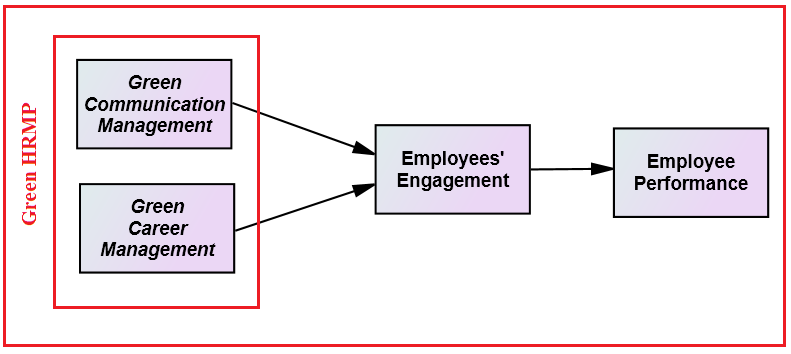
The conceptual framework of the study entitled “Green HRM Practices of New Generation Private Sector Banks in Coimbatore (Tamil Nadu)” proposes that GHRMP influence employee performance both directly and indirectly through employee engagement. GHRMP is the independent variable (IV) and includes green recruitment and selection, green training and development, green performance appraisal, green compensation and rewards, and employee participation in environmental initiatives. Employee engagement is the mediating variable, representing employees’ energy, dedication, enthusiasm, and involvement in organizational activities. Employee performance is the dependent variable (DV), reflected in employees’ task accomplishment, productivity, efficiency, and environmentally responsible workplace behaviour. The framework assumes that green HRM practices encourage employees to participate actively in sustainability initiatives, develop environmental awareness, and demonstrate stronger engagement, which may subsequently improve their performance. Previous studies have identified positive relationships between GHRM practices and work engagement, supporting the proposed mediating role of employee engagement in explaining how green HRM practices translate into employee outcomes (Baykal & Bayraktar, 2022; Gupta & Jangra, 2024). Accordingly, the framework proposes three relationships: GHRMP positively influences employee performance; GHRMP positively influences employee engagement; and employee engagement positively influences employee performance. It further hypothesizes that employee engagement mediates the relationship between GHRMP and employee performance among employees of new-generation private sector banks in Coimbatore. These relationships can be empirically examined using path analysis to estimate direct, indirect, and total effects. The mediation effect should be confirmed using the collected data rather than assumed in advance, thereby establishing whether employee engagement serves as a significant mechanism through which green HRM practices enhance employee performance.
2.6 Need for the Study
The need for the study on “Green HRM Practices of New Generation Private Sector Banks in Coimbatore (Tamil Nadu)” arises from the growing importance of environmental sustainability and the need for banking institutions to adopt eco-friendly human resource management practices. Although banking operations are increasingly digital, activities such as energy consumption, paper usage, employee commuting, and resource utilization continue to have environmental implications. Green HRM practices, including green recruitment and selection, green training and development, green performance appraisal, green rewards, employee participation, and paperless HR administration, can encourage employees to adopt environmentally responsible behavior and contribute to organizational sustainability. New-generation private sector banks in Coimbatore need to integrate these practices into their HR policies to improve environmental awareness, employee engagement, organizational efficiency, and sustainable performance. Therefore, this study is essential to assess the extent of Green HRM implementation, identify the challenges faced by banks, understand employees’ perceptions of green initiatives, and recommend suitable strategies for strengthening environmentally sustainable HR practices in the banking sector. The findings may help bank management and policymakers develop effective GHRM policies that support environmental protection while maintaining employee productivity and organizational growth.
2.7 Statement of the Problem
The growing concern for environmental sustainability has encouraged organizations to adopt eco-friendly policies and practices to reduce their environmental impact. In this context, GHRM has emerged as an important approach that integrates environmental sustainability into human resource functions, including green recruitment and selection, green training and development, green performance appraisal, green compensation and rewards, employee engagement, and employee participation in environmental initiatives. New generation private sector banks in Coimbatore, Tamil Nadu, are increasingly expected to incorporate sustainable practices into their organizational operations; however, the extent to which Green HRM practices are implemented effectively and their influence on employee awareness, participation, engagement, and performance remain important areas of investigation. Challenges such as limited environmental awareness, inadequate green training, insufficient incentives for eco-friendly behavior, and difficulties in evaluating the outcomes of green initiatives may affect the successful implementation of these practices. Therefore, the present study seeks to examine the Green HRM practices adopted by new generation private sector banks in Coimbatore, identify the major factors influencing their implementation, assess employees’ perceptions and participation in green initiatives, and understand the contribution of these practices to environmental sustainability and organizational effectiveness. The findings are expected to provide useful insights for developing effective green HRM strategies that promote environmental responsibility and sustainable banking practices.
3. Research Methodology
3.1 Research Design
The study entitled “Green HRM Practices of New Generation Private Sector Banks in Coimbatore (Tamil Nadu)” adopts a descriptive research design to examine the implementation of Green HRM practices in selected new-generation private sector banks in Coimbatore, Tamil Nadu. The research focuses on green recruitment and selection, green training and development, green performance appraisal, green compensation and rewards, employee participation in environmental initiatives, and paperless HR practices. Primary data will be collected from bank employees through a structured questionnaire, while secondary data will be obtained from books, research journals, published articles, bank reports, and relevant websites. A suitable sampling technique will be employed to select respondents from the identified banks, and the collected data will be analyzed using appropriate statistical tools, such as percentage analysis, mean, standard deviation, correlation, regression, and other relevant techniques, depending on the research objectives. The descriptive research design will help identify the extent of Green HRM implementation, understand employees’ perceptions of environmentally responsible HR practices, and provide insights into strengthening sustainable human resource management in new-generation private sector banks in Coimbatore.
3.2 Questionnaire Design
Data is collected from private sector banks in Coimbatore, Tamilnadu through a well-designed questionnaire. The questionnaire construction for this study is divided into four parts. The first part of the questionnaire is a demographic profile of the private sector bank employees, the second part is green HRMP, the third part is employee engagement, the fourth part is employee performance. The first part is set up as a category and the other three as a measuring scaling technique.
3.3 Reliability
Pilot study was done to confirm that the results of this research questionnaire are reliable. The questionnaires are verified by involving 50 private sector bank employees in Coimbatore, Tamilnadu. Based on the private sector bank employees’ opinion, some changes are made in the questionnaire. Cronbach’s alpha tool is employed to test the reliability. All the variables of this questionnaire are above 0.70. The results show that it is reliable. This means that the questionnaire has a high reliability value.
Source: Primary data
3.4 Population and Sample size
Population and Sample Size: The population of the study comprises employees working in new-generation private sector banks in Coimbatore, Tamil Nadu. The study focuses on examining the GHRM practices adopted by these banks, including green recruitment and selection, green training and development, green performance appraisal, green compensation and rewards, and employee participation in environmental initiatives. A sample size of 150 respondents was selected from employees working in selected new-generation private sector banks in Coimbatore to collect relevant primary data regarding their awareness, perceptions, and experiences of Green HRM practices. The respondents were selected using the simple random sampling technique to provide employees with an equal opportunity for selection and to reduce selection bias. The collected data were used to analyses the implementation of Green HRM practices and their relationship with employee-related outcomes in the selected banks.
3.5 Sampling Technique
The present study entitled “Green HRM Practices of New Generation Private Sector Banks in Coimbatore (Tamil Nadu)” adopts the simple random sampling technique to select 150 employees working in new- generation private sector banks in Coimbatore. Simple random sampling is a probability sampling method in which every eligible employee in the defined sampling population has an equal chance of being selected for participation in the study. The researcher may prepare a sampling frame containing the eligible employees’ names or identification numbers and select 150 respondents using a lottery method or computer-generated random numbers. This technique helps minimize selection bias and supports the collection of data that reflects employees’ perceptions of green recruitment and selection, green training and development, green performance management, green compensation and rewards, and other environmentally responsible human resource practices. The use of simple random sampling is appropriate for systematically examini ng employees’ awareness, participation, and perceptions of Green HRM practices in the selected banking institutions, provided that a complete and accurate sampling frame is available (Setia, 2016; Thompson, 2012).
3.6 Tool for data analysis
Path analysis will be employed as the principal statistical tool to examine the relationships between GHRMP and employee engagement in new-generation private sector banks in Coimbatore, Tamil Nadu. Data collected from 150 respondents through a structured questionnaire will be coded and analyzed using suitable statistical software. Path analysis will help estimate the direct and indirect effects of green recruitment and selection, green training and development, green performance management, green compensation and rewards, and other relevant green HRM practices on employee engagement. The analysis will assess standardized path coefficients, significance levels, coefficients of determination (R2), and relevant model-fit indices to evaluate the proposed relationships and the explanatory power of the research model. This approach is appropriate for examining the interconnected relationships among organizational practices and employee outcomes, as demonstrated in research on green HRM and employee engagement (Noor et al., 2023; green HRM and work engagement research, 2022).
4. Results And Discussion
| S.No. | Model Fit Indicators | Calculated Values in the Analysis | Recommended Values (Premapriya, et al., 2016) |
|---|---|---|---|
| 1 | Chi-Square | 3.104 | --- |
| 2 | p | 0.215 | > 0.050 |
| 3 | GFI | 0.999 | |
| 4 | AGFI | 0.999 | > 0.90 |
| 5 | CFI | 0.999 | |
| 6 | NFI | 0.999 | |
| 7 | RMR | 0.010 | < 0.080 |
| 8 | RMSEA | 0.023 |
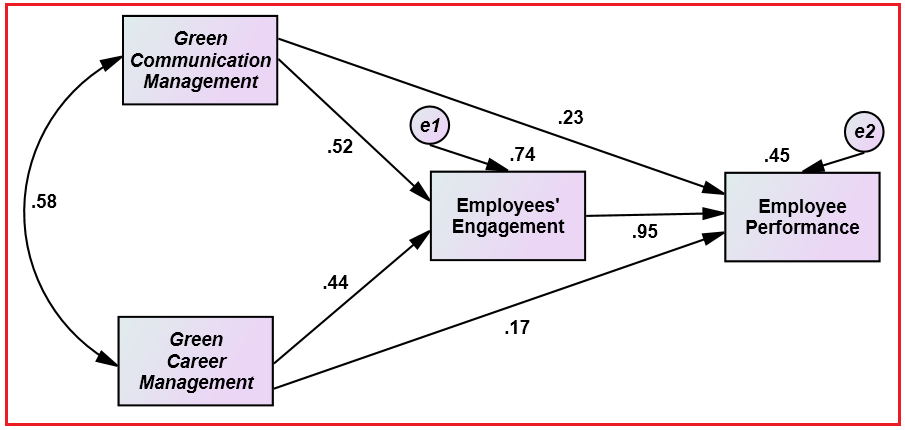
Source: Primary data The above table presents the mode summary of influence of green HRMP on employee engagement and employee performance. The path model presented, along with mode summary to verify the model fitness. The Chi-square statistic is 3.104 with p> 0.05. The table illustrates the model fit statistics such as RMSEA, RMR, NFI, CFI, AGFI and GFI. RMR and RMSEA are within than the recommended limit i.e., RMR and RMSEA is less than 0.08 (Indra, Balaji and Velaudham, 2020; Velaudham and Baskar, 2016). NFI, CFI, AGFI and GFI are within than the recommended limit i.e., NFI, CFI, AGFI and GFI is greater than 0.90 (Kantiah Alias Deepak and Velaudham, 2019; Velaudham and Baskar, 2015). All the model fit statistics imply a better model fit (Velaudham & Baskar, 2015a; Velaudham & Baskar, 2015b; Velaudham & Baskar, 2016; Premapriya, et al., 2016; Velaudham & Baskar, 2017; Deepak, et al., 2019; Josephine Reena, et al., 2019; Indra, et al., 2020; Hariprabhu Dhakal, et al., 2025; Hariprabhu Dhakal, et al., 2026; Hariprabhu Dhakal, et al., 2026a).
Source: Primary data The regression weights presented in Table 4 examine the influence of GHRMP, particularly Green Communication Management and Green Career Management, on employee engagement and employee performance in the private banking sector. The table also assesses the influence of employee engagement on employee performance. The estimates, standard errors, critical ratios, standardized beta coefficients and p- values indicate the direction, strength and statistical significance of the relationships among the variables. All five relationships are statistically significant at the 1% level based on the reported p-values, although the exact significance should be interpreted in light of the reported values and the study's statistical reporting conventions. The findings are consistent with the broader argument that environmentally oriented HR practices can contribute to employee attitudes and organizational outcomes (Renwick et al., 2013; Dumont et al., 2017).
The regression results reveal that Green Communication Management has a positive and statistically significant influence on Employee Engagement, with an unstandardized estimate of 0.421, a standard error of 0.025, a critical ratio of 16.641, a standardized beta coefficient of 0.524 and a reported p-value of 0.001. The positive beta coefficient indicates that stronger green communication practices are associated with higher employee engagement among private banking employees. Communicating environmental policies, sustainability objectives, green initiatives and employees' responsibilities can help workers understand how their individual contributions support organizational environmental goals. Such communication may strengthen employees' sense of involvement and shared purpose. The standardized coe fficient of 0.524 suggests that Green Communication Management is a substantial predictor of engagement in the reported model. This interpretation is consistent with Dumont et al., (2017), who examined the relationship between green HRM practices and employees' workplace green behavior, and with Renwick et al., (2013), who emphasized the strategic role of HRM in environmental management.
The results indicate that Green Career Management has a positive and statistically significant relationship with Employee Engagement, with an estimate of 0.481, a standard error of 0.034, a critical ratio of 14.091, a standardized beta coefficient of 0.444 and a reported p-value of 0.001. These findings suggest that career- related practices incorporating environmental knowle dge, sustainability competencies, green skill development and opportunities to participate in environmental initiatives can support employee engagement in private banks. When employees perceive that their career progression is connected to learning, professional development and the organization's environmental objectives, they may develop a stronger sense of purpose and commitment to their work. The standardized beta of 0.444 indicates a meaningful positive association between Green Career Management and Employee Engagement. This interpretation is consistent with the strategic HRM perspective discussed by Renwick et al., (2013) and research by Dumont et al., (2017), which highlights the relevance of green HRM systems and employees' perceptions of the environmental climate in shaping workplace outcomes.
The regression analysis reveals that Employee Engagement has a strong positive and statistically significant influence on Employee Performance, with an unstandardized estimate of 1.140, a standard error of 0.088, a critical ratio of 12.991, a standardized beta coefficient of 0.953 and a reported p-value of 0.001. Among the relationships reported in Table 4, this path has the largest standardized beta coefficient, indicating that employee engagement is the strongest predictor of employee performance within the specified model. In the private banking sector, engaged employees may demonstrate greater energy, dedication, concentration and willingness to complete their duties effectively. Such engagement may support service quality, customer responsiveness, accuracy in financial transactions and the timely achievement of organizational targets. The result is consistent with the broader evidence that employee engagement is associated with improved work outcomes, as discussed by Saks (2006), and with the Job Demands–Resources model, which explains how motivational processes can contribute to employee performance (Bakker & Demerouti, 2007).
The results show that Green Communication Management positively and significantly influences Employee Performance, with an estimate of 0.218, a standard error of 0.058, a critical ratio of 3.788, a standardized beta coefficient of 0.226 and a reported p-value of 0.001. The positive coefficient suggests that communicating environmental objectives, green workplace procedures and sustainability expectations may help private banking employees understand organizational priorities and perform their responsibilities more effectively. Clear communication can also encourage coordination, reduce uncertainty about environmental procedures and improve employees' awareness of how their daily work contributes to organizational goals. However, the standardized beta of 0.226 is considerably smaller than the reported beta for the relationship between Employee Engagement and Employee Performance, suggesting that the direct association between green communication and performance is comparatively weaker in this model. These findings align with Renwick et al., (2013), who emphasized the integration of environmental objectives into HRM practices, and Dumont et al., (2017), who demonstrated the relevance of green HRM and employees' perceptions of the green psychological climate to workplace behavior.
The regression weights indicate that Green Career Management has a positive and statistically significant influence on Employee Performance, with an estimate of 0.219, a standard error of 0.073, a critical ratio of 3.008, a standardized beta coefficient of 0.169 and a reported p-value of 0.003. The results suggest that career development opportunities that incorporate environmental awareness, sustainability-related training and green competencies may contribute to employees' ability to fulfil their professional responsibilities. In private banks, employees who receive opportunities to develop relevant skills may be better equipped to adapt to environmental policies, support sustainable banking initiatives and carry out their duties efficiently.
Nevertheless, the standardized beta of 0.169 indicates that Green Career Management has a comparatively modest direct association with performance among the relationships examined. This finding is consistent with Renwick et al., (2013), who discussed the role of HRM in supporting environmental management, and Bakker and Demerouti (2007), whose Job Demands–Resources model explains how workplace resources can support employee motivation and performance.
Green Communication Management and Green Career Management are positively associated with Employee Engagement and Employee Performance, while Employee Engagement exhibits the strongest standardized relationship with Employee Performance (beta=0.953). Green Communication Management has a higher standardized coefficient for Employee Engagement (beta=0.524) than Green Career Management (beta=0.444), suggesting that communicating environmental goals and practices may be particularly important for engaging employees in the private banking sector. Both green HRM practices also show positive direct relationships with Employee Performance, although their standardized coefficients are smaller (beta=0.226) and (beta=0.169), respectively). These findings suggest that banks should combine clear sustainability communication and environmentally oriented career development with initiatives that strengthen employee engagement. However, although the pattern of coefficients is consistent with the possibility that engagement helps translate green HRM practices into better performance, the table alone does not establish a mediation effect; that requires a formal indirect-effect test. The overall interpretation is consistent with the green banking research of Heliyon (2023), which reported positive associations between green HRM practices and employee engagement, and with Dumont et al., (2017), who highlighted the role of green HRM and psychological green climate in workplace behavior.
5. Finding and Implications
The findings provide important managerial implications for private-sector banks in developing effective Green HRMP to enhance employee engagement. The results indicate that Green Communication Management has a significant positive influence on employee engagement (β = 0.524, p = 0.001), followed by Green Career Management (β = 0.444, p = 0.001). Therefore, bank managers should establish effective communication systems to disseminate environmental policies, sustainability objectives, green workplace initiatives, and employee responsibilities. Regular environmental awareness programs, digital communication platforms, green team meetings, and employee participation in sustainability activities can strengthen employees’ understanding of the bank’s environmental commitments. In addition, managers should integrate environmental competencies into career development plans, training programs, promotions, and performance appraisal systems. Providing employees with opportunities to develop sustainability -related skills and participate in green banking initiatives can improve their sense of purpose, organizational identification, and commitment to environmental objectives. These measures can help private banks create a supportive organizational climate that encourages employees to actively participate in green initiatives.
Furthermore, the findings demonstrate that employee engagement has a strong positive influence on employee performance (β = 0.953, p = 0.001), highlighting the managerial importance of developing an engaged workforce to achieve organizational effectiveness. Green Communication Management (β = 0.226, p = 0.001) and Green Career Management (β = 0.169, p = 0.003) also have significant positive relationships with employee performance. Consequently, bank managers should connect environmental sustainability initiatives with employees’ daily responsibilities, performance targets, and professional development opportunities. Employees who actively participate in paperless banking, energy conservation, responsible resource utilization, and digital service delivery can be encouraged through recognition, constructive feedback, and career advancement opportunities. Managers should also monitor employee engagement and performance periodically to identify areas requiring improvement and ensure that green HR policies produce practical organizational benefits. Since employee engagement has the largest reported standardized coefficient in the performance model, strengthening engagement should be a central managerial priority. However, the reported coefficients should be interpreted according to the specified statistical model, and the results establish significant relationships rather than definitive causal effects. Overall, integrating green communication, sustainable career development, and employee engagement into banking operations can support improved employee performance while advancing the environmental and organizational goals of private-sector banks.
5.1 Conclusion
The study on Green HRMP and employee engagement in the private banking sector, based on a sample of 150 respondents selected through simple random sampling and analysed using path analysis, reveals that green communication management and green career management significantly influence employee engagement and employee performance. Green communication management has a positive and significant effect on employee engagement (beta = 0.524, p = 0.001), while green career management also positively influences employee engagement (beta = 0.444, p = 0.001). Furthermore, employee engagement has a strong positive effect on employee performance (beta = 0.953, p = 0.001), highlighting its importance in improving employees’ work outcomes. Green communication management (beta = 0.226, p = 0.001) and green career management (beta = 0.169, p = 0.003) also have significant direct effects on employee performance. These findings indicate that effective environmental communication, career development opportunities aligned with sustainability, and higher employee engagement can contribute to improved employee performance in private banks. Therefore, private banking institutions should integrate green HR practices into their commun ication, career development, and employee engagement strategies to foster a sustainability-oriented workplace and enhance overall organizational effectiveness.
5.2 Limitations and Future Research Design
The study on GHRM Practices of New Generation Private Sector Banks in Coimbatore (Tamil Nadu) has certain limitations that should be considered when interpreting its findings. The study is restricted to 150 respondents selected through simple random sampling, which may limit the generalizability of the results to all private sector banks in Tamil Nadu and other regions. Furthermore, the study primarily focuses on green human resource management practices and their relationship with employee engagement, while other factors, such as organizational culture, leadership support, environmental awareness, employee motivation, and organizational commitment, may also influence the outcomes. Future research may adopt a larger sample covering public and private sector banks across multiple districts and states to improve the representativeness of the findings. Longitudinal research designs could be used to examine changes in employee attitudes and engagement over time, while comparative studies could identify differences in green HRM implementation between public and private sector banks. In addition, future researchers may employ SEM, mediation analysis, and moderation analysis to investigate the relationships among green recruitment and selection, green training and development, green performance appraisal, green rewards, employee engagement, and environmental performance. These approaches would provide deeper insights into the effectiveness of green HRM practices and help banking institutions develop sustainable human resource strategies that promote employee engagement and environmental responsibility.
REFERENCE
- Ahmed, S., Ashrafi, D. M., Ahmed, R., Ahmed, E., & colleagues. (2025). How employee engagement mediates the training and development and work–life balance towards job performance of the private banks? The TQM Journal, 37(7), 2015–2040. https://doi.org/10.1108/TQM-10-2023-0316
- Alfadel, A., Al-Kahtani, S. M., Al-Mekhlafi, A.-W. A.-G. S., Alhebri, A., et al., (2025). Fostering sustainable development: The role of green HRM and gree n work engagement. Discover Sustainability, 6, Article 300. https://doi.org/10.1007/s43621-025-01167-z
- Anshima, Sharma, D., & Bhardwaj, B. (2025). Green human resource management practices and sustainable development in India: A systematic literature review and future research agenda. Social Sciences & Humanities Open, 11, Article 101420. https://doi.org/10.1016/j.ssaho.2025.101420
- Arora, M., & Kaul, A. (2020). Green human resource management: An empirical study of India. Visegrad Journal on Bioeconomy and Sustainable Development, 9(2), 61 –66. https://doi.org/10.2478/vjbsd-2020-0012
- Badaruddin, B., Yusriadi, Y., & Fatmasari, F. (2025). Organizational dynamics of employee performance in Indonesian banking with reference to Islamic work values and workplace engagement. Discover Global Society, 3, Article 180. https://doi.org/10.1007/s44282-025-00328-9
- Bakker, A. B., & Demerouti, E. (2007). The job demands–resources model: State of the art. Journal of Managerial Psychology, 22(3), 309–328. https://doi.org/10.1108/02683940710733115
- Baykal, E., & Bayraktar, O. (2022). Green human resources management: A novel tool to boost work engagement. Frontiers in Psychology, 13, Article 951963. https://doi.org/10.3389/fpsyg.2022.951963
- Baykal, E., & Bayraktar, O. (2022). Green human resources management: A novel tool to boost work engagement. Frontiers in Psychology, 13, Article 951963. https://doi.org/10.3389/fpsyg.2022.951963
- Chowdhury, S. R., Sakib, M. N., Sanju, N. L., Sabah, S., Chowdhury, F., et al., (2025). Aspects and practices of green human resource management: A review of literature exploring future research direction. Future Business Journal, 11, Article 147. https://doi.org/10.1186/s43093-025-00567-
- Dumont, J., Shen, J., & Deng, X. (2017). Effects of green HRM practices on employee workplace green behavior: The role of psychological green climate and employee green values. Human Resource Management, 56(4), 613–627. https://doi.org/10.1002/hrm.21792
- Faisal, S. (2023). Green human resource manageme nt— A synthesis. Sustainability, 15(3), Article 2259. https://doi.org/10.3390/su15032259
- Ghosh, S., & Basu, B. (2025). Analysis of the key influencing variables of employee’s engagement: A study based on selected Indian private banks. Journal of Marketing & Social Research, 2(7), 142–
- https://doi.org/10.61336/jmsr/25-07-17
- Guo, Y., Wang, S., & Yang, Q. (2 025). Green human resource management: Synthesising outcomes and identifying effective practices. Asia Pacific Journal of Human Resources, 63(4), Article e70033. https://doi.org/10.1111/1744-7941.70033
- Gupta, A., & Jangra, S. (2024). Green human resource management and work engagement: Linking HRM performance attributions. Sustainable Futures, 7, Article 100174. https://doi.org/10.1016/j.sftr.2024.100174
- Hariprabhu Dhakal, B., Chinnadurai, P., and Velaudham, C. (2025). Significance of Digital Human Resource Management Practices for Organizational Performance. EPRA International Journal of Economic and Business, 13 (10), 86-92.
- Hariprabhu Dhakal, B., Chinnadurai, P., and Velaudham, C. (2026). Hospital Innovation and its Impact on Quality of Care and Patient Satisfaction. International Journal of Versatile Research and Analysis, 4 (10), 18-24. https://doi.org/10.56975/ijvra.v4i10.711690
- Hariprabhu Dhakal, B., Chinnadurai, P., and Velaudham, C. (2026a). Influence of Microfinance on Socio-Economic Development of Women Fish Vendors: A Study in Cuddalore District. Journal of Advance and Future Research, 4 (10), 684-697. https://doi.org/10.56975/jaafr.v4i10.515680
- Hasan, H. (2023). Effect of organizational culture on organizational learning, employee engagement, and employee performance: Study of banking employees in Indonesia. Problems and Perspectives in Management, 21(3), 471–482. https://doi.org/10.21511/ppm.21(3).2023.38
- Hossain, M. S., Momen, M. A., Das, M. K., & Pervej, M. S. (2024). Green HRM practices and employees’ in role behavior: Mediating effect of organizational citizenship behavior towards the environment in the banking sector of Bangladesh. International Journal of Research and Scientific Innovation. https://doi.org/10.51244/IJRSI.2024.1109071
- Indra, M., Balaji, K. & Velaudham, C (2020). Impact of Social Influence and Safety on Purchase Decision of Green Cosmetic. International Journal of Future Generation Communication and Networking, 13 (3), 3036-3042.
- Ismawanti, R., Komariyah, I., & Suwandi, Y. W. (2025). Work engagement, psychologica l capital, and employee performance: The mediating role of employee well-being in the banking industry. International Journal of Applied Business and International Management, 10(3). https://doi.org/10.32535/ijabim.v10i3.4618
- Josephine Reena, A., Kanthiah Alias Deepak, R., Velaudham, C & Manivannan, M. (2019). Influence Of Brand Image On Purchase Intention Towards Fmcg Products. Journal of Emerging Technologies and Innovative Research, 6 (1), 742-745.
- Joshi, A., Kataria, A., Rastogi, M., Beutell, N. J., Ahmad, S., & Yusliza, M. Y. (2023). Green human resource management in the context of organizational sustainability: A systematic review and research agenda. Journal of Cleaner Production, 430, Article 1 39713. https://doi.org/10.1016/j.jclepro.2023.139713
- Kanthiah Alias Deepak, R., Velaudham, C & Manivannan, M. (2019). “Gypsy” Narikuravar Community: Problems in Accessing Health Care Services. Indian Journal of Public Health Research & Development, 10 (9), 48-54.
- Kenar, G., & Tat, C. (2026). How green HRM fosters green work engagement: The sequential roles of employee empowerment and perceived external prestige. Evidence-based HRM: A Global Forum for Empirical Scholarship. Advance online publication. https://doi.org/10.1108/EBHRM-12-2025- 0591
- Khan, A. J., Nasir, A., Khan, S., Munir, F., & Li, G. (2025). Seeds of sustainability in organizations: Green HRM and employee engagement as a cultivators of green branding and consumer trust. Acta Psychologica, 260, Article 105648. https://doi.org/10.1016/j.actpsy.2025.105648
- Khatun, T., & Sharmin, N. (2024). Impact of green human resource management on employee performance of private banks in Bangladesh. Feni University J ournal, 3(1), 189 –210. https://doi.org/10.3329/fuj.v3i1.86556
- Lawter, L., & Garnjost, P. (2025). Green human resource management and organizational performance: A systematic revi ew. Sustainability, 17(7), Article 3132. https://doi.org/10.3390/su17073132
- Mahdy, F., Alqahtani, M., & Binzafrah, F. (2023). Imperatives, benefits, and initiatives of green human resource management (GHRM): A systematic literature review. Sustainability, 15(6), Article 4866. https://doi.org/10.3390/su15064866
- Mishra, S., & Rath, N. (2024). Impact of green HRM practices on environmental performance of Planning, 19(4), 1457–1469. https://doi.org/10.18280/ijsdp.190423
- Monika, Saini, M., Jajoria, T., & Aditi. (2023). The relationship between employee engagement and employee performance in the banking sector of Haryana. Journal of Namibian Studies: History Politics Culture, 33, 3095–3111. https://doi.org/10.59670/jns.v33i.4858
- Noor, J., Tunnufus, Z., Handrian, V. Y., & Yumhi, Y. (2023). Green human resources management practices, leadership style and employee engagement: Green banking context. Heliyon, 9(12), Article e22473. https://doi.org/10.1016/j.heliyon.2023.e22473
- Pandey, D. L., & Ri sal, N. (2025). Green HRM practices and employee performance of Nepalese commercial banks: Test of AMO model. International Journal of Innovative Research and Scientific Studies, 8(1). https://doi.org/10.53894/ijirss.v8i1.4804
- Pandey, V., Mathur, G., & Pandey, V. K. (2026). Green human resource management as a driver of sustainability outcomes through employee engagement and organizational image. Discover Sustainability, 7, Article 1264. https://doi.org/10.1007/s43621-026-03528-8
- Parasa, S. R., & Prasad, V. S. (2024). Comparative analysis over the employee involvement, employee engagement and employee performance in the Indian banking sector. Journal of Emerging Technologies and Innovative Research, 11(3), b151 –b164. https://www.jetir.org/view?paper=JETIR2403118
- Premapriya, M.S., Velaudham, C. & Baskar, P (2016). Nature of Family Influenced by Consumer Buying behaviour: Multiple Group Analysis Approach. Asian Journal of Research in Social Sciences and Humanities, 6 (9), 908-915.
- Ramesh, H. N., Kumar, P., & Kumari, T. K. B. N. (2025). Green human resource management practices and employee engagement: Banking context. International Journal of Creative Research Thoughts, 13(5), l30–l35. https://www.ijcrt.org/viewpaperforall.php?paper=IJCRT25A5259
- Renwick, D. W. S., Redman, T., & Maguire, S. (2013). Green human resource management: A review and research agenda. International Journal of Management Reviews, 15(1), 1 –14. https://doi.org/10.1111/j.1468-2370.2011.00328.x
- Ruželė, D., Stankevičienė, A., & Koreivaitė, G. (2025). The impact of remote work on job satisfaction, engagement and individual work performance in the banking sector. Evidence-Based HRM: A Global Forum for Empirical Scholarship, 13(5), 896–911. https://doi.org/10.1108/EBHRM-04-2024-0114
- Saks, A. M. (2006). Antecedents and consequences of employee engagement. Journal of Managerial Psychology, 21(7), 600–619. https://doi.org/10.1108/02683940610690169
- Setia, M. S. (2016). Methodology series module 5: Sampling strategies. Indian Journal of Dermatology, 61(5), 505–509. https://doi.org/10.4103/0019-5154.190118
- Sharma, T., & Arya, S. (202 5). Comparative analysis of Green HRM implementation in public and private banks and its impact on employees’ performance. Journal of Information Systems Engineering and Management, 10(4). https://doi.org/10.52783/jisem.v10i4.10658
- Singh, P., Mishra, A. K., & Keshri, K. (2024). Association of Green HRM practices with organizational effectiveness in banking sector: A case study of SBI. European Economic Letters, 14(1), 1467–1480. https://doi.org/10.52783/eel.v14i1.1204
- Talukdar, A., & Ganguly, A. (2026). Influence of sustainability culture on engagement of millennials and Gen-Z employees: Mediating role of green human resource management (GHRM). Management Research Review, 49(4), 407–424. https://doi.org/10.1108/MRR-01-2025-0005
- Thomas, J. P., Asha, K., Mian, G. M. S., Singh, D. A. P., & Kani, R. M. (2026). Enhancing organizational dynamics: The impact of emotional intelligence on managerial performance and employee engagement in Tamil Nadu's banking industry. International Journal of Occupational Safety and Ergonomics, 32(1), 148–161. https://doi.org/10.1080/10803548.2025.2511362
- Thompson, S. K. (2012). Simple random sampling. In Sampling (3rd ed.). Wiley. https://doi.org/10.1002/9781118162934.ch2
- Ud Din, A., Yang, Y., & Zhang, Y. (2025). The psychological benefits of green HRM: A study of employee well-being, engagement, and green behavior in the healthcare sector. Acta Psychologica, 254, Article 104823. https://doi.org/10.1016/j.actpsy.2025.104823
- Velaudham, C & Baskar, P (2015). Infl uence of Gender in Consumer Buying Behavior towards Air Conditioner in Chennai City. Annamalai Journal of Management, 3-9.
- Velaudham, C & Baskar, P (2015a). Influence of Gender in Consumer Buying Behaviour Towards Air Conditioner in Chennai City. Annamalai Journal of Management, 3-9.
- Velaudham, C & Baskar, P (2015b). Multiple Group Structural Equation Model Showing Influence of Age in Consumer Buying behaviour towards Air Conditioner in Chennai City. Annamalai journal of management, 89-96.
- Velaudham, C & Baskar, P (2016). Number Of Earning Members Influence Over Air Conditioner Buying Behavior: Multiple Group Analysis Approach. Annamalai Business Review, 59-68.
- Velaudham, C & Baskar, P (2017). Rural Women Empowerment through SHG in Dharmapuri District: Path Analysis Approach. SUMEDHA Journal of Management, Special Issue, 6 (3), 24-31.
- Vyas, K., & Dhar, S. (2026). Organizational climate as a determinant of employee engagement: A study on private banks. International Journal of Economic Practic es and Theories. https://ijapt.org/index.php/journal/article/view/310
- Xie, H., & Lau, T. C. (2023). Evidence -based green human resource management: A systematic literature review. Sustainability, 15(14), Article 10941. https://doi.org/10.3390/su151410941
- Yousaf, S. (2025). Impact of Green HRM practices on employee performance in the banking sector in Islamabad, Pakistan. ACADEMIA Nextgen Management Journal, 1(3), 1 –11. https://doi.org/10.63056/anmj.1.3.2025.1087
- Zhao, F., Wang, L., Chen, Y., Hu, W., & Zhu, H. (2024). Green human resource management and sustainable development performance: Organizational ambidexterity and the role of responsible leadership. Asia Pacific Journa l of Human Resources, 62(1), Article e12391. https://doi.org/10.1111/1744-7941.12391